Most residential structures are insulated with either fiberglass batts or cellulose because both are cheap sources of added R-value. But there’s more to insulation than R-value. For best results, the insulation must be accurately cut to fit the joist or stud cavities, and an effective air barrier is needed to keep unconditioned outdoor air from penetrating the insulation like wind blowing through a sweater. In most climates, a poly or kraft-paper vapor retarder is also needed to limit the flow of moisture-laden air and prevent condensation from forming within the insulation.
None of that is exactly rocket science, but doing the job right does take some care and attention to detail. Unfortunately, because both fiberglass and cellulose installations are typically subbed out to the lowest bidder, vapor retarders, air barriers, and the insulation itself are often thrown into place with little regard to quality.
When quality is a more important consideration than price, spray-applied polyurethane foam is emerging as the first choice of a growing number of builders. Although it costs up to several times as much as its competitors — an R-11 application of low-density foam goes for at least $1.00 per square foot of wall, compared to about 65¢ for spray cellulose, and 25¢ to 55¢ for fiberglass batts — foam eliminates many of the installation headaches associated with fibrous insulating materials.
First, foam has exceptional air-sealing ability. When sprayed or injected into a framing cavity, it sticks tight to the sheathing and framing and rapidly expands to fill every crack and opening in the exterior shell. This is especially valuable around rim joists and other difficult-to-seal areas. Some types of foam are also effective vapor retarders, so it’s often possible to omit the separate poly or kraft-paper vapor retarder.
Finally, going with foam can provide added flexibility in designing a framing package: Because dense varieties of foam offer a lot of insulating value per inch of thickness, it’s often possible to size studs and rafters based on structural loads rather than the amount of space needed for insulation.
Polyurethane Basics
Foamed-in-place polyurethane was developed in Europe. It was first used in North America during the 1960s, first as an insulator for commercial cold-storage buildings and later as a commercial roofing material.
Polyurethane foam has had a harder time penetrating the residential market. During the 1970s and early ’80s, a foamed-in-place product known as UFFI — an abbreviation for urea formaldehyde foam insulation — was widely used for retrofitting uninsulated houses but was later found to offgas potentially harmful amounts of formaldehyde into living spaces. The resulting uproar left all foamed-in-place insulating materials with an image problem that they have only recently overcome.
Today’s foamed-in-place insulation does not contain urea formaldehyde. Current products are made from isocyanate — a material derived from petroleum — and urethane resins, which are often made from sugar cane or soybeans. Potentially toxic vapors may be present while the foam is actually being applied, but the cured material is nontoxic and will not offgas harmful chemicals.
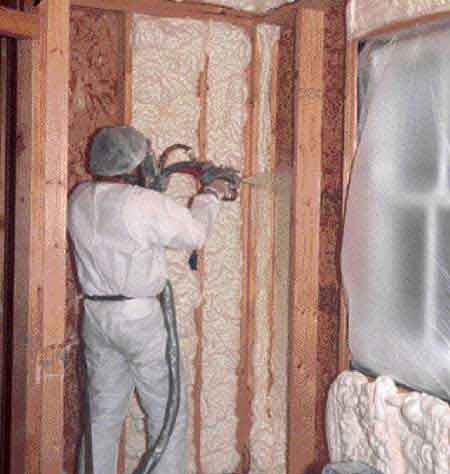
Equipment and materials. Application methods vary somewhat depending on the proprietary product used, but most residential foam contractors arrive on the site in a small box truck that contains the necessary drums of chemicals, a pumping machine, and several feet of hose. The pumping machine precisely meters out the two components of the foam and heats them to accelerate the chemical reaction that causes them to foam when combined.
The chemicals pass through separate lines that are combined in a single hose until they mix at the nozzle. The liquid that emerges expands almost instantly from a paint-like consistency to a thick foam that sets up into a durable solid.
Density and R-value. There are many brands of proprietary foams on the market, and they vary widely in density and insulating power. Commercial flat roofs, for example, are often insulated with a high-density material that weighs about 3 pounds per cubic foot, which makes it hard and strong enough to walk on without damage. But most residential foam insulation weighs between .5 and 2.0 pounds per cubic foot.
With most common building materials, lower density translates into higher insulating value. That’s why fiberglass batts insulate better than wood and wood insulates better than concrete. But the opposite is true of foam. A 1/2-pound foam such as Icynene, for example, has an R-value of about 3.5 per inch — roughly the same as fiberglass batts or loose-fill cellulose.
A denser, 1.8-pound foam, on the other hand, has an R-value of about 7. But because the 1.8-pound foam contains nearly four times the amount of chemicals per unit of volume as the 1/2-pound material, the square-foot cost is substantially higher.
Trimming the foam. High-density foams are usually applied to a total thickness that’s significantly less than the depth of the framing. An experienced applicator will take care to avoid getting much foam on the exposed edges of the studs, since any stray drops or spatters have to be scraped off before the drywall goes on. Low-density foams, by contrast, expand much more and usually bulge out beyond the framing. This excess material must be trimmed off with a long, flexible saw blade before the wall or ceiling finish can be applied.
Framing dimensions. With low- density foam, as with fiberglass batts or cellulose, the dimensions of the framing are driven more by the insulation value required than by structural considerations. For example, the 2×6 wall studs used on so many residential jobs are overkill from the standpoint of supporting the weight of the building. The real reason for using them is that they provide stud bays deep enough to accommodate R-19 fiberglass batts. Because the R-value of low-density foam is comparable to that of fiberglass, the framing requirements are also similar.
But when a denser foam is used, it’s possible to pack more R-value into a shallower bay. With 1.8-pound foam, you can frame walls with 2x4s and still achieve an R-value of 24 (see Figure 1). Another option is to frame with 2x6s and fill the cavities only partially, leaving an open space for running pipes or wires.
Figure 1.Polyurethane foam expands to between 30 and 100 times its wet volume. Dense, closed-cell material such as this has twice the R-value per inch of light, open-cell material.
Moisture Control
In walls or ceilings insulated with porous insulating materials such as fiberglass, a poly or kraft-paper vapor retarder is usually installed on the warm side of the insulation (that is, on the inside in heating climates and on the outside in cooling climates) to prevent condensed moisture from wetting the insulation. But because foam itself is resistant to water vapor, it may be possible to omit this added step. The question of whether to install a separate vapor retarder will depend partly on the specific foam you choose and partly on your local building inspector.
Tiny bubbles. Dense foams have what’s known as a closed-cell structure, which means that the gas bubbles that form during the application process remain permanently locked into the cured foam. The result is something like a three-dimensional bubble wrap with extremely tiny bubbles. Because there are no interconnections between individual bubbles, the foam absorbs little water and also resists the passage of water vapor. According to most building codes, a vapor retarder must have a perm rating of less than 1.0, and some dense foams meet this standard.
Low-density open-cell foams, on the other hand, have a structure more like a very fine-grained sponge. The cured material consists of a series of tiny interconnected passageways. These open cells are too small to permit the passage of much air, but they are more permeable to water vapor than closed-cell foams. Unless there’s an exceptional amount of vapor drive, though, that isn’t usually a problem. Most condensation in framing cavities is caused by leakage of moist air, not differences in vapor pressure, and even low-density foams block air movement so effectively that problems are unlikely. Some building inspectors will allow you to omit the vapor retarder even if the perm rating of the foam is above the required minimum value (Figure 2).
Figure 2.Open-cell foam is more permeable to vapor than closed-cell material. All foam is designed to be used without a vapor barrier, but some inspectors will make you use it, as in this kitchen that was insulated with 1/2-pound foam.
Trading places. Proponents of foam claim that it’s an ideal insulating material for mixed climates, where the warm and cold sides of the building envelope reverse during the year. During the heating season, the vapor retarder belongs on the inside of the wall, but when the air conditioning kicks on during the summer, it belongs on the outside. This is a practical impossibility with permeable insulating materials. But because foam is uniformly solid, it resists the passage of vapor equally well in either direction.
Roofs and Attics
Cathedral ceilings are notoriously difficult to insulate effectively. Unlike walls, ceilings don’t have air barriers like Tyvek and are usually vented to maintain a cool roof surface and prevent ice dams. But venting makes it easier for cold air to infiltrate batt insulation, which reduces its effective R-value. Ceiling penetrations like recessed lights are also common sources of air leakage.
Cold roofs and foam. One way to deal with these sorts of troublesome leaks is to fill the ceiling with spray foam. According to Matt Momper — whose Indiana-based company is one of the region’s largest installers of foam, fiberglass batts, and other materials — foamed cathedral ceilings should be vented if possible.
“Some roofing manufacturers won’t warrant their shingles if the roof isn’t vented,” he says. Before spraying the closed-cell foam, Momper installs polystyrene baffles below the sheathing to create a channel connected to soffit vents and a continuous ridge vent.
But if the rafters aren’t deep enough to leave room for a vent channel, or if the design of the roof makes it impractical to install a ridge vent, Momper has found that unvented ceilings also work well.
Unvented attics. Foam is also effective in areas where codes permit unvented attics. This technique is especially popular in parts of the South, where the humidity is high and it’s common to put air handlers in the attic. Spraying the underside of the sheathing and the gable-end walls turns the attic into a conditioned space and prevents humid air from entering and condensing on cold ductwork (Figure 3).
Figure 3.Spray-applied foam insulation allows you to build cathedral ceilings without venting or vapor barriers. It also allows you to build unvented attics.
Placing the air handler in the relatively cool environment of a sealed attic also decreases the load on the hvac system and may allow you to install smaller, less expensive equipment. Finally, any air that leaks from ductwork located in the attic will help cool the conditioned space rather than escaping uselessly to the outdoors.
Other Applications
Spray foam works well under floors because it won’t sag or fall down the way batts sometimes do. This makes it a good choice for rooms over exterior porches or small additions built on elevated piers. Foam is especially useful for insulating truss-framed assemblies and other areas that are difficult or impossible to insulate with batts (Figure 4).
Figure 4.Rim joists are difficult to insulate and nearly impossible to fully seal with traditional insulation and vapor barriers. Foam allows you to do a much better job insulating areas that are often poorly done.
Unvented crawlspaces. Spray foam adheres well to masonry of all kinds, including the irregular stone foundations sometimes encountered in old houses. As a result, it’s becoming a popular choice for sealing and insulating the perimeter walls of crawlspaces, especially in areas where unvented crawlspaces are permitted by code.
Like unvented attics, unvented crawlspaces aim to prevent condensation and moisture problems by keeping humid air outside the conditioned envelope. The air-sealing properties prevent the entry of airborne moisture, but it’s also important to seal out moisture in the soil. The usual way of doing this is to cover the dirt floor of the crawlspace with a continuous poly vapor retarder
Foam and batts: hybrid or bastard? Some insulation contractors install foam and batts in the same framing cavity in order to combine the air- sealing and vapor-resistant properties of foam with the economy of fiberglass. Momper uses this technique regularly. The framing cavities are first sprayed with a 1/2-inch layer of closed-cell foam before the rest of the cavity is filled with batt insulation to beef up the overall R-value.
Momper reports no problems with this approach, but the technique is a controversial one within the spray-foam industry. Opponents of this method refer to it as “flash and dash,” the implication being that it’s a shoddy way to do the job. They claim that putting foam outside the fiber insulation may result in a wrong-side vapor retarder in heating climates. Proponents say that it’s an effective system because the foam will prevent air from infiltrating the wall, and vapor usually gets into walls because of air infiltration, not because of diffusion.
Foam and structural strength. There’s both anecdotal and scientific evidence to suggest that spray-in-place foam also adds strength and stiffness to wood-framed buildings. Builder Joseph Jackson, of Faust Contracting in Little Silver, N.J., recalls framing a house that moved slightly every time the wind blew. Once the walls were sprayed with 2-pound foam, Jackson reports, the structure felt absolutely rigid.
According to Craig DeWitt of RLC Engineering in Clemson, S.C., Clemson University has performed extensive testing to evaluate the structural value of foam. Racking tests showed that walls filled with sprayed-in-place foam were stiffer than walls filled with fiberglass batts. Tests also showed that spray foam significantly strengthened the bond between rafters and sheathing, which is a plus in high-wind areas. DeWitt cautions that building codes do not recognize sprayed foam as a structural component. But he says that engineers can include the strength of this bond in the structural calculations for engineered buildings.
| Foam Manufacturers | |||||
| Manufacturer | Product | Density | R-value per Inch | Phone | Website |
Corbond Corporation | Corbond II | 1.8 | 7.3 | 888/949-9089 | |
Demilec | Heat Lok 217-4 Sealection 500 | 1.8 .5 | 7.0 3.8 | 817/640-4900 | |
Foam Enterprises | Comfort Foam | 1.7 | 7.0 | 800/796-9743 | |
FOAM-TECH | Supergreen Foam | 2.2-2.5 | 7.0 | 802/333-4333 | |
Bio-Based Systems | GSC Biobase 500 GSC Biobase 1700 | .5 1.7 | 3.7 6.8 | 800/803-5189 | |
HealthySeal | HealthySeal | .5 | 3.8 | 800/769-3626 | |
Icynene Inc. | Icynene | .5 | 3.6 | 888/946-7325 | |
North Carolina Foam Industries | NCFI 2020 plus NCFI Sealite | 1.7-2.0 .5 | 6.7-7.0 3.5 | 800/346-8229 | |
Resin Technology Division | Permax RT-2041 RT-5090 | 2.0 .5 | 6.5 3.4 | 800/729-0795 | |
| Resources |
Insulation Contractors Association of America 703/739-0356 Spray Polyurethane Foam Alliance 800/523-6154 |