If you and your project manager spend 13 hours preparing an estimate for a remodeling job, how much money have you invested in the project? Would you have been better off spending those 13 hours getting things done on one of your current projects?
You can’t answer those questions unless you understand where you get the most return on your time — yet most of the contractors I talk with have only a vague conception of how many hours they devote to various jobs and activities. They don’t know how to quantify their time and often don’t grasp the benefits of doing so.
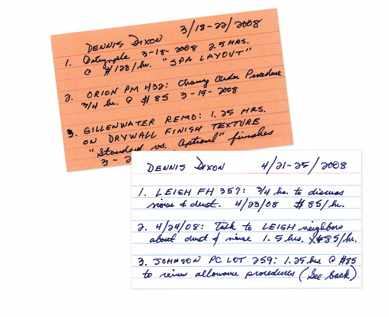
I recommend that you keep detailed records of how you and your senior employees spend your time. Doing so is fairly simple: I carry recipe cards in my wallet and make a note of time spent on specific tasks. The bookkeeper gets my cards at the end of the week.
This type of recordkeeping can yield meaningful results in as little as six months, giving you a powerful tool for managing your business more profitably with fewer headaches. In my case, seeing the cumulative value of my time made me much more conscientious about how I spent it. And because I also got serious about tracking other things — such as my employees’ time and my company’s overhead in general — I became better at predicting job costs and more focused on managing the details of my business. As a result, my company’s quality and efficiency skyrocketed.
Today, I make as much money doing eight projects as I used to make doing 18.
Time as Money
If you’re like most contractors, some of your time will be a direct job cost and some of it will be part of your overhead. I’m not going to tell you which activities to put in which category. Instead, I want to show you the value of understanding where your hours go, no matter how you classify them.
The biggest reason to track how you spend your time is that it will help you earn more money. A lot of builders and remodelers set an income target of “as much as I can make” and hope there’s enough profit at the end of the job to pay themselves a decent wage. I believe that every contracting firm, regardless of size, should include the owner’s compensation as part of its overhead. If you’re a small contractor, it may not be realistic to pay yourself a full salary — but there is an alternative: Pay yourself a smaller base salary, plus a periodic bonus based on profitability. If you have a target income of $125,000 per year, you could pay yourself $5,000 per month in salary and the rest in quarterly bonuses.
To hit that target, you will have to include your time as an expense in all cost estimates, and you’ll need to look for ways to spend more of your time generating income. For example, my records tell me I will need to devote an average of three to four hours per week to a full-scale kitchen remodel. This makes my actual overhead cost closer to 16 percent than the 15 percent many contractors quote, and I set my prices accordingly.
When I began recording my hours, one of the first things I noticed was the unpaid face time I was giving away to clients. To avoid this, I now ask the following question when qualifying homeowners: “How much interaction with me do you anticipate you’ll need?” Their answer, along with my intuition and experience with past clients, helps me estimate how much handholding time they’ll require.
I include my compensation for that time in a line item on the estimate called Owner Project Management. It ranges from 1 percent to 11 percent of the total job cost, depending on the clients. (This is in addition to the 16 percent overhead mentioned above.)
For example, if I have a $150,000 remodel where I anticipate having to be on site or in phone conversations with the clients for an average of three hours per week, and the job schedule is 16 weeks and my rate is $128 per hour, I will add $6,144 to that line item (3 hours/
week x $128 x 16).
The clients never see this line item, as it’s folded into a larger cluster of overhead or management costs. It’s for my internal use, so I can make sure that I’m getting paid for my time. Once the job starts, any time I spend with the clients gets credited to this line item. If they start needing more attention than I thought they would, that’s a signal for me to start acting like a manager and focus on moving the job forward.
A lot of contractors object to building the cost of their time into estimates. The reasoning goes like this: “If I charge what I’m really worth, I won’t get the job. We’re bidding against other companies that don’t know their costs.”
That may be true, but if you have to lower your profits to get work, you should do so with your eyes open and a clear understanding of the consequences. You also need a baseline below which you won’t go — usually the point at which it costs you money to go to work. But in order to stay above that line you need to know where it is.
Gaining Control
Even if you can’t ask your clients for more money, knowing the costs and implications of your and your staff’s time pays off in lots of other ways, because it forces you look at how much a job is really costing you. Facts and figures about job costs are powerful managerial tools. They will help you do the following:
• Decide whether to bid on a job. This goes back to the question at the beginning of this column: Is bidding against four other contractors for a job worth your time? The answer depends in part on how much it costs you to complete the bid. You can determine that only if you understand how much of your company’s time the bid will require.
• Calculate your profit from various job types. Where do you make the most money for the least amount of management time? Is it the small remodel, the large remodel, or the custom home? Having this information can help you prioritize the kinds of work your company pursues.
• Set a minimum change-order fee. My minimum administrative fee for change orders is $175 because my recordkeeping has shown me that $175 is the value of the time that even the simplest change order will take away from productive work. If I like the clients, I can waive the fee as “courtesy of Dennis Dixon.” That lets them know that I am giving them something for free, and they appreciate it.
• Manage your designer. After I started seriously tracking my hours, I saw that my project manager and I were spending way too much time resolving architectural questions and poorly detailed specifications. Now we make it clear to the architect and the structural engineer that any time spent on this will be charged to them by the hour. If they balk, I tell them I’ll bill the homeowner. It’s amazing how quickly that brings them around to our way of thinking.
• Waste less time. If your time is worth $60 per hour, should you spend three hours sweeping up a job site? Should you be running errands for the electrician who forgot two screws? Having the actual numbers will help you make good decisions in these matters.
• Avoid nasty surprises. A business in poor financial condition may have enough cash flow to pay most of its bills for some time, leading the owner to misdiagnose its financial health as “profitable” — when in fact it’s about to fail. Getting into the habit of paying attention to your actual costs will put you in position to see trouble before it strikes.
The more you work with these numbers, the more effective a manager you’ll be — because understanding your company’s true overhead will make you better at prioritizing your company’s time and efforts.
Dennis Dixon is a custom builder in Flagstaff, Ariz., and a regular speaker at JLC Live.