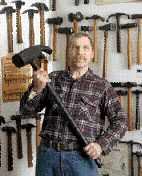
Most carpenters still carry a hammer on their toolbelt. But even those who pound a nail the old way once in a while would probably admit, if pressed, that hammers are beginning to seem sort of, well, last century.
In fact, hammers have been museum pieces since the first year of the 21st century, when an Alaska longshoreman and former shipwright, carpenter, and blacksmith named Dave Pahl opened what’s thought to be the world’s only museum dedicated exclusively to hammers.
By the way, if you know anything about the monstrous 36-pound claw hammer that Pahl is holding in the photo above, he’d love to hear from you. “It’s a beautiful hammer, but I have no idea what it was used for,” he says. “It’s the only one I’ve ever seen.” (And no, it wasn’t used for driving and pulling railroad spikes.)
Below is a gallery showing some of the hammers in the collection:
The Hammer Museum, in the southeastern Alaska community of Haines, contains several thousand hammers used in every imaginable trade. But to a carpenter, the museum’s extensive collection of claw hammers alone is worth every penny of the $3 admission fee. The museum is open from May to September, Monday through Friday, from 10 a.m. to 5 p.m.