
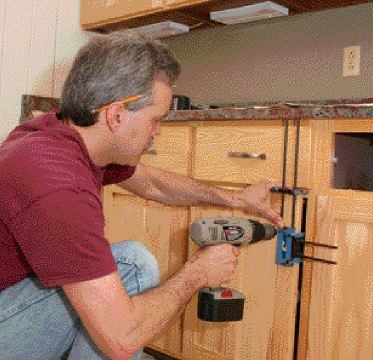
I’ve been a designer and a quality-oriented remodeler for 28 years. Seven years ago, if any of my customers had suggested refacing rather than replacing their tired-looking kitchen cabinets, I would have discouraged them in no uncertain terms. Visions of cheesy, delaminating edge-banding and flush high-pressurelaminate overlay doors and drawers didn’t fit my idea of a professional service or solution.
But I’ve changed my mind. The refinishing options — doors, drawers, hardware, and finishes — have undergone something of a revolution. There’s virtually no look or style that can’t be accomplished with today’s refacing products. Perhaps the greatest benefit to my customers is that they not only enjoy considerable savings over the cost of replacement, but they don’t even have to live without their kitchen during the typical weeklong process. We clean up every evening and my customers’ lives go on with little disruption.
Our franchise company, Kitchen Tune-Up, does between 50 and 100 kitchen jobs per year, either basic tune-ups or full refacing. While it would be possible to track down all the necessary products, tools, and materials needed to do a refacing job, as many refacers do, I decided from the outset that it was too much effort. The hassle of coordinating suppliers and deliveries, as well as recovering from supplier errors, damaged goods, and anything else that can screw up a job, convinced me to go the franchise route (Kitchen Tune-Up, 800/333-6385, www.kitchentuneup.com).
I work with a formalized ordering system that follows every job by number from start to finish. All of the specifications for the job are already in the supplier’s hands. If a door arrives damaged, or the customer decides to change something, or if we just plain forgot an item, we can quickly recover with a phone call and a firm delivery date. Buying into the franchise cost me around $35,000, but I was able to earn the fee back within two years.
Assessing Existing Cabinets
Refacing can make a dramatic difference in the look of a kitchen, but not every cabinet is a good candidate. First, the original cabinets must be of good quality — which in my book means built of wood or plywood, not particleboard. Particleboard doesn’t hold screws well, swells when it gets wet, has fragile edges, and sags when it’s loaded, whether it’s used for cabinet bottoms or shelving. So if I find face frames stapled to a particleboard carcass, I’m most likely to advise the prospective customer to consider replacement. Other refacing companies might proceed with refacing under these conditions, so I don’t always get the job.
Fortunately, though, there are plenty of older homes with solidly built cabinets that were either built in place or off site in the builder’s shop. Although ruggedly constructed, these cabinets tend to look utilitarian and dated, with flush plywood doors, flat-panel drawer fronts, and obvious depressions where finish nail holes were filled.
To bring them up to date, we veneer the face frames in real wood, RTF (rigid thermofoil), or laminate, creating the look of professional joinery and covering the nail holes along the way. The pressure-sensitive adhesives we use provide remarkable holding power; I’ve never had a callback for delamination.
Replacement door and drawer-front options are almost unlimited, including all common wood species and many stain, paint, and glazing choices. It’s difficult to distinguish an RTF door from a solid wood door.
Limits to change. Obviously, the decision to reface also depends on whether the customer is still happy with the current kitchen layout and feels no need for bigger changes. We can accommodate small layout modifications by dividing a large cabinet into smaller ones, or combining two or more individual units into a larger one. But if the customer wants to change more than a fourth of the cabinets, I usually recommend shopping for new cabinets. The extra cost of making major changes to the cabinet layout will quickly cancel the savings of refacing.
Countertops
If the cabinets look beat, the laminate countertop probably does, too. It isn’t cost-effective to relaminate an existing top, so we recommend full replacement. Also, customers often elect to upgrade from laminate to solid surfacing or stone.
Replacing a top usually takes only a day. We get this done first, in case there’s any damage done to the cabinets during the counter removal process. We sub this part of the job out to local companies that specialize in countertop fabrication and installation, and schedule our work around their delivery date. In fact, we don’t start a job until we have all the components for the entire project on hand in our warehouse. The more unknowns we eliminate before starting work, the better we can predict the end and schedule the next job out.
The Basic Tune-Up
Quite often, I find nothing wrong with the look of the old cabinets other than superficial wear and tear. If it turns out that my customer is actually happy with the original cabinets’ style, we’ll do a tune-up, cleaning and restoring worn, scratched finishes and servicing or replacing worn or outdated hardware. Often we’ll replace the counter as well. The average tune-up cost, not including the counter, is around $650 for a job that’s completed in one day.
Rob Carter, who handles much of our field service, uses a family of proprietary cleaning and restoration products to remove or disguise scratches and worn areas in the finish and restore the overall gloss. He cleans and adjusts or replaces drawer slides, door hinges, catches, and decorative pulls. When completed, the kitchen has close to its original appearance, with re-aligned and smooth-working drawers and doors. We leave the customer with maintenance tips and bottles of proprietary cleaning and polishing products. Tune-ups generate great word-of-mouth referrals and account for approximately 20 percent of the jobs we do.
The Complete Makeover
When the cabinet style has worn out its welcome, a tune-up won’t suffice. Instead, we replace the doors, drawers, and hardware, and give the kitchen an entirely new look. The first task is to accurately measure the existing cabinets, taking careful note of face-frame and opening widths and the divisions between cabinets. We ignore existing door and drawer dimensions, but carefully calculate the overlays and reveals between faces to create a new, uniform layout. We then order the new door and drawer fronts accordingly. It’s a painstaking and time-consuming process, but it pays big dividends in the final outcome.
What stays, what goes. I’ll often suggest minor changes, such as repartitioning a cabinet or replacing particleboard shelves with edge-banded plywood or solid lumber shelving. Solid lumber shelves cost more, so I suggest using them only where they’re open or visible. As an option, we can also reline cabinet interiors with prefinished 1/4-inch plywood, glued and tacked in place, but we recommend restricting this treatment to open and glass-front cabinets. Otherwise, the cost can approach that of a new cabinet.
Part of the beauty of both the tune-up and the refacing processes is that the cabinets don’t have to be emptied, so they’re never taken out of service.
Like any job done well, 80 percent of the work lies in the preparation. Demolition typically involves more than simply removing the cabinet doors and front panels. Existing valences and built-in soffits may no longer have a function in the revised kitchen, so we often remove them. We also often replace the old wall-mounted exhaust fan with a range hood, leaving a hole to repair. Window and door trim may need to be replaced to match the cabinets. A new wall oven may require a slightly different-size cabinet opening, calling for face-frame modifications. Sometimes, we can revise the layout slightly, swapping a sink base for a cooktop or vice versa. This requires the addition or removal of stiles and rails, new interior bracing, and other modifications to the cabinetry. The demolition and restructuring phase typically accounts for two-thirds of the time spent on the job. By the time Rob tackles the actual refacing, he’s in the home stretch.
Veneer. All original doors, drawer fronts, and pulls are removed and scrapped. To keep things economical, we don’t resurface the inner edges of the face frame, since they don’t show with the doors closed. It’s not unusual to find adjacent face frames that don’t quite align, but correcting this condition isn’t cost-effective or essential. Instead, Rob fairs uneven joints with filler and then sands the face to a uniform plane. Face veneer covers the joint and makes the two pieces look like one.


