
In recent years, builders have been paying more attention to the importance of keeping water out of walls. News of construction-defect lawsuits in California, EIFS failures in North Carolina, and the “leaky condo” crisis in British Columbia have all driven home the point that leaking buildings can cause major headaches for builders. One result of the focus on waterproof walls is the growing use of peel-and-stick membranes and other types of flexible flashing.
The term “flexible flashing” is used to describe a broad category of nonmetallic flashings, including both peel-and-stick and nonstick flashings. Manufacturers have not yet agreed on a generic term for these products, which are referred to as self-adhering bituminous tapes, flashing tapes, waterproofing tapes, flexible window flashings, flashing membranes, and wall tapes.
Only in the past few years have these flashings become common on residential job sites. Flexible flashing is rapidly replacing traditional felt splines for sealing the perimeter of finned windows. Some flexible-flashing manufacturers promote the use of these products at other locations, as well: to cover below-grade concrete cracks, at roof penetrations, under exterior door sills, over deck ledger boards, at inside and outside corners of wall sheathing, under stucco shelves and parapets, and over sections of wall sheathing susceptible to splashback. But by far the most common use of flexible flashing is at window and door perimeters.
These new materials have some significant advantages over traditional flashing materials. Unlike most metal flashings, for example, peel-and-stick flashings conform easily to unusual shapes. Most types of flexible flashing can be folded to form a waterproof end-dam on a rough windowsill, where making the same shape with copper would require soldering the flashing at the corners. Manufacturers claim that peel-and-stick flashings, unlike metal flashing, can form a waterproof seal between the flashing and the substrate.
These flashings are versatile and easy to install. But before slapping peel-and-stick over every exterior crack, you need to be sure you’ve chosen the right product for a given application. It’s also important to know about potential compatibility problems and to avoid accidentally creating a wrong-side vapor barrier.
Rubberized Asphalt
Most peel-and-stick flashings are made from rubberized asphalt, also known as modified asphalt, modified bitumen, or rubberized bitumen. Rubberized-asphalt membranes were originally developed to protect roofs from ice dams. As builders recognized new uses for the product, several manufacturers began selling it in narrow rolls — typically between 4 and 12 inches wide — for a variety of flashing applications (Figure 1).
Figure 1. Self-adhering rubberized-asphalt flashings are made of the same material as the eaves membranes used to prevent ice dam leaks. |
Rubberized asphalt used for flashing is made by modifying asphalt with styrene butadiene styrene (SBS), which makes the asphalt more rubber-like. SBS-modified asphalt, being elastic, can accommodate thermal expansion and contraction in building components. Because of its “cold flow” characteristics, rubberized asphalt can also seal around fastener penetrations.
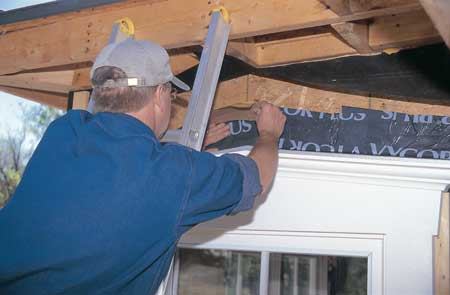
Sticky stuff. As long as the surface is clean and warm, rubberized asphalt sticks to a wide variety of substrates: dimensional lumber, plywood, steel, aluminum, hard vinyl, asphalt felt, and plastic housewrap (Figure 2). Some manufacturers of rubberized-asphalt flashing advise that their products may not stick well to concrete, masonry, or OSB unless these substrates are first primed.
Figure 2. Rubberized-asphalt flashings, like Grace’s Vycor Plus, stick well to unprimed plywood. Some manufacturers of rubberized-asphalt flashings warn that adhesion to OSB can be difficult unless the OSB is first primed. |
To make it possible to handle such a sticky substance, one side of the rubberized asphalt is laminated to a thin sheet (usually about 8 mils) of cross-laminated high-density polyethylene, and the other side is protected with a siliconized paper release sheet. Instead of polyethylene, some manufacturers laminate a thin layer of aluminum foil to the top of their rubberized-asphalt flashings (Figure 3).
Figure 3. Since foil-topped flashings like Peel’N’Stick from Polyguard Products can be left exposed to the weather for a longer period than polyethylene-topped flashings, they are a good choice when siding installation may be delayed. |
Stickiness is a double-edged sword. In warm temperatures, when rubberized asphalt is at its stickiest, it can be impossible to readjust a flashing once it has touched a surface.
Keep it covered. Rubberized-asphalt flashings, except for those laminated with aluminum foil, should not be left exposed to the weather. Eventually, ultraviolet light breaks down the polyethylene, exposing the modified asphalt, which then begins to oxidize. Most manufacturers recommend that their flashings be covered within 30 days of installation, although one manufacturer, Protecto Wrap, says that its BT20XL Building Tape can be left exposed for up to 120 days.
Butyl Rubber
Several manufacturers make peel-and-stick flashings from butyl, also called butyl rubber (Figure 4). Butyl flashings are usually black, resembling their rubberized-asphalt cousins. However, butyl flashings lack the asphalt smell that distinguishes rubberized-asphalt products, and they feel more rubbery. Like rubberized-asphalt flashings, butyl flashings are available with a top surface of either polyethylene or aluminum foil. Those with a top surface of polyethylene should not be left permanently exposed to the weather. FlexWrap, a butyl flashing from DuPont, has a top layer of corrugated Tyvek that enables it to conform to curved shapes, like the heads of arch-top windows.
Figure 4. Self-adhering butyl flashings, like rubberized-asphalt flashings, can have a top layer of either polyethylene or aluminum foil. Butyl flashing, although more expensive than rubberized-asphalt flashings, can be installed over a wider temperature range. |
More from Journal of Light Construction
-
Practical Energy Upgrades
12 MIN READ
-
Monopour Lessons Learned
11 MIN READ
-
