
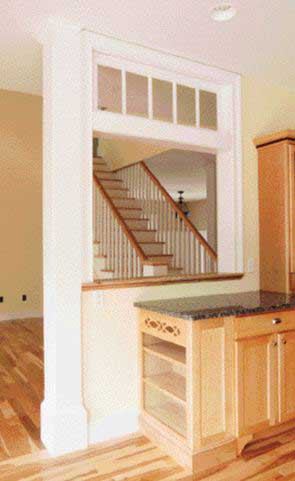
I’ve built homes and furniture in northwestern Vermont for 25 years, but for the past 10 years, my design-build firm has focused on the highly competitive new-home market. Most of my homes are in the “move-up” category in desirable neighborhoods. Buyers in that market segment expect some interesting architectural details and a premium trim package. It could be my formal education in accounting, or it could be old-fashioned Yankee ingenuity (or frugality), but I’ve always prided myself on good-looking trim details that don’t cost a fortune. Those details make my homes distinctive and get people in the door, but it’s their impact on the bottom line that’s made my business successful.
One of my favorite ways to give my customers something out of the ordinary while saving money is to use MDF trim instead of solid wood. Besides standard trim details like baseboard, casing, and crown, I use it for custom details like wainscot and built-ins. With MDF trim costing less than half of what a similar wood product costs, I can create an attractive high-end look without pushing the selling price into the stratosphere.
I think that cost-effective finish work today is really about knowing how and where to integrate new or nontraditional materials. There was a time when I used only natural wood for all my casings and finish trims. Now I actually choose MDF over wood because it’s better for painted trim — with the money I save, I splurge on hardwoods for areas that call for a strong first impression.
What’s Available?
I try to stick with stock profiles because the factory-applied primer makes finishing easier, although I sometimes use custom wainscoting. Some MDF profiles are new designs, but many are based on traditional wood profiles. One of my favorites is Windsor 3 1/2-inch casing. This versatile trim can be used for window and door casings, chair rail, or top-rail on wainscoting, or even as a frame for bathroom mirrors. It creates a custom effect with minimal work. Because this trim is so versatile, I never throw anything away — I’m always finding new uses for even the smallest pieces.
| |
Working With MDF
MDF is made from super-compressed paper and glue, so it doesn’t have any discernible grain. That’s both the most notable benefit and the greatest difficulty in working with it. On the plus side, it can be cut, machined, and filled easily; on the minus side, the lack of grain makes thin sections prone to breakage. As a result, we miter rather than cope inside corners. Another key to successfully working with MDF is using sharp tools — especially sharp saw blades. We use high-quality, 80-tooth blades and sharpen them regularly.
We also glue miters and returns, using MDF 2400 Adhesive from Koetter Woodworking (Borden, Ind.; 812/923-8875, www.koetterwoodworking.com). This two-part adhesive sets fast, so it’s critical to check the fit first. A small bead of adhesive is applied to one side of the joint, and the other side is sprayed with activator. Once the two pieces touch, there’s only about five seconds before the bond is set.
Another helpful tip is to use 18-gauge brads instead of 15-gauge finish nails. We’ve found that the smaller wire reduces “mushrooming” or “puckers” around the nail hole and makes finishing easier. Initially, I had concerns about the smaller nail having enough strength, but we haven’t had any problems.
Besides costing less than wood, one of MDF’s greatest attributes is its dimensional stability. Seasonal changes in temperature and humidity won’t cause swelling, splitting, or opening of joints. That makes it the perfect wainscot material.
| | |
Finishing
When it comes to paint, the primed finish of MDF is obviously easier to cover than bare wood. I use MDF trim with a smooth, baked-on finish, which saves time in sanding and can eliminate a second coat of finish paint. We fill nail holes and imperfections with Dap 222 filler and caulk gaps with a high-quality latex caulk. Once the MDF trim is painted and finished, the final touch is to urethane the bird’s-eye or curly maple stools and caps.
I have finally come to the conclusion that not only can MDF be used in place of wood, it delivers a better result when painted trim is desired. I attribute a lot of our success using MDF to our finish carpenters, Lucien and Larry Poitras and Steve Tucker. Those guys put together the custom details that create our unique look and style.
Bill Poseyis the owner of W.E. Posey Design/Build in Shelburne, Vt.


