
I started out in the construction industry 20 years ago, installing siding, windows, and gutters. At one point I had a full-time crew dedicated solely to gutter installation. Eight years ago, when I partnered with a friend to form Access Builders Corp., a general contracting firm, I held on to my gutter machine. It was paid for and I figured I could use it on our projects. Lately, with the downturn in the market, it’s been getting quite a bit of use as we pick up gutter jobs to fill in the schedule.
Customers often ask me, “Why do I need gutters if I don’t have a wet basement?” My answer is always the same: “It will add years — maybe decades — to the life of your foundation.” Here in Minnesota, the ground can stay frozen from late November until the end of March, and the frost can reach 5 to 6 feet deep. Many areas around the Twin Cities have heavy clay soil, which retains water. When the soil freezes, it expands, which can put a great deal of stress on a foundation. Gutters help keep the soil next to the foundation dry.
Gutter Machine
When I got out of the full-time gutter business, I sold the trailer the gutter machine was mounted to and moved the machine into my shop. I built a rugged dolly so I can easily move it out of the way when I’m not using it. If I’m doing a job with gutters no longer than 35 feet, I run them off in the shop and haul them to the job site on my ladder rack. When I need longer runs, I take the machine to the site, loading it on my truck or trailer with a couple of winches.
My particular machine is a Panther 5-inch made by KWM (kwmgutterman.com). It’s been very reliable and I would have no problem recommending the brand. New, this machine costs around $6,500, but you can often find a used one for about a third that cost. But be careful when shopping for a used machine: Depending on the brand, some older models require frequent adjustments, which can be intimidating for the crew and will slow down production.
My machine is designed to run a standard 5-inch K-style ogee gutter. It can handle a number of materials, including galvanized steel, copper, and coated aluminum. The most common material in our area — and the one we mainly use — is enamel-coated aluminum. Most manufacturers of the coil stock offer plenty of colors, so getting a color that matches the house paint or trim color is usually not a problem.
Keep in mind that you don’t have to own your own gutter machine. There are companies out there that will “chop and drop” — make the gutters you need for a specific job and deliver them to the site. If you already own ladders and staging, the only other equipment you need is a set of hand tools: a cordless screw gun or impact driver, a caulking gun, right and left cutting tin snips, a downspout crimper, and a snap-lock punch, which is used to crimp on the end caps.
Safe Staging
When you set up scaffolding for a gutter install, you shouldn’t put the plank too close to the house. Remember that you’re working on the roof overhang, not the wall, and the gutter will stick out another 5 inches once it’s installed. So put yourself at a comfortable working distance from the fascia.
Some crews hang gutters working from the roof. This is dangerous and can lead to an inferior installation. Say the fascia board is out of level, which is common on older homes. Not only do you have to hang the gutter so that it drains properly in the right direction, but you may also have to fudge the placement so as not to accentuate the sloping fascia. If you’re working from the roof, it’s nearly impossible to position the gutter so that it looks good from the ground. Plus, it’s tough to concentrate on quality while hanging on for dear life over the edge of the roof.
Gutter Assembly
While the gutter is on the ground, I crimp on the end caps using my snap-lock punch. I use plenty of sealant as I go, making sure every joint is watertight. (Driving around town sealing up leaky gutters is not a profitable way to spend a day, especially given today’s gas prices.) I don’t use regular caulking or silicon — they don’t work! Spend the extra two dollars on a proper sealant. I use 12-1 Seam Sealer from Ruscoe (330/253-8148, ruscoe.com). It flows better than caulk and oozes into the gaps.
I use a hole punch to make the outlet holes, which I do on the ground when possible. The punch leaves a nice clean hole for the drop outlet tube that the first elbow attaches to. You can also easily use the punch after the gutter is installed, which allows you to place the hole exactly where you want it in reference to the house. My punch is an older model that only makes holes. For around $200, Malco (800/328-3530, malcoproducts.com) offers a punch that can either make a clean hole for an outlet tube or be set to leave tabs for attaching the elbow directly — meaning you don’t need the drop outlet.
If you don’t have a punch, you can also make the holes by hand: Mark the location, using the drop outlet as a template; drill out the corners with a core bit; and finish the cut with snips.
Hangers and Aprons
Before installing the flashing apron or the permanent hangers, you need to make sure the gutter is exactly where you want it. So I generally start out by fastening the gutter through the back using just screws. If the fascia is in good shape, zip screws are often good enough for this first step. Once the gutter is attached to the fascia, I check to see that it’s centered properly. It should run about 1/2 inch past the ends of the shingles. When it’s centered, I check to see that it slopes toward the outlets. I don’t follow a prescribed percentage of slope; the idea is to avoid areas where water can pool. (In this part of the country, pooling water means more mosquitoes.)
I consider gutters to be an architectural element, so I always try to slope them as little as possible while following the lines of the fascia. A gutter that slopes too drastically will make the fascia look crooked. As mentioned above, on older homes it’s not always possible to follow the fascia lines; it’s more important to ensure that the water will flow to the outlets.
Once I’m satisfied with the gutter placement, I install the apron flashing, which prevents water from running behind the gutter. If the roofing was installed with a properly overhanging drip edge, you don’t need an apron; you just have to tuck the back of the gutter underneath the lower leg of the drip edge. On some jobs, however, a sloping gutter may end up lower than the drip edge; in that case, I’ll use an extra piece of flat apron flashing to bridge the gap.
Finally, I install the gutter hangers on 24-inch to 32-inch centers. If the fascia is nothing more than a 3/4-inch trim board, I try to hit the rafter tails with the hanger fasteners.
There a several types of hangers. The most common in this market — and the one I use — is called a fascia hanger. I like the fascia hangers that come with a screw already attached. These cost more, but I’ve found them to be well worth the extra money. In particular, I like the fact that the attached screw doesn’t have to be driven all the way to the fascia. This comes in handy when the shingles are hanging out too far or when I’m working on a building with a rigid roofing system, like metal or cedar shakes.
For other general fastening, I use 1 1/2-inch pole-barn screws. They’re strong, they bite aggressively into metal fascia, and they come with a rubber washer in place. Plus they require the same 1/4-inch nut driver as the zip screws, which means less time spent changing drivers.
Downspouts
I probably don’t need to mention it here, but make sure you tuck the higher section of the downspout into the lower one. Believe it or not, I’ve seen it done the other way plenty of times, sometimes by those calling themselves professionals. On horizontal runs, keep the downspout seams facing up; it looks better and water doesn’t leak through. Elbows are made only one way, so keeping their seams up is not an option. For aesthetic reasons, I put vertical downspout seams against the wall.
I fasten downspout joints with a zip screw on each side. If the customer prefers, I’ll use rivets instead; they’re definitely superior, but they take longer to install and cost more. Wherever possible, I attach the downspout saddles (or clips) where the downspout meets the elbow; this saves time and reduces the number of holes in the downspout.
Whenever the house is sheathed with a fiberboard product and the siding is something less than solid, I make an effort to hit a stud or a corner board when installing downspout clips. You have to be careful attaching saddles to vinyl siding — it expands and contracts considerably, and the longer the piece of siding, the more movement there is. When I’m screwing a downspout saddle to vinyl, I make sure the piece of siding is pulled toward the saddle, so that it can expand away from it. If you find yourself screwing a downspout saddle to the middle of a piece of vinyl siding, make sure the siding has room to expand in both directions. You don’t want to be responsible for a big bulge in the siding when the weather warms up.
Screens and Covers
Gutter covers — intended to prevent leaves from clogging the works — come in two main styles: screened and solid. I use both types, depending on the situation. The solid covers work well and look nice, but in heavy rains the water may shoot over the top of them. Also, they can be difficult to install if the roof pitch is steeper than 8/12. The main problem with screened covers is that they get clogged up with seeds or needles, so you have to be aware of the tree species in the area. The aluminum screens I use cost around $1 per linear foot. When I install a solid cover, I use an aluminum product called LeaFree (877/543-2700, leafreeguttercovers.com), which cost about $3 per foot.
Pricing Gutter Jobs
Gutter contractors in our area charge between $4.50 and $6.50 per linear foot for hanging gutters with an apron, and $3.50 per linear foot for installing downspouts. I charge an additional $20 for inside and outside miters. I don’t mind quoting general prices over the phone — it at least gives people a starting point and weeds out those who are not really serious. That said, I never give a final estimate without visiting the site and checking conditions. Getting paid $6 per foot for two 50-foot gutters 9 feet off the ground is considerably more profitable than hanging one 8-foot gutter three stories up.
And don’t forget about the existing gutters. I usually charge about $1 per foot to tear off and dispose of an existing gutter, unless it’s the kind with a built-in apron; those have to be cut off with a shearing tool, which takes longer than hanging the new gutter.
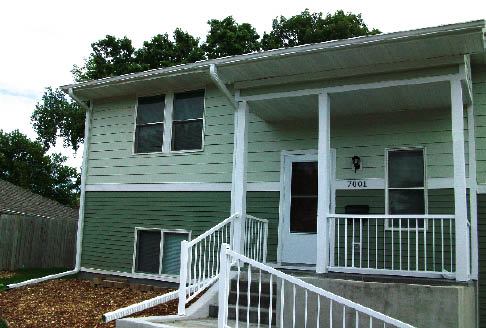
The job shown on these pages was a Habitat for Humanity project, but if it had been for a paying customer, I would have invoiced for $620: $220 for materials and $400 for labor. Altogether the job took four hours on site with one skilled installer and a helper, plus some prep time spent before arriving at the site. Had I used a chop-and-drop supplier, materials would have cost an additional $100.
If you plan to hang gutters on a part-time basis — maybe on projects where you’re doing other exterior work — a machine is not necessary, but if you want to run a full-time gutter operation, owning one is essential. Having your own machine will save you around $100 per eight-hour day for a two-man crew, not to mention many hours of schedule delays.
While there are plenty of small tricks to the trade, hanging gutters is not a difficult operation for a skilled builder. Keeping gutter installation in-house may be another way to save money and keep your crew busy in this challenging market.
Mark Petersen is co-owner of Access Builders Corp. in Shakopee, Minn.


