
Q. When applying caulks and sealants, is it better to push the bead with the nozzle of the caulk gun, so that more sealant enters the joint, or to pull the caulk gun along the joint, which I think leaves a cleaner-looking bead that’s easier to tool?
A. David Dobson, an architect and licensed general and glazing contractor in San Diego, responds: On most job sites (and even in the promotional material of many manufacturers), I’ve found that applicators usually drag caulked sealants when they apply them. But it’s hard not to pull the caulking gun too quickly and stretch the caulking bead, which will prevent enough sealant from being applied to the joint.
Applied too thinly, a caulked sealant can suffer from cohesive failure, meaning it’s not strong enough to maintain its bond. Or, it can shear (split) along the length of the joint. This is particularly a problem when a sealant is used to create a “bridge” joint, where the gap between two materials is simply painted over — rather than filled — with sealant.
When using a simple caulk to fill a joint that isn’t expected to move or to repel moisture, joint failure is usually no more than a cosmetic problem. But when high-performance polyurethane and silicone sealants are used to form long-lasting welds between dissimilar materials that are expected to be both flexible and air- and watertight, a properly designed and installed sealant joint is critical. That’s why these sealants should be applied by using the caulk gun to push — rather than pull — the bead along the joint. This technique helps work the air bubbles out of the sealant and pushes the sealant into the joint instead of pulling it out.
Keep in mind, though, that caulked sealants applied too thickly lose their elasticity. To picture this, take a rubber band and stretch it, then double it up a few times and try stretching it again. Like the rubber band, the thicker bead of sealant becomes less flexible and loses its elongation properties.
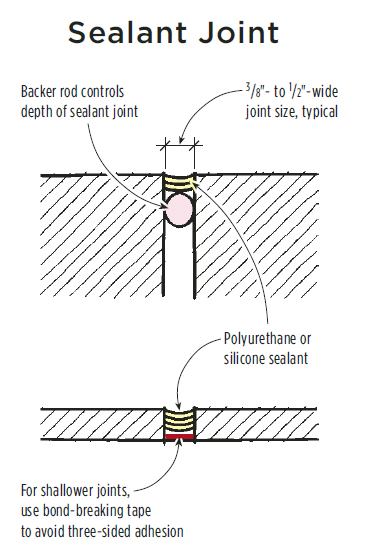
In general, the best joint size for most caulked sealants is between 3/8 inch and 1/2 inch (always refer to the sealant manufacturer’s recommendations for joint designs).
Sealant joints should be designed to avoid three-sided adhesion. A sealant that adheres to three sides of a joint will tear along one of the sides when the two materials move differentially. One common way to avoid three-sided adhesion is to use a bond-breaking tape underneath the joint (see illustration).
Another way is to install a closed-cell foam backer rod before filling the joint with sealant. Available in different diameters, backer rods are useful for controlling the depth of the joint between thicker materials, and therefore the size of the sealant bead.


