
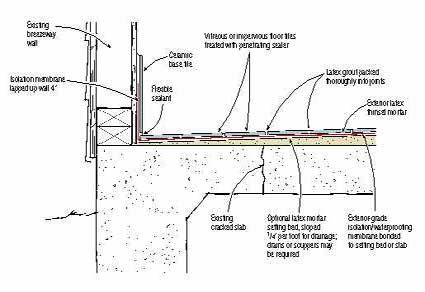
Q. I’ve been asked to tile the floor of an enclosed breezeway that gets tracked with a lot of dirt, leaves, and snow. Besides being subject to the temperature extremes found in Ohio, the existing concrete slab has a crack running across its width. Is porcelain tile the best option in this situation, and how should it be installed?
A. Contributing editor Michael Byrne, an expert tile setter and consultant in Los Olivos, Calif., responds: While breezeway enclosures are good because they help shield walkways from precipitation and temperature extremes, they can also trap moisture. A floor that puddles is a nuisance and a safety hazard, and in the environment of an enclosed breezeway, chronic excess moisture can lead to mold and wood rot. So, depending on your breezeway’s design and exposure, you may have to slope the walkway prior to tiling and provide a method of draining off excess water. And even without the need for a slope, scuppers, or a drain, retrofitting this installation for tiling will still require a waterproofing/crack-isolation membrane applied to the slab. Finally, if the crack in the concrete exceeds 1/8 inch wide or results in uneven concrete surfaces, the walkway should not be tiled at all.
Flat or sloped, all exterior tiled walkways need a waterproofing membrane. If sloped, the slope should allow the walkway to self-drain. I prefer to float a crowned, bonded latex mortar fill over a concrete slab, but many walkways are finished with the tiles sloped to one side only. Drainage is needed in either case; I recommend fitting the enclosing walls with scuppers large enough to allow for the free flow of excess water, leaves, and whatever else is going to be tracked in.
The crack is a serious problem requiring careful membrane detailing to limit tile damage and prevent water from getting between the membrane and the setting bed, which could damage the surrounding structure. Many isolation membranes aren’t suitable for exterior use. I use Noble Deck, a sheet membrane made specifically for this purpose (The Noble Co., 800/878-5788, www.noblecompany.com). I lap the membrane about 4 inches up the wall and use the company’s shower-pan dam corners to detail the membrane around scuppers and openings (an exterior floor membrane has much in common with a shower pan). Regardless of the membrane system you install, make certain that the perimeter joints are filled with an approved sealant and not hard grout, which can damage the tiles and render the membrane useless.
Porcelain tiles are highly resistant to moisture penetration, but not all porcelain tiles work well in breezeways. Some have a coarse surface finish that helps reduce slips and falls but also makes the tiles ideal dirt magnets. Dirt lodged in the surface pores can be very difficult to remove, so make sure your tile dealer directs you to a tile made specifically for use outdoors: It should be both freeze/ thaw stable and easy to maintain.
I also recommend using high-quality latex thinset mortars and grouts that are approved for exterior use; follow manufacturer instructions and wet/dry mixing ratios to the letter. For spreading uniform layers of latex thinset mortar, a notched trowel should be used to achieve the industry-standard 95 percent adhesive coverage. Any less and moisture is likely to pool in the voids, expand when it freezes, and pop tiles off the surface. To achieve 95 percent minimum coverage, the tile industry recommends the use of a 1/4-by-1/2-by-1/4-inch U-notch trowel for 12-inch tiles, but only on-site experimentation will reveal the right trowel. It isn’t the size of the trowel or the notch profile that is important; it’s the coverage.
When grouting, make sure that all the grout joints are thoroughly packed. Water can easily fill voids in the grout, and on freezing cause significant damage to the installation. All membrane systems require that any joints abutting restraining walls, plumbing, or other penetrations be filled with a flexible sealant — not caulk — rated for exterior use.
Vitreous or impervious tiles, latex thinsets and grouts, an exterior waterproofing/crack-isolation membrane system, a sloped setting bed when needed, and regular applications of a penetrating sealer will get you a simple-to-maintain tile walkway. Anything less and your customer isn’t going to be happy.


