
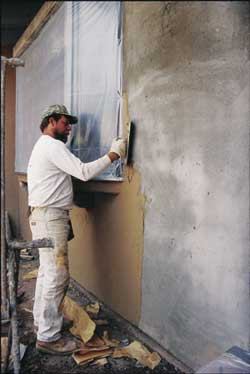
Carefully installed flashing paper and caulk are the keys to preventing leaks
There are three stucco wall systems in use today: traditional three-coat stucco, so-called one-coat or synthetic stucco systems, and EIFS (Exterior Insulating Finish Systems). While water damage in EIFS walls has made the news in recent years because of class-action lawsuits, the fact is water can and does penetrate the finish in all three systems. This is especially true in houses with little or no roof overhang, where excessive amounts of water can run down the wall. The solution to building a water-tight stucco wall is to view it as a system in which all parts must be correctly installed, particularly at penetrations, joints, openings, and other areas susceptible to leaks. Too often, however, the stucco finish gets all the attention, while the underlying protective membranes and flashings — which are the main defense against water intrusion — are overlooked. In my 24 years as a stucco contractor, I have gone beyond the minimum requirements of the code to devise flashing details that have withstood the test of time. In this article, I will explain the materials and techniques I use to prevent leaks in stucco walls. In every case, you can tell if you have installed the flashing and building papers correctly by imagining the path water will take if you were to spray the wall with a hose before applying the plaster. If the water can flow freely over the paper from layer to layer without ponding or finding its way inside, then the wall is properly flashed.
Lath Paper
I work primarily with one-coat and traditional stucco, both of which rely on water-resistant membranes in conjunction with flashing at all wall openings and penetrations to direct any water that makes it through the stucco down towards the bottom of the wall. EIFS systems, which are applied directly over foam, originally relied on a water-tight skin to keep all water out. But because water from leaks at penetrations can become trapped behind the foam, EIFS manufacturers are developing systems that also use a water-resistant membrane behind the foam. The UBC currently requires Grade D (10-minute) paper for the membrane. While this is adequate, during periods of heavy rain, the water will eventually saturate the paper and find its way to the wood framing through any holes and tears. If left unchecked, this moisture can damage the structure, but at the very least will cause excessive expansion and contraction of the wood frames. The resulting cracks in the stucco base and finish coats are not only unsightly, they could allow even greater water intrusion, leading to more cracks. The code also calls for horizontal laps of 2 inches and vertical laps of 6 inches. I think these minimum overlaps should be doubled. I have seen water travel sideways and back up behind the overlaps, especially if the paper has wrinkled, which it tends to do when it gets wet. Heavier paper. To break the cycle of leaks leading to cracks leading to more leaks, I recommend upgrading the paper. I have done extensive testing of various papers, and at a minimum I prefer to use a 28-pound, 30-minute paper, which is made by a number of companies (see ” Sources of Supply“). The 30-minute paper is easier to fold and bend than heavier (60-minute) paper, and unlike lighter weight paper, it is more resistant to splitting when exposed to moisture, sunlight, and extreme temperature changes. I have also tested Dupont’s Tyvek Stuccowrap, although I haven’t yet used it for as long as the other papers, and I find it has a number of advantages when installed behind stucco. Tyvek bends more easily than paper and it’s less likely to tear during installation. Tyvek flashing paper is not available, but Dupont does make a special tape, which I have found to be easy to work with at seams and joints. Tyvek is also dimensionally stable, both when wet and when subjected to wide temperature swings, so the holes around nails and staples won’t gradually grow larger the way they do in conventional building papers. In addition, Tyvek won’t wrinkle like building paper when it gets wet, an important advantage because wrinkles are a likely place for holes to develop. Stuccowrap also appears to be beneficial to the stucco curing process. By not drawing the water out of the scratch coat, it allows the stucco to hydrate more effectively, developing greater strength and density.
| |
Figure 1. Carefully layered flashing paper and strategically placed caulk make for a leakproof window. When nailing the window in place, make sure all nails are driven flush; bent and protruding nails should be pulled so they won’t snag and possibly tear subsequent layers of paper. |
Flashing Paper
Around openings and penetrations, many stucco contractors use sisal kraft paper, which sandwiches a layer of asphalt paper between brown kraft paper, but we have experienced many problems with it. Sisal kraft paper is easily cut by sharp objects, such as the corner of window frames; when wet, it develops wrinkles that make it difficult to get it to lie flat, leading to rips if the winds pick up. One alternative is Moistop, which is made by sandwiching kraft paper between two layers of polyethylene. It bends easily around flashing and holds up well over time. Moistop does not wrinkle when wet like sisal kraft, but it does rip in the wind. I now prefer to use Future Flash, a 20-mil rubberized asphalt membrane sandwiched between 4-mil polyethylene on the face and polyester on the back. One reason is its strength: During fall and winter we can get winds that blow 50 miles an hour or more, and Future Flash won’t tear apart like sisal kraft and Moistop. Paper products won’t stretch either, whereas Future Flash has 128% elongation. I also like Future Flash because it’s not self-sticking, so any water that does make its way behind the membrane has a chance to find a way out. If all the horizontal laps are sealed, they may create a dam that will catch water. When water-testing stucco walls, I have watched water that leaked through nail penetrations run down the backside of the paper and find its way out again between the overlaps. At horizontal surfaces, I prefer to use Vycor (formerly called bituthene), a rubberized-asphalt and poly membrane originally designed for use as roof flashing. It’s thick enough to be durable, and adheres well to itself and to most other materials. Vycor also seals itself around any fasteners that are driven through it, and it’s self-sticking in temperatures above 60 degrees F. When it’s very hot, though, Vycor becomes so sticky it can be difficult to handle, especially when working alone. Vycor will also bleed if left exposed, so it must be used only where it will be covered by other materials.
Figure 2. For doors installed over wood subfloors, the author uses a soldered metal pan at the sill, making sure the metal deck-to-wall flashing overlaps the side flanges and that the flashing paper around the opening is properly layered. All doors should be securely shimmed and nailed through the jambs to prevent cracks in the stucco from door movement. |
Caulk
We also use a lot of caulk, both to repair pinholes and tears in the paper and to seal flashing at penetrations and openings. Caulks vary greatly in quality, and so do the conditions under which they are applied. A caulk that works well in hot, dry weather may not perform as well in cool, damp conditions; similarly, a caulk may have to bond to surfaces that are moist or dirty, shiny or dull.


