I run a full-service home-improvement and remodeling company that was founded by my dad in 1976. Today, we have two basic divisions: one that handles kitchens, baths, additions, and basement finishing; and another that does handyman services and exterior work, including siding, roofing, and door and window replacements. Last year, our company did around $4 million in sales, and fully 30 percent of that was generated by what we call AWAs, or additional work authorizations — otherwise known as change orders.
Clearly, change orders are a vital piece of our business model, and they don’t just happen by accident. We lay the groundwork for changes by keeping clients happy and informed throughout the job process. Dissatisfied customers, we know, are unlikely to authorize additional work.
Building Trust
In years past, once we sold a job there’d be no visit or contact with the clients until the start of work, which could be as much as two months later. We learned the hard way all the problems that can crop up during that lull. So now we maintain near-obsessive communication with the clients, from the very first sales call (when customer anxiety levels are typically high) all the way to the end of the job.
We lay the groundwork for a trusting relationship at that first meeting. The salesperson explains our operating plan — standardized steps we follow strictly on every job — so that the clients know from the beginning what to expect and when to expect it.
Having an operating plan and sticking with it is critical to our success. Whenever there’s a problem on a job, I dissect the situation and identify what went wrong. Inevitably, I discover that the trouble arose because we failed to follow our operating plan to the letter.
Getting Acquainted
During most of the first visit, the salesperson focuses on listening; the idea is to get acquainted with both the job and the clients. Only after prequalifying and getting to know the customers does the salesperson present our proposal, typically during a second visit. The proposal outlines absolutely everything that’s in the specification and — equally important — everything that is not included. The salesperson also informs the clients that we always conduct two preconstruction meetings.
Double-check. The first of these two meetings is what we call the “remeasure visit.” It’s conducted by our production manager within a couple of days of the proposal presentation. He walks the job with the clients, remeasuring and reviewing the proposal line by line. This provides an opportunity to detect errors or oversights and to emphasize work that is not included. For example, the job may involve installing new exterior siding and trim but not new gutters. If the existing gutters are dingy-looking and will detract from the new look, we have an obvious opening for an AWA. Thus, we can often add to the scope of the original proposal during the remeasure visit, based on the trust we’ve already established through our careful attention to detail.
Triple-check. The second preconstruction meeting happens when, a few days before the start of work, the lead carpenter and the salesperson walk the job with the clients. Once again, they go over the proposal and review any special needs previously discussed with the production manager, such as where a dumpster must be located, where lumber drops should or should not happen, and so on.
These two visits help bulletproof the job against miscommunication or the forgetfulness that can creep in between the time of sale and the start of work.
Preparing Clients for Changes
It’s the salesperson’s job to thoroughly prepare the customers for every aspect of the upcoming job. That includes explaining the reality of AWAs and why they may occur. Some change orders are generated by conditions that can be anticipated but not predicted with any kind of certainty. For instance, if the house is 50 years old and we’re going to be opening walls, we know there’s a good chance we’ll find wiring or plumbing that must be brought up to code. Other hidden conditions are more of a surprise, such as termite damage revealed under the sill during a door replacement job. The salesperson points out the contract clause that covers these types of contingencies.
Then there are AWAs for work not within the scope of the original proposal. Most of the building stock we work on is 20 to 30 years old, so unless the clients have already replaced every component of their house, there are innumerable opportunities for adding work — a wood floor in need of refinishing, walls that could use a fresh coat of paint, an aluminum slider or windows that could be replaced. We come to the clients’ home not only as installers but as consultants with a home inspector’s eye for problems. The house tells us what it needs, and we bring those needs to the homeowners’ attention and offer solutions.
Educating customers this way isn’t just a sales gimmick. As professionals, it’s our job to root out problem areas, and we consider it negligent not to do so. Say we’re hired to replace a patio slider, and the installer notices decay in the decking while he’s setting up outside. If he doesn’t call attention to this problem and an accident occurs later on, the homeowners are sure to be upset that we didn’t warn them.
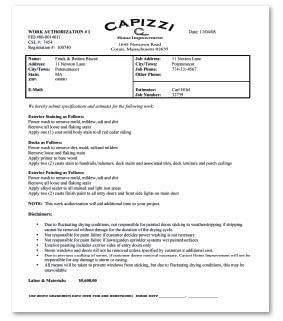
After the clients signed the original proposal for this job — which involved installing aluminum trim coil over existing exterior trim at a cost of $18,850 — they decided they also wanted the house’s siding and deck stained. The new work is carefully detailed on this AWA (additional work authorization) form; one-third of its $9,600 cost is due upon signing.
Accommodating Additional Work
A construction schedule is a moving target. Generally we have enough manpower available to cover contingencies. If bad weather delays a job, the production manager immediately informs pending projects of any schedule changes. We already know the potential for change orders and preconfigure each job’s time frame accordingly. If we know the job is going to take four weeks, for instance, we assign it five weeks in the proposal. This allows us to either complete the work earlier than expected or to accommodate added work without compromising our schedule. It’s also possible under these circumstances that we can start the next job earlier than proposed.
We do everything in specialty fashion, according to the type of work performed. If, during a siding-replacement job, the clients decide they also want the roof replaced, our roofing crew performs that work. If the roofing crew is three weeks out at that point, we schedule the new work three weeks out. What matters most is not that we achieve an uninterrupted flow of work, but that everything is done in a timely, professional manner.
Reviewing the Job
At the conclusion of every job, we ask clients to complete a customer satisfaction survey. Once a month, the entire company gets together for a TQM (total quality management) meeting. We review the survey results and analyze all of the prior month’s projects. The installers consider the salesperson’s performance and evaluate how well the job was measured, estimated, and specified. For each job, we discuss the issues that cropped up, how well the process worked, and its final profitability. In this way, we’re constantly tweaking our procedures, looking for any possible improvements and the very best ways to implement them.
Staff Incentives
Although each and every employee is authorized to write an AWA, 80 percent of our AWAs are generated by the production manager. This is mostly because he constantly inspects and reviews the job with the clients and is the person most responsible for maintaining communication. The 9 percent sales commission on every change order is shared equally between the person who generated it and the initial salesperson on that job. This motivates the salesperson to train the crew to spot AWA opportunities and gives crew members yet another good reason to care about their work.
Tom Capizzi Jr. runs Capizzi Home Improvement in Cotuit, Mass.