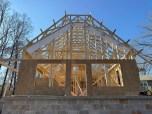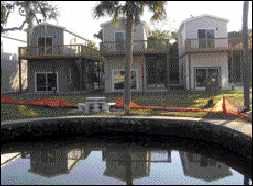
TriBird’s 545-square-foot, one-bedroom, one-bath modulars, built atop nearly 14-foot concrete block walls that double as garages, comply with all flood and wind regulations. These, like most, have canal frontage just off the Gulf of Mexico.
When the owners of a Palm Beach County waterfront mobile home park voted to sell the land to a developer earlier this year, it seemed like the official end to one of Florida’s storied 1950s-era seaside mobile home villages.
But it may be too early to write the park’s obituary. Although Briny Breezes residents sold out, and plans for multimillion-dollar condos move ahead, the bulldozing of Florida’s roughly 5,580 mobile home parks has slowed. The main causes: a real estate crash that’s resulted in a glut of single-family homes and condos, and increasingly organized campaigns among park residents and affordable housing advocates.
“Anecdotally, the number of mobile home parks is decreasing, but at a slower rate today than a few years ago,” says Jim Ayotte, executive director of the Florida Manufactured Housing Association.
Statewide, momentum is building to save the parks. The town of Davie, in South Florida’s Broward County, has 31 mobile home parks containing nearly a quarter of the town’s housing stock. Public pressure late last year spurred town officials to slap a year-long moratorium on redevelopment of the parks while they worked on a plan to preserve them. Earlier this fall, the Miami-Dade Board of County Commissioners passed a similar, four-month-long moratorium covering the county’s 47 mobile home parks.
Enter the Modular
A new trend in coastal parks offers one possible solution for these sites: swapping aging, ground-level mobile homes for elevated modulars — at a price that comes close to the rock-bottom affordability of traditional mobile home parks.
Helped by a new state law that removed regulatory hurdles, TriBird Development is converting a 43-unit mobile home park, located in Hudson along Florida’s sparsely populated north-central Gulf Coast, to a 43-unit modular home park. Many of the homes have water views, and all have guaranteed access to community docks with boating access to the Gulf of Mexico via a freshwater spring and canal. But their most distinguishing characteristic is price: $69,900 — a rare species in Florida, to be sure.
Filling a Niche
TriBird president Brad Birdsell, his brother, and father bought the run-down park in 2005. They considered carving it up into residential home sites or converting it to condominiums. But with so many condos on the market, and any redevelopment requiring rezoning, they decided to try the raised modulars. “We felt this was one thing that was lacking,” Birdsell says. “Not everybody needs a 2,500-square-foot house on the water.”
The Florida state legislature helped pave the way for the new approach. A law passed in 2007 frees mobile home parks to redevelop as modular parks that follow identical rules, allowing residents to own their own structures while renting the land beneath them.
The Florida Manufactured Housing Association lobbied for the law to give park owners a way to upgrade without redrawing their typically tiny lot sizes.
TriBird charges owners between $400 and $500 lot rent per unit. Birdsell insists that when considered with a mortgage, insurance, and property taxes — single-unit owners pay a 43rd share — the total monthly cost is far less than a more traditional, higher-priced single-family home and lot.
So for now, the spirit of the Florida mobile home park lives on, with at least some residents even improving their waterfront views.