
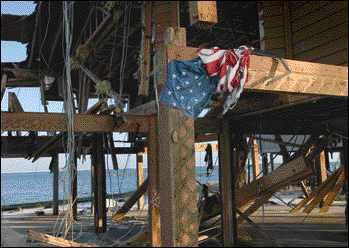
The 2004 hurricane season challenges coastal building codes
Hurricane Ivan devastated older homes in Pensacola built before enactment of the Florida Building Code. The hurricanes of 2004 — Charley, Frances, Ivan, and Jeanne — tore across Florida, resulting in more than $22 billion in projected losses, making it the most expensive storm season in U.S. history.
As a hurricane wind engineer, Tim Reinhold picked through 200 homes damaged by Charley, Frances, or Ivan. Among the newer ones, he discovered missing soffits and blown-off roof tiles but few total losses.
“You can definitely see a difference between the performance of newer and older buildings,” noted Reinhold, vice president for engineering at the insurance-industry-backed Institute for Business & Home Safety (IBHS) in Tampa.
In early October, Floridians were still mopping up from the four hurricanes of the season — the last of which, Jeanne, barreled ashore north of West Palm Beach on September 26th. But insurers and home builders, traditionally on opposite ends of the building code debate, agreed Florida’s 2002 building code requirements largely succeeded in helping new homes survive the season’s back-to-back storms.
Consensus ended there, however. Insurers hoped to leverage the Insurance Information Institute’s projected $22 billion in losses to push through measures intended in part to strengthen the Florida Building Code’s protections against damage to homes’ interiors and contents. Builders’ groups argued insurers were overreaching, and stressed a more cautious approach.
“There is not a whole lot of evidence right now that additional code strengthening is needed,” said Jack Glenn, director of technical services for the Tallahassee-based Florida Home Builders Association.
CODE REPORT CARD
This is the most historic hurricane year since Hurricane Andrew hit in 1992. That storm’s inflation-adjusted $20 billion path of devastation prompted Miami-Dade and Broward Counties in 1994 to adopt what remain the nation’s most stringent hurricane codes. A year later, Hurricane Opal’s $3 billion slam to the Florida Panhandle convinced many lawmakers that another Andrew could strike anywhere, sparking discussions that culminated in the Florida Building Code, which went into effect on March 1, 2002. The key provision requires contractors to reinforce walls, roofs, and openings to withstand wind speeds and flying debris based on predicted hurricane intensity where the home is located. New homes in Daytona Beach must hold up to 120-mph winds, while Key West requires 150-mph-proof homes.
Officials at the IBHS and the Tallahassee-based Federal Alliance for Safe Homes (FLASH) praise the structural performance of Florida Building Code-built homes. “It’s clear to us that, post-Hurricane Andrew, we’ve gotten much better at keeping the roof on,” said Leslie Chapman-Henderson, the alliance’s president. But IBHS officials noted that the homes often suffered serious internal damage, and observed frequents failures involving: Soffits. The alliance’s investigations near Punta Gorda after Hurricane Charley found repeated instances of wind blowing out soffits and pushing rain into attics, where soaked insulation collapsed ceilings, ruining interiors.
Ceramic roof tiles. Investigators said that while hurricane-resistant shingles were an improvement, other ceramic tiles often broke off, damaging not only homes but whole neighborhoods. “You end up with a debris storm that is not just air — it’s air laced with tiles,” said Scott Schiff, a professor of civil engineering at Clemson University and director of the university’s Wind Load Test Facility. Chapman-Henderson noted that screwed-down tiles performed better than those attached with mortar.
Pool cages and lanais — those aluminum structures protecting pools or shading verandas and patios — were frequently toppled over or blown away.
CODE CHANGES TO COME?
Glenn acknowledged reports of failures of soffits and tiles, saying they may indicate a need for code upgrades. But, he said, officials also need to scrutinize enforcement. “A lot of people have forgotten that over 40% of the damage in Andrew was attributed to lack of code compliance, not lack of code,” he said. As for aluminum structures, he said the Florida Building Commission, which maintains the Florida Building Code, had adopted rules strengthening the structures just prior to the storms that will go into effect with the code’s next revision.
Perhaps more significant than any tweak, insurers said damage reports back up their longtime advocacy for several overarching changes. Chief among these: eliminating a provision that allows contractors to meet wind requirements through “internal pressurization,” or building the structure strong enough to survive window blowout. Insurers contend that without shutters or impact-resistant glass, wind and rain ruin a home’s interior and contents, which one engineer estimated comprise two-thirds of a home’s value. Glenn countered that homes built under the state’s internal pressurization guidelines are 30% stronger than those with shutters or impact-resistant glass, and such homes are also cheaper. “Our position has always been that it ought to be the consumer’s choice,” he said.
Each year, builders add only about 2% worth of new homes to Florida’s 7.6 million housing units — meaning more than 90% of the state’s homes were built before the 2002 code. That said, with projected losses topping Andrew’s damages, increased premiums or canceled policies may force more and more homeowners to become involved. Says engineer John Pistorino, whose Miami-based firm helped shape Miami-Dade’s code, “The public will demand better construction because they can’t rely on insurance companies to be there anymore.” — Aaron Hoover
Au Naturale
Today’s coastal landscapers lean toward native species
A century ago, wealthy vacationers who built resort homes on Maine’s Mount Desert Island favored formal terraced gardens cared for by paid help. Today, second homeowners want yards that “look like Maine,” sending landscape architect Jennifer Booher picking through blueberry fields in search of weathered granite boulders and scouring nurseries for native paper birch and striped maple. Of one native landscape for a house on a picturesque point denuded by a careless builder, she boasts, “If you didn’t know we had been there, you couldn’t tell anyone had been there.”
Landscape architect, Jennifer Booher’s goal for this Mount Desert Island, Maine, home: “If you didn’t know we had been there, you couldn’t tell anyone had been there.
Spurred by practical, regulatory, and aesthetic concerns, builders and homeowners crowding the East Coast’s last ocean views are also bringing back its native coastal plants. Three climate zones south of Maine, in Charleston, S.C., “a lot of people just want to have nature up near their houses,” says Mary Palmer Dargan, an Atlanta-based landscape architect with frequent jobs there. Farther south, Florida’s 1,200 miles of coastline bloom with native plants. Rules at WaterColor, a 499-acre resort and residential community in the state’s panhandle, forbid lawns and restrict plant choices to yaupon holly, scrub oak, beach rosemary, and other natives. Meanwhile, the phone rings daily at the 141-member Association of Florida Native Nurseries (AFNN) as builders and homeowners from Key West to Pensacola seek such natives as sea oats and seashore paspalum. “We used to be mostly wholesale, but now we’re 50-50,” notes Sharon Dolan, co-owner of Maple Street Natives in Melbourne on Florida’s Space Coast. “A lot of homeowners are coming around.”
THE CALL OF THE NATIVES
Native plants require less care and grow better in sun-drenched, sea-spray-soaked environments. They also use less water. That’s increasingly important to many coastal counties and state agencies. Collier County, for example, home to fast-growing Naples on Florida’s west coast, insists that waterfront owners plant natives exclusively.
The maturing environmental restoration industry also is spurring large-scale native plantings. Florida-based EarthBalance, for instance, specializes in restoring wetlands and environmentally abused areas, such as old phosphate mines. Last year, in a nearly $1 million contract with the U.S. Army Corps of Engineers, workers completed a three-year project to “revegetate” 21 miles of newly built sand dunes at North Carolina’s North Myrtle Beach, planting over one million sea oats, panic grass, and American beach grass seedlings. EarthBalance, which grew 700,000 of the project’s plants in its native nursery and catalog business, also serves the private sector. Three years ago the company turned to a palette of native plants to landscape a golf course around a tidal creek. The golf course’s construction permit required some of the work “but it was mostly driven by the desire to make the golf course look like it had been there a long time,” says Don Ross, president of EarthBalance.
In sun-drenched, sea-spray-soaked Melbourne, Fla., native species such as verbena, firebush, and Florida gamagrass (right) require less care and grow better than conventional lawn grass (left).
Indeed, enthusiasts maintain that changing aesthetics may be the biggest force behind the interest in natives. Randy Harelson owns the Gourd Garden and Curiosity Shop, a native plant nursery in Seagrove Beach adjacent to the WaterColor resort and near the environmentally themed St. Joe Corp.’s other large holdings. He says one reason soaring demand has grown his business from a one-man shop a decade ago to today’s 10-employee operation and two-acre nursery is that the region remains relatively pristine. Newcomers, he says, “see the big old live oak trees and the beauty of the native woods and even the scrub at the beach and they say, ‘That’s what I want.’ ” — Aaron Hoover
Currents: ACQ Takes Its Toll
Builders continue to struggle with the corrosive effects of treated woods, particularly in extreme exposure conditions. Having been told by his local Simpson Strong-Tie rep that the company is no longer recommending its ZMAX framing hardware for use in direct contact with ACQ (Alkaline Copper Quat) lumber in Florida, builder Cameron Bradford of Orlando-based Bradford Building Corp. has resorted to using a bituminous membrane between the treated lumber and framing connectors. “I was looking at the about 44 post pads that we installed two weeks ago, and they are already showing signs of corrosion,” reported Bradford. “I’m going to pull the posts and wrap them with that Vycor product that Grace makes.”
Both Grace Construction Products and Simpson Strong-Tie offer brochures addressing the issue, and Simpson Strong-Tie’s latest technical bulletin (www.strongtie.com/ftp/bulletins/T-PTBARRIER05.pdf) outlines the practice of using barrier membranes such as Vycor Deck Protector underneath framing hardware as a layer of protection from the new treated woods.


