Forensic engineers play leading roles in setting future building policies
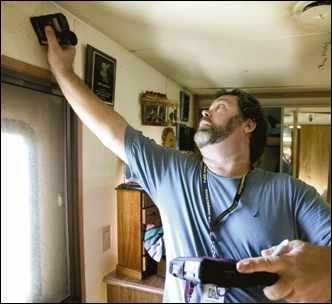
Garry McAlpin, an inspector under contract to FEMA, inspects a home damaged by Hurricane Charley.
The hurricane shifted the 1930s-era waterfront home off its pilings, sending them shooting through the living-room floor. That much was clear. Wilbur T. “Dusty” Yaxley’s job was to find out whether the storm’s winds or surge were to blame.
Yaxley, of Seffner, Fla., is among a small cadre of structural forensic engineers whose date books filled as four hurricanes struck Florida last fall. Their job: To distill, from a home’s jumbled and sodden remains, the drama of how wind, rain, flooding, construction, materials, or a combination led to its demise. Hired by insurers, homeowners, or builders, forensic engineers typically help settle private disputes about who should pay for repairs. But as building costs escalate and a river of new non-field-tested materials reaches the construction market, they’re also playing a bigger public policy role.
Yaxley noticed that although water entered the house, the waterline was near the floor, suggesting the surge’s force wasn’t sufficient to move the structure. But what cinched the case was that the line was not parallel to the floor, meaning the house was already listing off the pilings before it flooded.
End result: The wind insurer had to write the check.
Most cases aren’t so clear-cut. The confusion common in chaotic post-hurricane devastation is the very thing that gives forensic engineering its biggest challenges — and greatest power. That’s particularly true in a post-storm public arena, when constituencies of homeowners, home builders, insurers, and bureaucrats vie to evade responsibility for widespread damages.
A strict interpretation of the Florida Building Code suggests that application of self-adhesive underlayment directly to the roof deck is a violation. Instead it must be applied over a nail-down roofing felt — a rule identified as “stunningly stupid.”
Case in Point: Central Florida
Take, for example, the 2004 hurricane-induced moisture problems in Central Florida homes: At least 680 homeowners in Orlando’s Orange County, and hundreds more in four neighboring counties, complained water poured through their windows and walls, ruining carpet, wood floors, and cabinetry. Many residents and insurers claimed home builders cut corners, with hundreds of insurers reportedly refusing claims.
Stung by the allegations, the Florida Home Builders Association (FHBA) hired a forensic engineer and leading national expert on moisture-related building problems, Joe Lstiburek, to investigate. Lstiburek analyzed the complaints, observed local builders at work, and did experiments on separate systems, such as stucco-covered block walls.
His January 2005 report found the storms constituted “overwhelming” weather, causing failure in systems that would hold up to more moderate conditions. But he also faulted the Florida Building Code, regional code-enforcement practices, building materials such as housewraps, manufacturing testing standards for such major components as windows — in short, a multiplicity of elements in Florida homes. “There were at least a dozen things we could do better and should do better next time around,” Lstiburek said.
As one of several “stunningly stupid” shortcomings, he singled out a Florida Building Code requirement that waterproof self-adhering roof membranes be attached to nailed-down roofing paper rather than directly to the sheathing. If hurricane-force winds blow off the shingles, they can pick up and carry away the roofing felt and the waterproof material at just the moment when it would be needed most, he said.
On the sensitive issue of workmanship, Lstiburek said he found some “atrocious” examples, but they did not constitute consistent, repeated causes of the flooding.
From Blame to Prevention
While home builders would have liked to put all the blame on extreme weather, they will likely use the report in their defense in damage disputes with insurers or homeowners. “I think they would be foolish not to,” said Jack Glenn, director of technical services for the FHBA.
But Glenn said the FHBA’s main goal in hiring Lstiburek was to pinpoint causes of water damage and ways to prevent it in future homes. The association will tap Lstiburek’s findings as it seeks to influence the 2006 revision of the Florida Building Code, he said. In the meantime, staffers are developing a training program on ways contractors can beef up water protection in homes.
Florida’s hurricanes are only the latest cause of the increasing demand for structural forensic engineers, Lstiburek noted. “We have more problems because we’re building with different materials, and these materials are put together in ways nobody ever thought of or considered,” he said. “And in many cases it takes an extreme set of circumstances for people to take a breath and ask the question, ‘Why are we doing it this way?’ That’s what I do.” — Aaron Hoover
CurrentsSafe HavenIn hurricane zones, clients may be wise to foresake the Jacuzzi and opt for the ultimate home amenity: a “safe room” — a shelter within a home built to withstand winds up to 250 mph. Originally designed to shield homeowners from the wrath and destruction of tornadoes, DuPont’s StormRoom is a prefab room within a room made with Kevlar that fits the bill. Or check out FEMA’s manual “Safe Rooms and Community Shelters: Taking Shelter From the Storm,” which provides complete instructions for building one out of concrete (www.fema.gov/mit/saferoom). Houses That WorkThe Building Science Consortium — in collaboration with top home builders operating under the umbrella of the U.S. Department of Energy’s Building America program — have developed complete energy and moisture management details for homes in every climate zone. Offering detailed plans and drawings of homes suited to each zone, the project includes best practice building methods for meeting the extreme energy and moisture demands of homes in hot, humid climates along the southern coastlines and throughout Florida. Where humidity levels reach more than 70% throughout the year, improperly detailed homes provide ideal conditions for mold, mildew, and rot. Problems are compounded by intense solar radiation that imposes enormous thermal loads on the house, which not only increases cooling costs but keeps indoor surfaces cool for longer periods of time, thereby increasing condensation levels that also encourage moisture failures. In-depth, practical solutions to these widespread coastal problems can be found online at www.buildingscience.com/houses thatwork or at www.eere.energy/gov/buildings/building_america/ pdfs/34585.pdf |
Roofer’s Holiday
To meet the demand for new roofs, out-of-state roofing contractors flock to the storm-torn Sunshine State
Roofing contractor Dan Walters has spent two months living with his crew in cheap motels nearly 1,400 miles from his family. But the 60-hour workweeks and abundant jobs in hurricane-devastated Florida make the conditions worthwhile for the New York-based contractor and his eight employees, who would normally spend the winter idled or doing other work.
The U.S. Army Corps of Engineers’ “Operation Blue Roof” covered 143,000 storm-damaged roofs last fall, while local jurisdictions gave out 500,000 smaller tarps to help keep water out of homes. Six months later, many of the tarps remain.
“A lot of companies lay guys off in the winter,” says Walters, owner of Hamburg, N.Y.-based Coast to Coast Restoration. “We wanted to keep our guys working, plus I’ve got new equipment I want to pay for.”
Walters, whose company has reroofed about four homes weekly since arriving in Southwest Florida in late November, is hardly alone. Hundreds of roofing contractors from states as from away as Texas, Kentucky, and New York relocated to the Sunshine State following quadruple hurricane strikes last fall. With an estimated 300,000 roofs in need of replacement statewide and only about 2,500 active state-certified Florida roofing contractors, out-of-staters have helped Floridians get out of the rain, says Steve Munnell, executive director of the Florida Roofing, Sheet Metal and Air Conditioning Contracting Association.
But the migration has also caused some problems. For out-of-state roofers, these ranged from confusion about the rules for setting up shop in Florida to allegations that supply houses reserved much-in-demand shingles and other supplies for local customers.
Some out-of-staters also had trouble obtaining Florida workers’ compensation insurance, one of the requirements for the temporary roofing contractors’ licenses first made available in September. According to Munnell, few Florida private market insurers wrote workers’ comp policies for out-of-state roofers, leaving those whose policies didn’t transfer from home with only one option: the state’s expensive insurer-of-last-resort, the Florida Workers’ Compensation Joint Underwriting Association.
Roofers from as far away as Texas and New York State have traded the slow northern work season for warmer climes and extra-long work hours.
Still, counties and cities had granted at least 1,119 temporary permits by late January, according to the Florida Department of Professional Regulation. Even with the help, Munnell estimates that some 2004-hurricane-related roof repairs won’t be finished until mid-2006. As the ubiquitous blue tarps in Charlotte, Escambia, and other hard-hit counties slowly disappear, the next issue surrounding the out-of-state roofers may be what happens when customers discover flaws with their new roofs.
“If there are workmanship problems and they’re [the roofers] from Texas, they’re not coming back,” Munnell notes. His organization failed in its bid to require all out-of-state roofers to work as subcontractors to Florida roofers, a change he says would increase homeowner cost but also put local roofers on the hook for repairs. — A.H.
First Responder
Building expert joins post-storm search-and-rescue effort
Two hours after Hurricane Ivan made landfall, a Coast Guard HH-60 Jayhawk helicopter lifted off to do the first airborne reconnaissance of the Florida Panhandle coast. Among those on board: Forensics engineer Bill Bracken.
Bracken is Florida’s lead Federal Emergency Management Agency-qualified structures specialist. His primary job: Size up damaged or destroyed structures and advise firefighters and rescue workers before they attempt entry. Hired by the state during major emergencies, Bracken and four colleagues joined rescue swimmers, firefighters, and other first responders immediately after hurricanes Charley, Frances, Ivan, and Jeanne.
Engineers joined first responders in the search for missing persons in homes destroyed by Hurricane Ivan near Pensacola, Fla.
Forensic engineering typically values careful consideration over quick judgment calls. But Bracken, president of Tampa-based Bracken Engineering, said he’s trained to give immediate advice after examining cracking or listing buildings — making the call on whether the building “is in a state of equilibrium or of imminent collapse.”
“Our role is to do a very rapid assessment, because in our absence these firemen are going to rush in there,” he explained.
The engineers are also expected to put their expertise to use in the air. Jostled by 60-knot crosswinds from Ivan’s feeder bands, Bracken flew from near Pensacola, Fla., to Mobile, Ala., on September 16, 2004. Among the first to spot the collapsed oceanfront condos that are among Ivan’s most enduring images, he helped direct ground-based rescue teams past obstacles such as downed bridges to where they were needed most.
Last year’s four hurricanes are thought to have left at least 100 Floridians dead. Bracken may well have helped keep that number from rising any higher. In February, the Florida Fire Chiefs’ Association awarded him Search and Rescue Responder of the Year — making him the first forensic engineer to receive the award. — A.H.