
by Aaron Hoover
In the eastern United States, water flows from higher elevations toward the low-lying coast. As a result, most East Coast cities should have water to spare. “Under natural conditions, if you drew a well even close to the coast, you’d hit some freshwater,” says Paul Barlow, a hydrologist with the U.S. Geological Survey.
But overpumping can reverse the flow, drawing salt water where freshwater once drained. Saltwater intrusion of freshwater aquifers is a burgeoning problem in at least nine East Coast hotspots from southeastern Florida to Cape Cod, Mass., according to the USGS. Hardest hit of all may be South Carolina’s Hilton Head Island. There, saltwater contamination has forced the island’s largest water utility to abandon four supply wells since 1990. It may have to shut a fifth later this year.
“Right now the saltwater intrusion comes to a point halfway through the island, and a lot of our water comes from the edges of that point,” says Richard Cyr, general manager for the Hilton Head Public Service District, which serves 25,000 homes.
Traditionally in the U.S., water supply problems were largely confined to the arid West. But whether the cause is saltwater intrusion, overuse by cities and farms, or drought — or a combination of these problems — threatened water supplies are becoming more common in the East. That’s especially the case in coastal regions, where populations have soared. “Drought and overall short-of-water supply issues have really become much higher on the agenda in the Gulf Coast and East Coast states in recent years,” says Donald Wilhite, director of the National Drought Mitigation Center at the University of Nebraska.
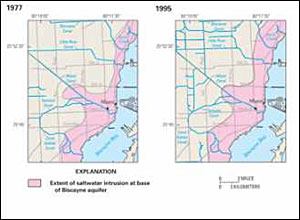
Saltwater Intrusion Comparison
The area marked in red indicates the increase of salt intrusion along the base of the Biscayne Aquifer from 1977 to 1995.
Figures modified from Parker and others (1955), Klein and others (1975), Hughes (1979), and Sonenshein (1997)
As of mid-July, summer 2006 appeared to be shaping up as normal to moderately dry on the East Coast. But water supply had already become a hot issue in several states:
• In Florida, state and regional water officials rejected a request by Miami-Dade County to boost withdrawals from the stressed Biscayne Aquifer to support new developments. The state later agreed to a temporary increase while Miami-Dade worked out a plan to increase water reuse and make other major overhauls.
• In New Jersey, Governor Jon Corzine proposed a tax of 4¢ per 1,000 gallons of water to raise money for land preservation and infrastructure improvements to help the state cope with water shortages. Lawmakers rejected the proposal, but the state is proceeding with a comprehensive water-supply plan. “People are paying more attention to it now, because people know that is it not an endless commodity,” notes Joe Mattle, supervising environmental engineer for New Jersey’s Division of Water Supply.
• In Maine, conflicts between maintaining river flows and lake levels to protect endangered Atlantic salmon and other species while ensuring adequate water supply for cities were on the rise. Water supply issues are “first emerging in the coastal zone because that’s where the population pressures are the greatest,” explains Catherine Schmitt, a science writer with Maine Sea Grant and the author of a report on the effects of the 2001-2002 drought on the Granite State’s drinking water supplies.
Freshwater Distress Areas
Accessing groundwater resources along the Atlantic coast has caused saltwater to intrude many highly productive freshwater aquifers. Selected areas identified by the U.S. Geological Survey (indicated here in red) show where salt water has intruded fresh groundwater, and where future development may cause the most stress to freshwater aquifers.
Up and down the coast, water supply threats have not forced widespread restrictions on new buildings nor spurred major price increases — at least not yet. But they are causing regional conflicts over water supplies and shaping public policy shifts. In June, for example, Georgia adopted a plan aimed in part at guarding freshwater aquifers against more saltwater intrusion along the Georgia-
South Carolina border in the Savannah-Hilton Head region. The plan seeks to reduce withdrawals from the Upper Floridan Aquifer by 5 million gallons per day by the end of 2008 — no easy task in light of the fact that Savannah-Hilton Head lie in an area “expected to experience the highest rates of growth in population during the next 25 years,” the plan notes.
Potential fixes range from increased surface-water withdrawals to boosted water reuse to desalination plants. The Hilton Head Public Service District, which has faced the issue longer than most, now pipes in water from a mainland surface-water system and relies on an extensive reuse infrastructure to reduce demand for new water. All but one of the island’s more than 20 golf courses now tap reused water, says Cyr, the water manager. Despite those and other steps, the utility is moving forward with plans to build a reverse-osmosis plant to transform brackish water into drinking water.
“There’s not only the issue of more water for growth; there’s also the issue of losing what you have,” Cyr notes. “Growth we could handle. It’s losing one of our major wells — that we can’t handle.” — Aaron Hoover


