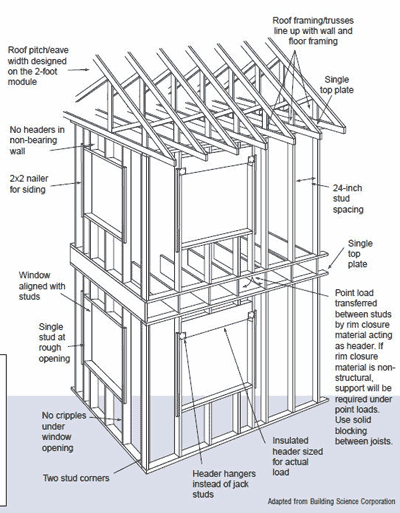
The release of a new draft specification for the EPA’s Energy Star 2011, guidelines for Energy Star qualified new homes program, has raised concerns among some energy raters and builders about whether advanced energy-efficient framing techniques required by the program are compatible with the beefy framing details needed to handle lateral pressures of wind in coastal regions. The new spec, slated to take effect in 2011, includes a new “Framing Checklist” that calls for two-stud corners, two-foot on-center stud spacing, single-member window and door headers, and framing reductions at window and door openings. The official comment period on the initial draft version ended this summer, and EPA officials are now working on a revised final version. Meanwhile, comments on the draft have been collected and are published on the EPA’s website. Michael Watt, Executive V.P. of the Long Island Builders Institute, made note of the potential structural conflicts in his comment, observing, “some Long Island [New York] municipalities will not allow items 2.1.1, 2.1.3, or 2.2 [two-stud corners, reduced framing around windows, and insulated sheathing]. The wind loads we are required to design to do not allow these practices.”
A 2002 DOE “Technology Fact Sheet”shows advanced framing details like those being proposed in the Energy Star 2011 guidelines. Feedback from the construction community raised questions about whether the guidelines would meet code and whether reduced framing at large openings could withstand hurricane-force wind loads. Alabama-based architect Sue Coleman, of Sun Plans, Inc., opposed the new framing checklist, arguing, “Framing is often determined by structural engineers with building inspector oversight. Some high wind areas and the Fortified Building Program which promotes building above code wind minimums do not allow for advanced framing.” But engineer Tim Reinhold, P.E., the Director of Engineering and V.P. of the Institute for Building and Home Safety (IBHS), which developed the “Fortified … for safer living” above-code construction program, says that two-foot on-center spacing and other “value engineered” framing techniques won’t necessarily conflict with that standard. “In terms of hold-downs, there are some issues,” says Reinhold, “because some of the big hold-downs that you end up with in coastal areas, you need to have double studs, in order to be able to anchor to it and distribute that load up into the shearwall. But the spacing of the interior members has no bearing on the shear capacity.” Studs that fall in between panel joints, in other words, do not factor into the racking resistance of a framed wall: “It’s really dependent on the perimeter framing,” says Reinhold. “You may have to go to a bigger stud — a 2×6 instead of a 2×4,” says Reinhold. “But then that gives you room for more insulation too, which increases your energy efficiency. And then the idea is that you line up the studs with the roof rafters (stack framing), so that you by-pass the top plate — which is why you can go with a single top plate.” On the other hand, Washington State University engineering professor Dan Dolan points out, shear capacity or racking resistance isn’t the only wind issue wall frames have to deal with. There are also “out-of-plane” forces — that is, the pressure of wind directly against a framed wall, which acts to bend the wall studs or to push in windows and doors. Dolan has been one of the leading participants in building code committee work on wall bracing revisions for the International Residential Code (IRC). Reducing the number of studs in a wall segment between panel joints has “no effect on the response in the shearwall. None. But it has a big effect on the out-of-plane loading on that wall,” Dolan explains. The issue is highly significant for framing of large openings in the wall, he goes on: “If you look at somewhere like Phoenix, Arizona, they can hardly get by without something like four king studs around a double-wide garage door, because the wind load coming in there becomes so high. And Phoenix is not like a hurricane zone. But they can’t get the thing to stand up. That’s why when you start saying, ‘We’re going to take out these jack studs and king studs,’ I say, ‘Whoa, wait a minute.'” “Consider a double sliding glass door going out onto a deck,” says Dolan. “All that load from that door comes into the king posts on the side of it. Even if it goes up to the header first, and then comes across, those studs at the edge of the opening become pretty heavily loaded in some not very high wind load zones. It really depends on the configuration of the wall. If you have little double-hung windows, you don’t have a problem, usually. But when you start getting big walls of glass into the building, you got big problems. More than just energy — you got structural problems, quick.”
Real-World Details In coastal Florida, brothers Scott Murray (a former builder) and Brian Murray (an engineer) have been working recently on the intersection between energy-efficiency issues and wind-resistant structural issues. ” I used to be a builder for a larger company years ago,” says Scott Murray, “and I partnered with Brian to work with him on his designs. We do a lot of up-front master plan design with production and semi-production builders that have been looking into advanced framing, and when we first looked at it, we thought it would not work, the way we currently design and the way things are being framed. But when I was looking to build my personal house, and we took a closer look, we found that 2-foot on-center spacing and single top plates and single-ply headers will work in this area [the 120-mph wind speed zone near St. Augustine, Florida]. I think the higher wind speeds, there obviously are going to be more limitations. But for the 120-mph wind speed, we are able to make a majority of those components work in some circumstances.” “It does depend on the geometry of the house, its location, and the exposure,” Murray notes. “For some of the big builders we work with, their homes typically are sometimes a little bit more cut up, where a lot of this stuff is just not architecturally laid out properly to take full advantage of efficient framing. So they are starting to see now where they have to start up from scratch, not just start with the engineering portion, if they want to take full benefit.” In the real world of house framing, however, the devil is in the details. For Scott Murray’s own house — which APA – The Engineered Wood Association has been publicizing as an example of advanced framing methods and raised-floor, conditioned-crawlspace construction — Murray elected to use a double top plate simply because pre-cut studs were not available in his market at the right length to use with a single plate. “We didn’t want the framer to have to cut every stud to length so that the drywall would work,” says Murray. And when the time came to frame walls, the Murrays decided to use double studs at every vertical panel joint also. “Looking at it,” says Scott Murray, “we could have eliminated that stud. And the wall was designed with studs two feet on center. But when the framer got to the site, he was extremely concerned about getting the amount of nails into those perimeter studs that we were calling out. Some of these panels along a wall segment may need nails at three inches on center — they get that tight. And we were concerned about the amount of nails for each panel going into that one stud at a panel break.” “You know, it’s humanly applied,” says Murray. “And that is the main system that resists both uplift and shear — there is no redundancy in it, the nail has to be shot just perfectly into the stud. There was concern there, and the framer had allocated for enough material to run studs 16 inches on center. And we were concerned also, so they double-studded it up.”
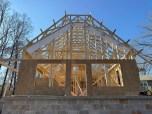
The doubled studs used here at panel seamsdefeat the energy-efficient framing scheme, but the framer worried that the large number of 3-inch on-center fasteners would splinter a single stud.
When even professional engineers and builders struggle with the practical issues of combining energy-efficient building science with wood-frame structural engineering, it’s no wonder that energy raters, who may have little if any structural knowledge or framing experience, balk at the idea of interfering with framing decisions. In Florida, however, there is strong pressure now to solve the puzzle and find answers — and not just because of the voluntary Energy Star program. C. W. Macomber, an APA field engineer based in Florida and specializing in wind-resistant construction for the Southeast region, says, “In Florida, our governor has set a mandate for homes to be 50% more energy-efficient by the year 2018. To do that, builders are starting to see that they have to take advantage of every chance to squeeze out more energy savings from their systems, wherever they can.”