
Andrew P. DiGiammo
I’ve been running a design/build construction firm specializing in oceanfront custom homes since I received my degree in architecture in 1990. Like most builders, I may take prospective clients to see homes I’ve designed and built, but I don’t often get a chance to evaluate how the buildings are performing in service. There are times when I wonder, “How is that deck down by the bay doing?” or “How are the gutters on that house holding up?” So, recently, I took part of a day to inspect the exterior details on one of my earliest projects, located in a particularly exposed area.
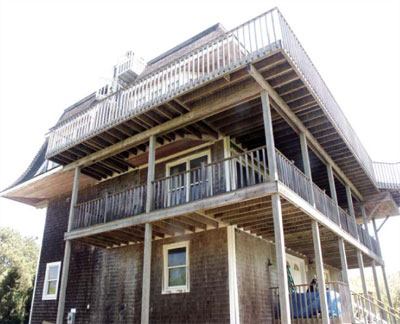
Built in 1994, this house is surrounded by sand dunes on a barrier island, with the ocean to the south and a saltwater bay to the north. To capture a 360-degree view of the water over the high dunes, we built a rooftop deck of mahogany, suspended over a rubber membrane roof. On the side facing the ocean, the building has a two-story elevated deck; part of the top-story deck is framed as a stacked double cantilever that supports a large hot tub.
After 14 years building waterfront homes, architect/builder Andrew DiGiammo took an inspection tour of one of his early homes to see how the materials he had chosen were holding up.
The structure was ambitious, particularly for me at the time as a relatively new builder. And the exterior finish materials face especially rough weather, with salt winds from every direction, lots of sun and rain, and seasonal freeze/thaw cycles. After more than a decade under intense conditions, I was eager to see how the materials I had chosen were performing.
In general, I was satisfied with what I found. Some of the finishes would have benefited from a little routine maintenance, and in a few cases I could have selected more appropriate hardware. But the structure was in excellent shape, and even natural wood that had not been maintained was mostly in good condition. A few items did take quite a beating, however — providing a reminder that the coastal environment is not a gentle one.
The Structure
This house was one of the first buildings in which I used treated engineered wood (Figure 1). The entire house is built on a framework of preservative-treated Parallam girders (www.trusjoist.com), supported by concrete piers resting on isolated pad footings. Posts for the second- and third-story decks are also treated Parallam (continuous 6x6s that run the full height). After more than 10 years in the weather, all the Parallam timbers are in prime condition — they look as good as new.
Figure 1. The author was happy with the performance of preservative-treated Parallam girders and posts, connected to concrete piers with custom-fabricated galvanized steel anchors (left). But he noticed accelerated corrosion on some of the nails used to fasten joist hangers in the treated sawn-lumber deck structure (right).
I used custom-fabricated steel anchors to connect the Parallam girders and posts to their concrete piers. The anchors were specially ordered from a steel fabricator (any good steel shop can supply this type of thing). They are made of 1/4-inch steel plate bent into a U shape; the steel was bent and holes for carriage bolts were drilled before the pieces were sent to be hot-dip galvanized.
We embedded the anchors into the wet concrete when the piers were poured, then we drilled the wood members and bolted them in place. Posts and girders are suspended above the concrete pier, providing an air gap to keep the wood dry (we set a Simpson Strong-Tie standoff post base under each post, to act as a spacer). When the bolts are torqued tight, the contact area between the U-shaped anchor and the wood member develops a significant amount of friction, which combines with the bolts themselves to support the post or girder. More than a decade later, not one of those joints has budged, and the galvanized anchors don’t show any sign of deterioration. I’m very happy with the performance of this design element.
I’m not quite as happy, however, with the condition I noticed in some of the hangers and fasteners we used to assemble the treated southern yellow pine deck framing. In a few cases, the crew apparently used nails that were not compatible with the galvanized joist hangers. When dissimilar metals are brought into contact in a moist environment, one metal can attack the other — a process known as bimetallic galvanic corrosion (Figure 2). This phenomenon is worse in a saltwater exposure than in conditions of regular rain or dew. Using regular roofing nails or common framing nails for hangers is a common practice but not a good idea. Not only is the connection weaker, but the nails rust more quickly and will eventually need to be replaced. Whenever you use framing connectors or hangers in an exposed coastal environment, it’s important to be especially careful with fastener choice. In the case of decks, I’d advise builders to ask the manufacturer of the hangers to specify and supply the appropriate nails — and the crew on site, in turn, has to understand why it’s important not to substitute something else.
Figure 2. If dissimilar materials meet in the presence of an electrolyte (which can be moisture in the air or rainwater), galvanic corrosion occurs. Saltwater is an electrolyte supreme, so wherever salt spray and constant moisture exist, the process of galvanic corrosion is accelerated. The farther apart two metals are from each other on the scale, the faster the deterioration will be.
Wood Shingles and Clapboards
I used cedar wood without any paint or coating for this home’s siding and roofing (Figure 3, page 4). The roof is shingled with western red cedar, and the walls are shingled with white cedar (which grows in the Northeast). The rooftop deck’s parapet walls are sided with red cedar clapboards.
The white cedar wall shingles, in general, are doing fine. They’ve weathered to varying shades of gray, but they’re still doing their job and will last for a long time.
Red cedar is a more durable species than white cedar, and the shingles on this roof are also bigger and heavier than the ones on the walls. However, the roof shingles have a rougher exposure than the wall shingles — they’re in a more horizontal position, where they get direct rain and sun and can accumulate debris. They’re now supporting growths of algae, lichens, and moss, particularly in the lower-slope and more shaded areas.
We’re also starting to see some fastener failure on the red cedar roof. We used galvanized nails to attach the shingles, and the same natural chemistry that makes red cedar resist rot is mildly corrosive to galvanized nails (and much more to ordinary steel). One photo in Figure 3 shows a missing roof shingle, and you can see how the fasteners in the newly exposed area are rusting. Code in my area now requires stainless-steel fasteners for red cedar roofing applications, but even before that code change, I switched to using stainless-steel nails for fastening all naturally rot-resistant wood. In fact, we now use stainless-steel fasteners for all exterior siding or trim, as well. (You can see why if you look at the stainless-steel nail heads in the parapet clapboards in Figure 3 — the cedar is gray and weathered, but the nail heads are still shiny.)
Figure 3. Red cedar roof shingles have collected dirt, algae, lichens, and moss over the years (top left). Vertically applied white cedar shingles on the wall look cleaner and newer (top center); both types should be cleaned periodically. Galvanized nails used to attach the roof shingles have been attacked by the corrosive chemistry of the wood (top right) — the author now uses stainless-steel nails for all cedar applications, as he did on the parapet clapboards (bottom right). Lead flashing has had a partial protective effect on the top course of red cedar roof shingles (bottom left).
I’m not as concerned about this red cedar roof’s condition as I would be if it were the primary roof of the home. In fact, the entire lid of the house is wrapped in rubber roofing membrane — the projecting mansard overhangs with their shingling are there to shelter the walls and to protect the rubber roof from sunlight. This roof has no leaks, and won’t have any, whatever happens to the wood shingles.
Generally, an owner will get better performance out of a wood shingle roof if the roof is cleaned every two years with water and a cleanser that kills algae and fungi. If owners don’t want to take that on, you might want to steer them toward metal or composition roofing.
Natural Wood Decks and Rails
I used a mahogany decking on all the decks, and red cedar for rails and balusters (Figure 4). All that wood is still in good shape, but the mahogany was not my first choice. As I recall, we used it at the time because the owner had gotten a good deal on this lumber and asked us to use it. I prefer to use ipe (sometimes called Brazilian walnut) for natural wood decks. In my market at least, ipe seems to be a more consistent product, and very weather resistant.
Figure 4. Naturally rot-resistant cedar rails (above) and mahogany decking (bottom) have performed well, but the author notes mahogany can be inconsistent, depending on the variety and on the presence of sapwood rather than heartwood boards in the shipment.
Not that some mahogany isn’t durable — if it’s the right kind of mahogany, and if it’s all heartwood rather than sapwood. The problem is that there are hundreds of species and subspecies of mahogany and no real grading system for them, so you don’t know for sure what you’ve got until you break open the bundle. In my experience, the heavy pieces are heartwood, but lighter boards may be sawn from less durable sapwood. On this deck, I noticed that a few pieces of exposed decking here and there were darker than the others, apparently because they were holding water — maybe because they’re sapwood, or maybe just because of the grain pattern from sawing. Down the road, some boards in this deck may need to be replaced.
The rooftop deck on this house is designed for ease of repair, however. As I mentioned earlier, the roof under the deck is a rubber membrane. The deck itself is built in sections, with pairs of joists suspended from parapet walls at both ends of the house and in the center. If the rubber roof ever needs maintenance, the strips of decking over the joist ends can be pulled up, and each section of herringbone deck can be lifted out as a piece.
Paints and Finishes
The trim on this house is red cedar. We primed it with Cabot’s Problem-Solver Primer (oil based) and applied two topcoats of Cabot’s acrylic solid stain (www.cabotstain.com). It’s a good combination: While the paint in some areas has collected some dirt and grime, it is still adhering well, and there is no bleed-through of extractives from the cedar (Figure 5).
Figure 5. The author has gotten good performance from Cabot oil-based primer and acrylic solid stain (top). In a few places, staining from galvanized nails has bled through (middle photos), and the underside of one clogged Douglas fir gutter has lost its paint (bottom).
I did see a ring of discoloration around some nail heads on some of the stained trim. I think this is caused by the slow breakdown of the galvanizing on some nails. The trim nails were set and puttied over; oxidized galvanizing can’t get through the putty, but it bleeds to the edge of the putty and comes up through the stain. Here again, stainless-steel nails are a better choice: They won’t break down and create that staining effect.
Stain did fail under extreme circumstances in one area, at the end of a gutter. I use Douglas fir gutters on most of my houses, treating the inside of the gutter with linseed oil and priming and staining the outside. We line the very ends of the gutters with copper, where they meet the leaders. The downspout in Figure 5 had been clogged for some time, allowing water to pool at the low spot for extended periods and to overflow and flood the underside of the gutter during rainstorms. Eventually, the coatings on the gutter’s underside gave up. This system does need to be kept clear in order to work properly, but the fact that the rest of the gutters on the house are still in good shape indicates that the stain job is not a problem.
The owner of the house has tried a clear urethane varnish on the deck railings and parapet caps, with mixed results (Figure 6). Although the wood in both areas is holding up fine, the film-forming finish doesn’t last. In my experience, there is no clear finish that will hold up on a horizontal surface in the coastal environment — sun, rain, and salt air destroy them all. I recommend Messmer’s deck cleaning and deck stain products (www.messmers.com) to my customers for use on horizontal surfaces. But while the products work well, they’re not permanent: Messmer’s recommends using the cleaner twice a year, and reapplying the deck stain every one to three years.
Figure 6. Periodic cleaning and re-staining is the only finish solution for these deck railings and parapet caps: Although the bare wood holds up, no film-forming clear finish can last long under coastal weather conditions.
Doors and Door Hardware
On the ground level of this house in the back, I used a standard steel entry door with a push-button combination lock (Figure 7). The door shows some rust, and the lock is tarnishing. Fiberglass doors are clearly more durable in the coastal environment.
Brass hardware on some French doors upstairs is tarnishing badly, especially the exterior levers. The entry latch set in Figure 7 is standard door hardware and, as you can see, isn’t designed for the beach environment. Andersen and some other door makers supply upgraded hardware for severe exposures; these days I always order the tougher hardware and go with the white-coated variety. I haven’t found any brass hardware that keeps looking good on a beach house over time.
Exterior Fixtures
Exterior accessories like light fixtures, vent caps, hose bibbs, and the like have not had an easy time of it on this house (Figure 8). The low-voltage downlighting fixtures in the soffits, for instance, are corroded. Lighting suppliers don’t have many products rugged enough for this environment, but plastic fixtures hold up much better. In general, I like to use “remodeling fixtures” designed to be snapped in and out rather than fastened to the building structure. When they deteriorate, the fixtures can be easily replaced. I also try to use plastic fixtures whenever I can, to eliminate the metal altogether.
Figure 7. Doors and hardware take a beating on the beach. A steel door shows rust (middle) and its pine jamb has deteriorated (top left), while a hardware-store storm-door closer is rusting badly (top right). Standard brass door hardware is tarnished and pitted (bottom photos). For beach construction, the author recommends ordering special hardware designed for extreme exposures.
The hose bibb in Figure 8 is in good shape, but the screws holding it have rusted. This may be another case of bimetallic galvanic corrosion; by experimenting with different screws, we might find one that holds up better here. Two exhaust vent caps are also rusting badly; those just have to be replaced.
Figure 8. Recessed lighting fixtures tough enough for the beach are scarce, so the author uses “remodeling” fixtures that are easily replaced (top). Replacement may also be the only option for this rusting vent cap (middle left) or for rusting screws on a hose bibb (middle right). Galvanized caps terminating metal-and-asbestos fireplace vents have also rusted (bottom), but a stainless-steel boiler-vent cap is in good shape.
On the rooftop I found an interesting contrast in the performance of vent terminations. Galvanized caps for the metal vents for two zero-clearance fireplaces were rusting badly, while a stainless-steel vent for a gas burner was in good shape. Evidently, galvanized metal isn’t sufficiently protected for this environment — wherever possible, you have to use stainless.
Lessons Learned
There are all kinds of specialized products for home exteriors, and they all have their pluses and minuses. But it’s good to know that we can build a working house on the beach with simple, basic materials: Treated wood for exposed structures, naturally durable woods for siding, roofing, or decking, painted natural wood for trim, and galvanized or stainless steel for fasteners. With attention to construction detail and with a reasonable amount of routine maintenance, simple beachfront construction can last a good long time.~
Andrew P. DiGiammo is a registered architect and custom builder. He runs Master Builders, Inc., based in Assonet, Mass. Photos by Ted Cushman.


