by Clayton DeKorne
As an industry, we know how to build a home suitable for coastal living. Daunting as the climate can be — with its hurricane-force winds, floods, home-crushing waves, incessant rain, high humidity, short drying cycles, scorching sun, and corrosive concentrations of salt — the home-building industry has the capacity to construct homes capable of withstanding these forces. Complete protection, however, requires the know-how from a number of different sources. The titles gathered here provide a good representation of this collective knowledge and even point the way toward overcoming new perils looming on the horizon.
COASTAL CONSTRUCTION MANUAL
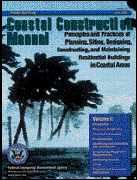
FEMA’s Coastal Construction Manual, known as FEMA 55, remains a staple for every coastal builder. Covering everything from the complete history of the hurricane damages unleashed on U.S. coastlines to the principles of designing and constructing residential buildings in coastal areas, this feast of information fills a 4-inch binder when printed. It’s a bit lean on the sort of job-site savvy that leads to efficiency and elegance, but it’s rich in basic building facts, and it will provide the essential savoir faire for designers, construction managers, and trade partners.
For those with a smaller appetite, FEMA has produced a series of 31 bite-sized fact sheets, Home Builder’s Guide to Coastal Construction Technical Fact Sheet Series (FEMA 499), that summarize flood-insurance requirements and provide information about proper siting of coastal buildings, detailing structural connections, and weatherizing building enclosures. Check out the series at www.fema.gov/rebuild/mat/mat_fema499.shtm.
A virtual engineer between book covers, the Wood Frame Construction Manual (WFCM) from the American Wood Council offers prescriptive solutions that are “deemed to comply” with ASCE 7 for seismic, wind, and gravity loads for a limited range of house sizes and shapes. Even easier to use are the new Guides to Wood Construction in High Wind Areas — five short handbooks geared to five different wind-speed zones (90 mph, 100 mph, 110 mph, 120 mph, and 130 mph). Each provides drawings and tables specifying the main structural elements of a wood-frame house in a high-wind area. Published in cooperation with the International Code Council, the guides provide a quick and simple path to coastal code compliance.
FEMA’s three-volume Coastal Construction Manual covers everything from the history of hurricane destruction to load calcs and construction details. Even its tagline — Principles and Practices of Planning, Siting, Designing, Constructing, and Maintaining Residential Buildings in Coastal Areas — is massive. Yet this work lives up to its billing, providing a veritable bible for the coastal builder. Available free in print or on CD from the FEMA Publications Distribution Facility, 800/480-2520.
UNDERSTANDING WIND LOADS
A new series of easy-to-use Guides to Wood Construction in High Wind Areas addresses wind design requirements in 90-, 100-, 110-, 120-, and 130-mph wind zones. The guides are based on provisions contained in the Wood Frame Construction Manual for One- and Two-Family Dwellings, 2001 Edition, the reference document for high-wind wood-frame construction in the International Residential Code (IRC). Available free to download at www.awc.org/Standards/wfcm.html.
FORTIFIED HOMES
The Institute for Business & Home Safety — a nonprofit arm of the insurance industry — has been charged with reducing the risk of natural disasters by upgrading the built environment. Towards this goal, IBHS instituted the Fortified … for safer living program, which presents a set of prescriptive building guidelines intended to exceed ASCE 7. The Fortified … for safer living Builder’s Guide is the key document that provides a clear and concise overview of the structural requirements for resisting high winds. Builders who submit their project to a program plan reviewer, follow the Fortified guidelines, and have the home inspected by a program inspector, can certify the project as a Fortified home.
Whether or not this wins the owner a break on insurance premiums (it could, depending on the provider), the program should lend real value to a coastal home. While the program requirements have been crafted with an eye toward practicality, it’s got real teeth and it’s not necessarily an easy certification to get. The inspector must visit the site four times during construction to verify compliance with the Fortified standards, which themselves have been painstakingly considered by some of the best wind and civil engineers in the business. The requirements are meant to exceed the International Building Codes, and thereby go beyond basic life and safety standards, to meet a standard of care that would mitigate expensive damage to homes.
The Fortified … for safer living program has modified its wind requirements to cover homes built to resist winds 20 mph more than those set for a particular location under the ASCE 7 standards. This means that coastal homes from Texas to Maine built to the program’s requirements will be protected from hurricane-force winds from 120 to 170 mph (up from 100 to 150 mph per ASCE 7). The revised program also addresses protections from flood hazards, water intrusion, and fires — all likely hazards in coastal regions. It’s available free to download at www.ibhs.org.
GULF COAST GUIDEBOOKS
While critics have disparaged FEMA’s response to Hurricane Katrina, it is heartening that the engineers charged by FEMA with mitigating future disasters mounted an impressive response to Katrina with the publication of Recommended Residential Construction for the Gulf Coast: Building on Strong and Safe Foundations. Dubbed FEMA 550, this groundbreaking guidebook provides engineers and builders with the essential information needed to build coastal foundations that can stand up to the huge wave forces of another hurricane on the scale of Katrina.
Developed as a guidebook to rebuilding the Gulf Coast, it includes pre-engineered foundation designs, some that match the traditional Gulf Coast vernacular home designs found in A Pattern Book for Gulf Coast Neighborhoods (www.mississippirenewal.com/documents/Rep_PatternBook.pdf) developed by the Mississippi Governor’s Commission on Recovery, Rebuilding, and Renewal. Together, both the Pattern Book and FEMA 550 provide a rich resource for easing two of the biggest costs of the rebuild: engineering and architecture.
On August 29, 2005, Hurricane Katrina struck the Gulf Coast with record-breaking storm surge that destroyed foundations and devastated homes from Louisiana to Alabama. Katrina was so destructive that engineers assessing the carnage no longer looked for “success stories” (homes that were only moderately damaged), but rather searched for “survivor” homes that, while extensively damaged, still bore a slight resemblance to a residential building. Hurricane Katrina proved that a strong, elevated foundation is key to a home surviving a major storm. FEMA’s latest guidebook set out to address just that (available online at www.fema.gov/library/ viewRecord.do?id=1853).
WATER WOES
In her recent book, Mirage: Florida and the Vanishing Water of the Eastern U.S., Cynthia Barnett does not mince words criticizing rapacious land developers, and her contempt for those who put short-term profits in front of long-term sustainability may grate on the ears of the biggest builders. But if her assessment is harsh, it’s well substantiated, and ultimately, it’s difficult to argue against the recurring historical patterns of mismanagement and political bumbling that have devastated water resources in some of the wettest regions of our country.
An example of the eastern water crisis
Along the Atlantic coast, freshwater aquifers are bounded by saltwater on the seaward side. If the aquifers are allowed to flow unhindered, the outflow exerts pressure that keeps the saltwater at bay. But as more freshwater is pumped to meet rising demand, the pressure is reduced and saltwater encroaches on the freshwater supply. The U.S. Geological Survey has identified these sites where development of groundwater resources has caused significant saltwater intrusion.
It is perhaps because these regions are so wet (Florida, for instance, averages more than 54 inches of rainfall per year) that regulators have been slow to curb the uptake of in-ground water resources. In the East, we don’t bother to capture the vast rainfall in reservoirs much. Easterners want the land for development, not bodies of water, and we have the luxury of deep, ancient aquifers from which to pump the water we need. But as Barnett explains, slowly and surely, from the Florida Keys to the Great Lakes, municipalities have been overpumping groundwater to keep up with the rapid pace of development. These actions have successfully depleted water reserves, made deserts on land that used to be swampland, and even induced sink holes that swallow houses and trees whole. In Florida, regardless of how much rain might fall from the sky, the downpour cannot sustain the state’s current 8.3-billion-gallon-per-day water habit in dry times, much less keep up with the projected 21% population increase that will drink up an additional billion gallons per day in the coming decade. Not just in Florida, but all along the eastern seaboard, increasingly scarce water supplies will do more to limit growth than any increase in mortgage rates ever can. In the interests of long-term sustainability of coastal building, everyone inhabiting the region ought to sit up and take notice. Water wars are no longer the drama only in the West. They have begun to dominate state politics on the East Coast, and Barnett provides strong evidence that they will only get worse.
Cynthia Barnett’s recent book Mirage: Florida and the Vanishing Water of the Eastern U.S. provides a highly readable, even gripping, account of the water crisis now facing nearly every state in the nation. (University of Michigan Press; www.press.umich.edu)
MAKING SENSE OF GREEN BUILDING
Alex Wilson has been at the business of “green building” long before it was a hot topic. He’s the founding editor of Environmental Building News — a no-nonsense, tell-it-like-it-is, advertising-free monthly assessment of green-building practices — and president of BuildingGreen.com, an online portal for rational building know-how. Builders and remodelers entering the “green space” will want to consult Wilson’s Green Building Products — a compendium of some 1,600 products that qualify as green — to sort out the confusing and sometimes misleading claims about material choices. But first you should pick up his most recent book, Your Green Home: A Guide to Planning a Healthy, Environmentally Friendly New Home, as a primer for prioritizing the issues and steering customers in the right direction.
The take-home messages in this book: Green is not about choosing pressed-granola flooring and whole-wheat cabinets. Material selection takes a backseat to the two most important steps to building a green home: (1) build a smaller house, so you use fewer materials in the first place, and (2) focus on making the home more energy efficient, so the continuous consumption of energy can be contained. After that, reliance on alternative-energy supplies and resource-efficient building materials makes sense.
Alex Wilson’s book is intended for builders and consumers alike. More than just about any book out there, this guide deftly cuts through the current hype on the topic to prioritize the issues and focus our attention (and our wallets) on what really matters to the planet. (A Mother Earth News Book for Wiser Living; available from www.buildinggreen.com)
MOISTURE MITIGATION
Coastal builders require a strong working knowledge of building science. There’s no shirking in this department: Understanding the physics of heat and moisture through the building enclosure is integral to keeping water out of walls, particularly along the humid coastlines saturated by wind-driven rains. Short drying cycles raise the ante for builders attempting to keep wall cavities dry and avoid moisture-related callbacks and litigation.
Unfortunately, there’s a relative scarcity of building-science information that is both lucid and accurate. Some of the best material is that written and compiled by engineers John Straube and Joseph Lstiburek, much of it available at BuildingScience.com. Not all of the material you will find here is easy to read. Much of it requires a real diligence to get through, and if it seems opaque, one would be well served to participate in the duo’s Building Science Fundamentals seminars listed at www.buildingscienceseminars.com. Indeed, Straube and Lstiburek shine in person in a way that is sometimes diminished by their writing.
Every coastal builder to some degree needs to aspire to the building sciences. Joseph Lstiburek and John Straube take the drudgery out of that ambition, if not online (www.buildingscience.com) then in periodic seminars (www.building scienceseminars.com).
Whether you’re taking the seminars or not, several must-reads for coastal builders include the following titles:
• BSD-013: Rain Control in Buildings. Rainwater is the biggest threat to the long-term durability of any home (and perhaps doubly so for a coastal home). Straube’s textbook look at the dynamics of wind-driven rain begins to build our understanding of how a raindrop really thinks.
• BSD-105: Understanding Drainage Planes. The first, best step to controlling rainwater is to install an effective drainage plane. Lstiburek clearly lays out what “effective” actually means and just what’s required to get the job done right.
• BSD-108: Investigating and Diagnosing Moisture Problems. One of the documents that reads much like Lstiburek talks, this engaging overview of the “first principles” of moisture movement in buildings provides a solid basis for troubleshooting problems, with examples of some common yet often misunderstood problems.
• BSD-111: Flood and Hurricane Resistant Buildings: Following Hurricane Katrina, Lstiburek took a commonsense look at the threat of hurricane-driven winds, rain, and floods, arriving at practical advice for rebuilding the Gulf Coast that applies to all coastal construction.
(To locate these articles online, use the search function at buildingscience.com/index to search by BSD article numbers.)
Clayton DeKorne is the editor of Coastal Contractor.