By David Bentley and Elizabeth Churchill
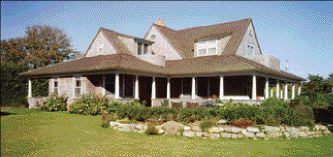
In our work on Nantucket Island, we have had the opportunity to rehabilitate several turn-of-the-century Shingle Style summer houses. The house named ‘Wideawake,’ profiled in this article and shown in the photo below, was built in the late 19th century in the village of Siasconset, a former whaling outpost that dates from colonial times. The house was expanded and renovated in 1914 by the architect Fredrick P. Hill as a guesthouse for the silent film star Robert Hilliard. By the time our clients purchased the property, the original cedar roof shingles had been replaced with asphalt, and much of the original detailing on the house had been removed or replaced with plain painted trim boards. To rehabilitate the house, we repaired and restored the original materials and detailing, effectively returning the house to its authentic Shingle-Style appearance.
HISTORIC CONTEXT
The unique characteristics of the Shingle Style were originally designed for vacation homes for a new upper class of Americans that had been created by the Industrial Revolution. The industrialization of cities along the Eastern seaboard and in the Midwest following the Civil War brought unprecedented economic affluence. However, it also created a population boom in the cities, which in turn led to an increase in urban congestion, squalor, and disease. A “home by the sea” epitomized a life free from toil, with endless days of carefree living, and provided an image of escape from the increasingly unpleasant realities of modern urban life. For the fortunate classes, a seaside retreat provided a refuge, if only temporarily, from these unpleasant byproducts of modern urban life.
Many of these new houses by the sea were designed by the leading architectural practitioners of the day, including: McKim, Meade, and White; Peabody and Stearns; William Ralph Emerson; Lamb and Rich; Bruce Price; John Calvin Stevens; and many others. Their plans and perspective renderings were published in early architectural magazines like American Architect and Building News, founded in 1876, and their forms and details were popularized and widely copied in pattern books and periodicals, such as Shoppell’s Modern Houses of 1890. Generally referred to as Modern Colonial, or simply Modern, in their time, these houses were named ‘Shingle Style’ by architectural historian Vincent Scully in his 1955 book of the same name — based upon their shared characteristic of a smooth-flowing shingled exterior.
‘Wideawake,’ a shingle-style summer house on Nantucket Island, was returned to its authentic 19th century appearance with the repair and restoration of original details by the authors. (Photo by Michael Meyer)
WEATHER ADAPTATIONS
The distinct building forms of the Shingle Style were derived from the simple adaptations to the coastal environment found in colonial architecture. The smooth-flowing shingled skin served to channel persistent wind-driven rain around the structure. Walls were sheltered by roof overhangs and porches that often ended in a knife-edge, which minimized their exposure to the weather. Due to the difficulty in maintaining painted surfaces near the coast, exterior trim work was minimized in favor of shingled rakes and cottage corners. Curved forms and flared shingles were frequently used as a means of channeling wind and water away from the building, but these details also served the dual purpose of integrating the house into the surrounding environment.
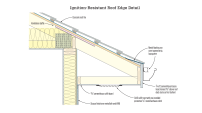
‘Wideawake’ provides an example of many of these Shingle Style adaptations to the seaside location. The house is wrapped on three sides by a sheltering porch, with deep overhanging eaves. The sharp eaves edge, made by mitering the roof sheathing directly to the beaded board soffit, eliminated the fascia board — a detail that we discovered had not proven very durable over time. Movement in the materials in response to changes in moisture content had opened the joint and allowed water to penetrate into the cornice and underlying structure. Our detail restored the knife-edge appearance of the eave but replaced the original miter joint with a fascia mold, which covers the end of the roof sheathing and soffit while maintaining the horizontal line of the roof. The 5/4-inch-butt red cedar roof shingles overhang the nosing to conceal the molding.
SHINGLED TRIM
To create the smooth-flowing appearance of the exterior, builders of Shingle Style houses typically used cottage corners rather than wooden trim boards at a building’s corners. In this detail, shingles are woven around the corners, alternately lapping each course over the next. The continuous lines of shingles create a horizontal emphasis that is uninterrupted by vertical divisions. Where the roof meets the wall at a gable end, the shingled rake was the preferred treatment. Woven like a cottage corner, the shingled rake is constructed by folding the roof shingles, which have been cut to a uniform width, over the top of the shingled sidewall (Figure 1). Although the shingle rakes at ‘Wideawake’ had been replaced with 1×6 painted trim, we were able to confirm their prior existence from a remaining section of the original structure encapsulated inside the 1914 porch addition. Because these woven joints tend to open up over time, we wrapped the corners below with Ice and Water Shield to channel any water penetration through this joint out over the shingled wall.
FIGURE 1.To create a traditional shingled rake, the author “folds” the roof shingles over the edge using shingles cut to a uniform width. (Illustration by David Bentley)
Another favored Shingle Style detail — used to direct water runoff away from the building foundations while also integrating the building with the site — is the flared skirt. The flared horizontal base serves as a visual transition from the vertical shingled wall of the house into the horizontal landscape around it. This detail was created by furring out the base courses of shingles from the sheathing to create a gentle curve at the bottom of the wall (Figure 2). Furring strips were commonly removed when sidewall shingles were replaced, so this important relationship of the building to the ground was often lost along with the detail.
FIGURE 2.Furring strips create a flared skirt that produces a gentle curve at the base of exterior walls.(Illustration by David Bentley)
Shingle Style details, developed in response to often-harsh seaside conditions, contain many lessons for the current generation of seaside builders. Applied to new construction, such traditional details can impart an ageless character to today’s coastal homes, and when used in remodeling, they can blend new with old, relating our modern buildings to the historic seaside communities they are joining. — David Bentley and Elizabeth Churchill, architects on Nantucket Island, Massachusetts, have been building seaside homes for over 20 years. The restoration of ‘Wideawake’ was completed with the capable assistance of Michael Phillips Construction.