
by Eric Borden
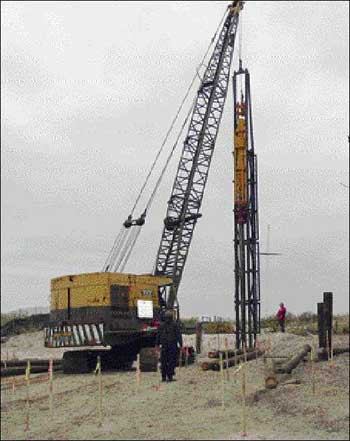
A 1,500-pound drop hammer driving piles will send shivers down a neighbor’s back — and the potential for damaging adjacent structures runs high. The solution is a careful inspection of the neighbor’s property before the pile driver ever arrives.
We primarily build custom homes on the shifting sands that comprise the barrier islands of the New Jersey coastline. Timber piles serve as the foundation, or support the footings for a masonry foundation, on every home we build. For all oceanfront homes in the V zone, the new FEMA regulations require a tip depth of minus 10 feet (that is, 10 feet below sea level). Average grade elevations of plus 8 to plus 10 feet and finish-floor elevations of plus 16 feet are common. As a result, we are typically driving 25- to 30-foot-long timber piles with a butt diameter of 10 to 12 inches. And more than almost anything else we do, this work presents an enormous liability risk, largely because of the kind of communities we work in.
Infill Community
These communities were established mostly as rural fishing settlements during the previous century. Now they are primarily resort vacation communities with all of the problems surrounding a burgeoning summer population. Several of our shore towns go from winter populations of under 10,000 to summer populations of 100,000 or more. It’s good for us because everyone wants “bigger, better, more.” As in all shore communities, we have managed to fill every vacant piece of sand with a house. Our jobs have changed over the last 30 years from new construction on vacant infill property to replacement of older housing. That means the first guy on the job is usually driving a track hoe with a demolition grapple.
Building on the narrow barrier islands along the Jersey shore, every job starts with piling — either below the footing to support a masonry foundation (top) or elevated to the first-floor girders (bottom).
Without an abundance of property on the islands and close to the mainland shores, the lots we build on are usually pretty tight. Small lots, large houses with a maximum number of bedrooms, and lots of summer visitors put parking spaces at a premium, so zoning laws in our area are more concerned with how many parking spots are maintained than with how close a house is to the property line. A usual setback for our projects is “15 feet combined, 5 feet minimum.” This translates into how the homes are sited: a minimum 5-foot setback on one side of the lot and 10 feet on the other. We have actually built in areas where the rear setback was 31/2 feet and the deck on the house was just 3 inches from the property line on the side.
With houses this close together, the sight of a crane and pile-driving rig typically causes alarm among the neighbors. One project that we constructed called for a teardown of a 4,200-square-foot two-and-a-half story home that was originally constructed around 1910. The house was sited just 3 feet from the property line. The home next door was a 4,000-plus-square-foot 1920’s English Tudor home constructed of cinder block with stucco exterior and half-inch slate roofing. It included 6- by 7-foot true-divided light windows facing the property line, and landscaping with 9-foot-tall cinder-block retaining walls. All of this was constructed on beach sand at the oceanfront dune line long before any building codes as we know them existed. In other words, this was a tremendously wealthy home with a lot of delicate and expensive detailing, all waiting to be damaged by the work we were about to perform.
As the general contractor, our company always assumes the greatest liability in all areas of the business. Even with an ironclad contract, proof of insurance, and indemnity, we cannot rely on our subs to provide us with the level of protection we need to maintain the health and well-being of our company. Consequently, we must take steps to do our own due diligence to protect us from claims that might arise from the performance of our subcontractors. And the pile-driving crew is always the first to come under our purview.
Neighborly Charm
Our projects usually impact everyone within a 200-foot area. Our work puts constraints on access and parking, and it generates noise and debris — all of which make for very tough conditions when you factor in the typical attitude of vacation residents. Being in a vacation area, neighboring homeowners can be trying, to say the least. They won’t tolerate a lot of inconvenience, and they expect quiet all of the time. So we have to take steps to alert the neighbors of our presence. As soon as we are awarded a job, our first response is to send out a letter of introduction to the adjacent homeowners, giving them a basic understanding of the project, our time frame, and our contact numbers. This in itself can alleviate many of the future problems by encouraging an open line of communication. But it’s only the first step.
Empty lots no longer exist in most of the crowded beach communities, so new construction typically starts with a track hoe. The author’s crew can take a 4,000-square-foot house and whisk it away, leaving a clean site in two days or less.
When a 1,500-pound drop hammer is falling from 10 to 15 feet, hitting the butt of a 25-foot timber pile a few hundred times, and you have 70 or 80 piles to do, the neighbors tend to get up in arms no matter how charmingly you may have introduced yourself. Their biggest concern is whether the process will damage their foundations or cause other damage to their homes. There are many stories of “priceless” items that vibrated off shelves, pictures that fall, and chimneys that crack.
So our next step to alleviate their fears is to meet with them, explain the process we are employing, and ask permission to have our engineer do a structural survey of their home. It’s much easier to get access to the neighboring properties before anything happens than it will be after something goes wrong. We need to assess the condition of their foundations. We are trying to determine if there are any signs of settlement, cracks in the foundation, signs of settlement on the interior, doors that don’t close, separation of the chimney from the structure, signs of water intrusion, cracked windows, or other such problems, so that we won’t get unfairly blamed for these after our work begins.
Day of Inspection
Once we have permission, we set the date for the inspection. At this time, a representative from our company meets the engineers’ and owner’s representatives at the property that we are surveying, and we get to it. We will only do one or two properties in a single day, depending on the size of the homes. It’s surprising how tiring three to four hours of this type of investigation can be. We come equipped with a pad for taking notes, a mini-recorder for recording our observations, a digital still-camera, and tape measures.
Overview. We first just record as many of the basic facts as we can, including the approximate age of the home and the type of construction (wood frame, concrete block/stucco, for example). We also make notes evaluating the overall condition (excellent, good, poor).
Exterior. Next, we examine the exterior by walking around the house looking for any cracks in the foundation or signs of recent or not-so-recent repair. As we work our way around the house, we document everything we find with photos (making sure that the date and time feature of our digital camera is on) and take notes on the dimensions and condition of every part of the structure. We also take the measurements to the property lines to locate the house on the lot, and note the conditions of sidewalks, retaining walls, driveways, decks, and anything else that shows signs of wear or needs replacement. And finally, we take photos of each elevation. If in doubt, we photograph it no matter how small it seems. A picture is truly worth a thousand words.
While more expensive than timber piles, helical steel piles are still cheaper than a lawsuit and the increase in insurance premiums that would follow.
Interior. After we complete our inspection of the exterior, we move to the interior. We methodically walk through the home taking photos of each room, checking each door, and making notes and photos of any pertinent details. We are sure to check that the windows open and close, and ask if any windows have had any problems. We also check the condition of the drywall or plaster, looking for any signs of water stains, paint bubbles, flaking at the sills, or anything that we might be blamed for later.
Report. Once we complete our inspection, a copy of the report is sent to everyone involved. A typical report will run two pages of print and several pages of pictures. Our costs for these reports from the engineer run $1,500 and up — the most that we have spent is $3,200. At a glance, these costs may seem unnecessary, but they will be a huge return on investment if you are accused of damaging someone’s home. Usually the neighbor is impressed with our efforts to protect their property and becomes our ally instead of our adversary. Since we have instituted this policy we have not had a single complaint of damage, and we have even been awarded several nice repair jobs just for pointing them out.
On the job next to the English Tudor house mentioned previously, our report saved us from having to rebuild and replace 30 feet of landscaping walls, as we were able to prove the condition existed before we started. We were certain our work had not caused the slightest movement of these walls because we monitored it carefully throughout the job. The report also alerted our piling contractor to take exercise great caution near these walls: He first air-jetted the piles as close to the final depth as possible and only drove the last couple of feet — just enough to reach the required tonnage. At every step, we kept a close eye on his progress, constantly checking the walls for any signs of leaning or shifting. We were fortunate no movement occurred. But if we had noticed any movement, we would have resorted to an alternate “low impact” method, such as using helical steel piles. Even at this point, it would have been more cost effective to redesign the entire foundation scheme than to spend years in court and pay the increases in insurance premiums that could arise from just one claim. ~
Eric Borden, owner of ESB Contracting, has been building high-end custom homes on the Jersey shore since 1986.


