Massachusetts Releases Road Map to Zero-Energy Buildings In recent years, state governments have begun to push ahead of the Federal Government in efforts to limit energy use and put a lid on carbon-dioxide emissions. California Governor Arnold Schwarzenegger signed legislation in 2008 intended to reduce the state’s carbon emissions to 1990 levels by 2020, through a complex effort that includes rules for automobile emissions and electricity generation as well as a toughening of building codes. In Florida, Governor Charlie Crist, who is friends with Schwarzenegger, has pushed his legislature to pass a step-wise toughening of that state’s performance-based energy code for buildings, requiring new buildings to use 15% less energy last year (compared with the 2007 code), to cut energy use 20% by 2010, and to slash total energy consumption by 50% by 2019. (Check Builderonline for Ted Cushman’s story, “Florida Sets Tough Energy Code Targets.”) Now, Massachusetts Governor Deval Patrick is joining the parade — and upping the ante. In March 2008, at the New England Sustainable Energy Association (NESEA) meeting in Boston, Patrick appointed a task force to create a road map to zero-energy buildings in Massachusetts, with what task force member Emile Chin-Dickey calls an “unbelievably ambitious” goal: making all new construction in the state zero net energy by 2030. This month, the Massachusetts Zero Net Energy Buildings Task Force delivered its product: a 56-page report titled “Getting To Zero.” (This link is a 5.79MB PDF.) The report lays out recommendations for achieving the zero-energy goal for commercial buildings, for government buildings, and for homes.
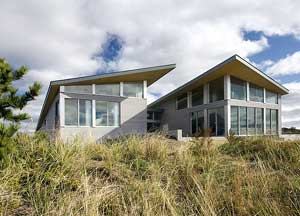
This net zero-energy custom beach home in Truro, Mass., was completed in 2008. Facing west across the Cape Cod Bay, it incorporates solar panels and geothermal heat pumps to produce more power than it consumes on an annual basis. Carbon-based energy consumption is limited to propane cooking equipment. For more information, see the ZeroEnergy Design website. Photo Credit: Eric Roth Emile Chin-Dickey is a principal with ZeroEnergy Design, an architecture and energy consulting firm based in Charlestown, Mass. Like much of his company’s professional team, Chin-Dickey was a member of Cornell University’s “Solar Decathlon” team in 2005. After earning college and advanced degrees, several team members stayed together to found an architectural firm with a focus on maximum energy-efficient design and construction. Says Chin-Dickey, “Our working and professional relationships extend back to the very beginning of the Cornell project. We had a chance to conduct a lot of research, and also to get a feel for how the working relationship and the design process should work. And it was through that trial and error that we were able to develop the business model and the design process that we have today, and to bring that to the market after the competition ended.” Now that the team has gone pro, says Chin-Dickey, “We staff architects and consulting engineers, and we can do custom residential design, as well as the mechanical and energy design. For our custom projects, we do both the architectural design and the mechanical and energy design. But for some clients who already have a design, or builders or developers who just want to make their building more efficient, we will provide just the energy design service — run an energy model and give them an idea of which are the most cost-effective building improvements.”
Emile Chin-Dickey cleans solar panels on his team’s Solar Decathlon house on the National Mall in Washington, D.C., 2005. Chin-Dickey and other members of the team went on to found ZeroEnergy Design in Boston, Mass. (www.zeroenergy.com). More photos of the 2005 competition. Photo Credit: Stefano Paltera/Solar Decathlon Incremental improvements to new and existing buildings are well within reach in Massachusetts, says Chin-Dickey — even for conservative-minded builders who may be resistant to new ideas. “We’ve worked with the more progressive builders, but we’ve also worked with a lot of the guys in family-owned businesses that have been doing it for several generations,” he says, “and with relatively minimal change to what they do, we’re able to help them get down to a HERS 70 pretty easily.” Getting all new homes to zero energy is a different story, though. “That’s going to be very difficult to achieve,” says Chin-Dickey, “and it’s not going to be a single product or method that gets us there. It’s going to be a continuous effort, and they’ve got to be coordinated.” On the other hand, the zero-energy new home is achievable now, and with existing technology — but at a price. ZeroEnergy Design can point to at least one example: the Truro, Massachusetts beach house they designed that was completed in August, 2008 (shown above). Designed as a vacation getaway for several generations, this house is able to operate in a scaled-back mode with just a small master suite occupied, or open up to host the whole extended family during major get-togethers. Chin-Dickey says energy modeling predicts that the house will produce as much energy on site as it consumes each year — although he cautions, “We don’t have a full year of operational data yet to prove that.” Existing Homes Pose Biggest Challenge — and Biggest Opportunity Paul Eldrenkamp, of Massachusetts remodeling firm Byggmeister, served as chair of the Zero Energy task force’s residential committee. According to Eldrenkamp, showcase projects like the Truro house are one key to making zero-energy houses practical as a mass-market product — which is why the task force recommended that the state create incentives for homebuyers and builders to plan and build demonstration projects. But Eldrenkamp also points out that changing only the way new homes are built can only accomplish a limited amount of savings in the short run. “Deep energy retrofits” of existing homes, he says, offer much greater opportunity. “In a good year, there are 20,000 or 25,000 new housing starts in Massachusetts — and we’ve got 2.2 million existing dwelling units.” Nationally, the average existing house scores about a 140 on the HERS rating scale — 40% worse than a code-compliant new home. But in Massachusetts, the task force estimated, the average existing house scores at 150 or worse — meaning that just bringing those houses down to today’s new-construction baseline could save a third of the energy the state now expends on operating homes. Governor Patrick didn’t instruct the task force to address the issue of existing homes, but the group took their effort in that direction anyway. “We had to,” says Eldrenkamp. “It would have been irresponsible, it would have been pointless, to miss the retrofit market.”
This simple house scored a -4 HERS rating, which means it produces more energy than it consumes. Built in Townsend, Mass., the home is cited as a case study in the “Getting To Zero” report. Source: www.mazneb.org Zero energy in a new home is a tough target. For an old-house retrofit, says Eldrenkamp, it’s close to impossible. “At Byggmeister, we have not been able to get close to zero net energy with any of our retrofits. In the whole U.S., there may be a handful of retrofits that got to zero net. People out in Boulder, Colorado, have been able to do retrofits to zero net — but they’ve got 300 days of sunlight.” On the other hand, stepwise energy improvements to an existing house can get close enough to zero that on a neighborhood scale, renewable energy production could theoretically make up the difference. “You want to think in terms of zero net energy neighborhoods, rather than zero net energy homes,” Eldrenkamp suggests. “Get each home down to a reasonable low load, and then look for open space where you can put a solar array to handle part of that neighborhood’s load.” Even on a house-by-house level, progress may have to be incremental. “You have to phase the energy upgrades on the houses,” Eldrenkamp says. “When you replace the roof, you add insulation to the roof plane. When you replace the siding, you add insulation to the walls.” The home will only approach zero energy load at the end of that process, he explains. The next step for policymakers, Eldrenkamp says, is to identify the short-term milestones on the path to zero. “The most effective tool we could have at the national level would be a very clear target for what residential energy use could be,” he explains. “If Obama said, ‘Okay, for reasons of national security, energy independence, carbon stabilization, et cetera, this is our national energy budget, and this percentage goes to residential’ — then the industry could take that and actually do something meaningful with it. Right now, we don’t have a specific target in mind — it’s more sort of, ‘Let’s do some stuff and see what happens.’ But if they gave the remodeling industry a target and said, ‘Tell us the most cost-effective way to get to that target,’ then we could have an intelligent conversation. Right now we can’t have an intelligent conversation — because we don’t know what the goal is.”