

Paul Fisette
A majority of home builders and remodelers have made the switch to oriented strand board (OSB) as a substitute for plywood roof sheathing. Initially, the decision was driven by the low introductory price of OSB, but the honeymoon is over. As of this writing, a sheet of OSB sells for a few dollars less than plywood. Nevertheless, the marketplace conversion to OSB continues.
OSB’s acceptance has been slow in coming. Early on, OSB got a bad rap because of its association with waferboard, a sheathing material with an amorphous blend of wood flakes that became available commercially in 1963. The first true OSB with layers of aligned fibers was introduced by the Elmendorf Manufacturing Co. of Claremont, N.H., in 1982. Among builders, its initial reception was chilly. Response warmed gradually as OSB established a reliable track record, and now OSB dominates the national market for residential sheathing, accounting for 60% or more of the structural sheathing sold nationwide. While many builders have become comfortable using OSB, new suspicions surfaced when code advisers in Florida’s Dade and Broward counties charged that OSB fails as structural roof sheathing in wet, windy exposures, such as those caused by Hurricane Andrew’s rampage across southern Florida in August 1992.
CONCERNS AFTER ANDREW
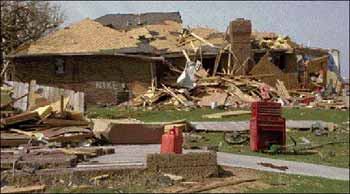
The damage from Hurricane Andrew was formidable and has only recently been surpassed by the quadruple whammy of 2004’s record-breaking storms. In response to public outcry, the Florida government moved into action, creating an advisory committee to investigate the nature of the structural damage and make recommendations that would limit future reoccurrences. Jose Mitrani, a civil engineer and professor at Florida International University in Miami, was involved from the beginning on the task force charged with investigating the failures. He does not think that OSB performs adequately as structural roof sheathing. “During that experiment we call Andrew, OSB did not behave as an equal to plywood,” claims Mitrani. “I saw shattered OSB all over the place and I did not see a lot of plywood.”
Mitrani later served as vice chair of the task force subcommittee investigating the performance of OSB, and reviewed mountains of reports submitted by consulting engineers and industry members. APA — the Engineered Wood Association, a trade association representing the OSB and plywood manufacturers, provided test data demonstrating how OSB performs when it’s wet and when it’s dry. “The data was convincing,” Mitrani says. “But when we plotted the results our way, the behavior of OSB was simply not as good as plywood.” Mitrani is convinced that dry OSB behaves as well as or even better than plywood, but when wet, it’s another story. He claims OSB swells when wet and causes nails to pull through the panels easily. APA rejects Mitrani’s condemnation.
Ed Keith, senior engineer with APA, was there from the beginning too, as part of Florida’s official damage assessment team. He claims, “The problems with roof sheathing were related to the fact that builders were not building correctly, and the inspectors were not inspecting adequately.” Keith insists that APA’s quality assurance testing of OSB and plywood is reliable, ensuring that builders get a durable roof sheathing. Panel manufacturers must submit to random testing to earn an APA stamp. APA-stamped OSB and plywood are tested for bending strength, stiffness, shear strength, and concentrated load performance. APA measures fastener holding capability and tests glue bonds with accelerated weathering wet/dry cycle tests to assure durability. The APA tests outlined in PS2/PRP 108 are product performance standards, and they predict that OSB and plywood perform as equals for their intended end use. This begs the question: Why did Mitrani and others see so much failed OSB during inspections? Proponents of OSB say it’s simple: Most homes were built with OSB (rather than plywood), so there was more of it around. And the OSB that failed did so because of poor workmanship and faulty installation.
“When I did inspections after Andrew, I saw panels with literally only four nails in the corners and roof framing members with no holes in them, indicating that the sheathing had never been nailed off or that sheathing nails had completely missed the roof framing targets,” says Keith. He claims the overall consensus among experts who have looked at roof-sheathing reports is that failures resulting from Hurricane Andrew were related to “workmanship and improper fastening,” not the selection of OSB.
John Pistorino, a principal of Miami-based Pistorino and Alam Consulting Engineers, considers OSB to be a viable product. Pistorino has been a special consultant for the South Florida Building Code since 1974. His company was a key participant in the production of the 1993 Federal Emergency Management Administration (FEMA) report “Building Performance: Hurricane Andrew in Florida,” and Pistorino took every picture in the report. “I saw more of the hurricane damage than most people because of the position I was in,” says Pistorino. The tests he conducted convinced him that OSB provides the structural capacity required for roof sheathing, and that OSB is not much more susceptible to water than plywood.
“Immersing OSB in water for a long period of time certainly shows that OSB swells more than plywood,” Pistorino explains. “But I am not sure this is what you see as a normal condition in the field.” He believes that OSB roof sheathing is more prone to rot and weakening when a roof is allowed to fall into disrepair, but considers this a maintenance issue. Pistorino found that improper fastening was the cause of most roof-sheathing failures during Andrew, echoing the opinions expressed in the majority of reports. He advocated for the banning of staples that is now part of the current South Florida Building Code. Tighter nailing schedules and ring-shank nails are now required. Florida currently has a statewide building code that allows the use of OSB and plywood as roof sheathing — except in Dade and Broward counties.
IMPACT RESISTANCE
Recently, I served on a National Research Council panel where we determined that there were literally thousands of code interpretations enforced in this country. Even states with a statewide code have communities with different interpretations and requirements for a given application, so it’s hard to say anything absolute about “the code.” However, there has been a move to create a uniform code through the development of the International Code Congress (ICC). The ICC permits the use of OSB roof sheathing interchangeably with plywood in its 2003 International Residential Code (IRC), which has been adopted statewide in 26 states nationwide, including nine states along the eastern seaboard and Gulf Coast.
Section R803.2 of the IRC regulates “wood structural panel sheathing” based on standards used to qualify panel performance, not the material used to make the panel. Of all the building codes that I am familiar with, it appears that Dade and Broward counties stand alone in their ban of OSB as acceptable roof sheathing. The reason: OSB fails the large missile impact test, in which a 9-pound 2×4 is fired at a panel from a cannon at a speed of 34 mph. The bar is set at the level of resistance provided by 19/32-inch-thick plywood, which is prescribed by Dade and Broward counties. OSB must be 30% thicker than plywood to pass this test. Some experts think the established test limits are arbitrary; they suggest it might make more sense to fire a 25-pound roof tile at 50 mph and see what happens to a panel.
MATERIAL SCIENCE
Nearly all structural-use plywood and OSB share the same Exposure 1 durability classification. This classification deems a panel suitable for temporary exposure to the weather, which a panel typically would face during construction. OSB and plywood also share the same set of performance standards and span ratings. Recommendations for installing both materials, including prescriptions for blocking, fastening, and the use of H-clips, are identical. Independent research conducted by Professor Poo Chow, a researcher at the University of Illinois, and others demonstrates that nail withdrawal and pull-through for OSB is as good as or better than plywood. However, there are real differences, particularly in the responses of each type of material to moisture.
OSB
PLYWOOD
When nailed properly, OSB resists wind uplift as well as plywood, but behaves differently on impact. While these test panels show similar results to the impact of a 9-pound 2×4, the splintering plywood (lower right) will hold a 2×4 during pressure cycles better than the OSB (left).
The wet test. Plywood gets saturated much faster than OSB. Plywood can get saturated when exposed to a couple of days of rain, while it will take more than a week to saturate OSB. However, plywood dries quickly, and OSB does not. Some consider this the Achilles’ heel of OSB.
OSB’s biggest downfall is its tendency to swell around the panel edges: It swells faster around the perimeter of the panel than the center. This swelling is irreversible. Once OSB swells, it stays swollen, and expanded panel edges can telegraph through thin roof coverings such as asphalt roof shingles. Manufacturers have reduced the likelihood of “ghost lines” by coating OSB panel edges to reduce water absorption, but the phenomenon is still common. Plywood does not have this problem; it swells uniformly, less dramatically, and reversibly.
Compounding this weakness is the fact that OSB is often made from aspen and poplar, neither of which are rot-resistant woods. Because OSB holds water, prolonged exposure to roof leaks or excessive humidity and condensation in unvented attics can cause OSB roof panels to degrade faster than plywood panels. So OSB, in its current state of development, is more sensitive to moist conditions, while plywood is more forgiving.
Stiff and strong. Wood is a widely variable material, but OSB makes up for this variability. With about 50 strands of fiber across its thickness as opposed to the 4-veneer thickness of plywood, OSB’s range of variability is much narrower. This means all sheets are consistently stiff and strong. While plywood may be slightly stronger on average, OSB is more uniform, with less difference from sheet to sheet. You never have a “soft spot” in an OSB panel because two knotholes overlap. Likewise, you don’t have to worry as you do with plywood about knotholes at the edge of an OSB panel when it is nailed in place.
MINIMIZING STORM DAMAGEThere are several steps contractors can take to help minimize roof-sheathing failure in hurricane zones. Build hip roofs and increase the pitch when possible. Fasten roof sheathing beyond what code requires: Increase nail size and frequency at the corners and along the edge of the roof, and inspect the roof from the attic side to verify that all nails hit the rafters. Don’t use staples or clipped-head power-driven nails, which do not provide adequate resistance to high-wind pressures. Expect that roof shingles will blow off, and apply strips of peel-and-stick membrane or flexible flashing tape over all seams in the sheathing to prevent water leakage. Then, keep your fingers crossed. |
THE BOTTOM LINE
Hurricane Andrew redefined the way we think about risk and damage. The dramatic increase in development and human population along our coastlines has upped the ante when it comes to structural damage control. And because it’s been estimated that more than 80% of the losses caused by Andrew were related to roof failures and associated water damage, roof construction clearly deserves special attention. Andrew proved that improperly fastened roof sheathing is easily ripped from framing supports. And when wind-borne projectiles crash into walls, windows, and roofs, significant damage results. Roof punctures may not immediately level a home, but they do allow rain to penetrate. When interiors are wet, the structures are weakened as rain-soaked ceilings collapse, removing the reinforcement provided by ceiling joists.
In the final analysis, there’s no doubt that both OSB and plywood roof sheathings work fine when installed and maintained correctly. But there’s also no escaping the fact that OSB simply is not as resistant to impact as plywood. Is OSB’s impact resistance strong enough? Many experts think it is. But when pressed, few will give up the advantage plywood provides in high-velocity hurricane zones just to save a few dollars per sheet. ~
Paul Fisette is director of Building Materials and Wood Technology at the University of Massachusetts, Amherst.
Hip Roof
Gable Roof
ROOF FASTENING ZONES FOR WIND UPLIFT
Zones shown indicate areas of the roof with different fastening requirements and should not be confused with ASCE 7 pressure coefficient zones.
| Roof Sheathing Fastening Schedule For mean roof height up to 35 feet | |||||
| Roof Fastening Zone | ||||
| 1 | 2 | 3 | ||
Region | Nails | Panel Location | Fastening Schedule (inches on center) | ||
High Wind Uplift | 8d | Panel Edges(a) | 4(b) | ||
| common | Panel Field | 6(b) | ||
Intermediate Uplift | 8d | Panel Edges(a) | |||
| common | Panel Field | 12 | ||
Basic Uplift | 8d | Panel Edges(a) | |||
| common | Panel Field | 12 | 12 | 12 |
(a) Edge spacing also applies over roof framing at gable-end walls.
(b) Use 8d ring-shank nails in this zone if mean roof height is greater than 25 feet.
Higher wind pressures at eaves, corners, and gable ends calls for tighter fastening schedules at the roof edges. Nail spacing for “High Wind Uplift” zones should be considered for all houses on the hurricane-prone coastlines of the Atlantic and Gulf States. Nailing for Intermediate Wind Uplift is appropriate for inland regions with basic wind speeds above 80 mph.


