by Charles Wardell
By the time hurricane Katrina’s floodwaters had been pumped from New Orleans, up to 250,000 homes had sat in stagnant water for weeks — some for months. The combination of wet homes and warm weather created a petri dish environment in which black mold flourished. Spore counts reached as much as 12 times the acceptable limits as mold quickly covered the insides of homes. The demand for mold remediation mushroomed, and it also raised the question of how much training a contractor really needs to do this type of work. The answers apply not just to the Gulf Coast but to any contractor faced with cleaning a flooded, moldy home.
Contractor Beware
While Louisiana requires contractors to be licensed for mold remediation, the need for thousands of homes to be gutted to the studs outstripped the supply of qualified crews. According to George Harrison, co-owner AirScrubbers, a New Orleans mold remediation firm, many inexperienced and unlicensed crews have been performing such work, and he has seen them make a lot of mistakes that may come back to bite them later. These include trying to kill mold with ineffective chemicals, leaving materials in place that should have been torn out, insufficiently drying the house before starting to rebuild, and not supplying workers with adequate protective equipment.
Improper removal can even make a mold problem worse. And it doesn’t take a Category 5 hurricane. A tropical storm or brisk nor’easter blowing rain through soffits and windows can soak drywall, insulation, and carpets, which must be addressed quickly to avoid mold growth. It doesn’t necessarily take a storm: Last July, Dante DeCapri, a building diagnostician and certified remediator of the Richmond, Va.-based EnviroGroup, visited a $1 million home in Williamsburg that had mold growing in part of a walkout basement. The problem: The insulation contractor had sprayed wet cellulose insulation between the wall studs, but the builder didn’t give it enough time to dry before having the drywall installed. “We told him that the drywall had to be removed,” DeCapri recalls. “It wasn’t that he didn’t want to spend the money. He just didn’t believe it was a problem.” Instead, the contractor hired someone to spray a sealant over the drywall and repaint it. It didn’t work. DeCapri was called back in December to find that the mold had spread throughout the basement. The only solution was to gut the walls of drywall and insulation after the space had been finished and the customer had moved in. “What had been a $7,500 problem was now a $75,000 problem,” DeCapri exclaims.
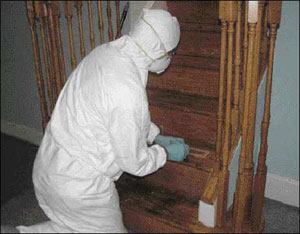
Mold work requires basic worker protections, including nitrile gloves, an N95 or N100 mask, safety glasses, shoe covers, and a Tyvek suit. If a remediation firm isn’t providing this level of protection for its crew, it may not be paying attention to other industry guidelines for safe mold removal.
Insurance companies are increasingly likely to deny claims against contractors who try to solve mold-related problems themselves, rather than calling in a specialist |
That job illustrates an important point: While the health effects of improper mold remediation are debatable, the financial liability isn’t. In fact, the Williamsburg builder was lucky not to have found himself on the receiving end of a lawsuit that his liability insurance wouldn’t cover. According to David Governo, a Boston lawyer who defends builders against construction defect and mold-related claims, insurance companies are increasingly likely to deny claims against contractors who try to solve mold-related problems themselves, rather than calling in a specialist. Mold remediation may include familiar processes like tearing out drywall, but insurers see it as equivalent to doing plumbing without a license. “If you haven’t done everything that the current state of the art [in mold remediation] calls for, you’re not complying with the standard of care in the industry,” he emphasizes.
That standard includes the ability to measure moisture in wall cavities and other inaccessible places, something few contractors have the equipment or know-how to do. It also includes precautions to protect workers: nitrile gloves, an N95 or N100 mask, safety glasses, shoe covers, and a Tyvek suit. If you don’t require the right protection and one of your workers files a workers’ comp claim, you could have big problems. The safest way to stay out of trouble, says Governo, is to subcontract all mold-related work to specialized companies.
Specialists include companies that test the house, dry the house, and remove or clean moldy materials. DeCapri advises builders to hire only mold professionals certified by the Indoor Air Quality Association (www.iaqa.org) who follow industry guidelines published by the Institute of Inspection, Cleaning and Restoration Certification. (The institute’s Web site, www.iicrc.org, lets you search for qualified contractors by city and state.) He also warns that a number of so-called remediators are doing restoration work without proper insurance, so be sure to ask for proof of coverage.
Testing, Testing
A qualified testing company can earn its keep by bringing some rationality to an often-emotional situation. “We talk with a lot of mothers who are terrified that their kids are going to die because there’s mold in the house,” says DeCapri. He blames it on media hype about “toxic mold.”
Ed Light, a certified industrial hygienist and president of Building Dynamics in Ashton, Md., agrees with DeCapri’s assessment. “There is a lot of misinformation and exaggeration concerning mold,” he notes. “Much of mold remediation that is going on is based on the idea that it is like asbestos or is toxic, but mold is normally present in all our environments. It’s not toxic and does not cause diseases. It is simply an allergen, and that is how we deal with it.”
On a significant mold job, the testing company will ask a hygienist like Light to write a testing protocol that takes the people who live in the house into account and outlines the conditions under which various types of tests should be done. A good protocol will minimize costs by specifying only the tests that are necessary. “There are a lot of specialized and highly priced experts who are generally not needed,” explains Light. “Issues with mold are pretty straightforward and so are the corrections. For instance, when something has been underwater for any length of time, it needs to be replaced.”
While black mold has been a rampant problem in post-Katrina New Orleans, it doesn’t take a Category 5 hurricane to cause a problem. The mold growth in a walkout basement of a $1 million home in Williamsburg, Va., was caused by wet-spray cellulose that was covered over too quickly.
Remediation Basics
That length of time is typically 48 hours, which is how long something has to stay wet before mold begins to grow. Because of this, drywall that has been soaked for two days or more will have to be torn out and discarded, as will other porous materials such as furnishings and carpet.
A research project led by Gina Solomon, a physician with the Natural Resources Defense Council (NRDC), showed what happens when these materials aren’t fully removed. Solomon led a team that sampled mold levels in homes across New Orleans in mid-October and then went back for follow-ups a month later. Indoor mold levels remained very high in homes that had been only partially cleaned. By contrast, homes that had been thoroughly cleaned, and where carpeting and drywall had been removed, had indoor mold levels comparable to mold levels outdoors.
The ability to accurately test for mold is an important reason to hire a specialist. Test procedures vary and must be specific to the site conditions. Not all tests are required in all situations. A remediator’s final report should outline every step taken, including details about measurement techniques, calibration procedures for the measurement tools, and control samples used to evaluate the severity of the problem.
Tear-out. If you want to minimize liability, don’t approach gutting a mold-infested home as normal demolition. What you can do depends, in part, on when you come onto the scene. Because it takes 48 hours for mold to appear, drywall that has been soaked for less than two days can probably be safely torn out, if done immediately. If it has been wet longer, consider hiring a professional remediator.
The proper way to do tear-outs and remediation includes using containment barriers and negative air pressurization techniques to keep mold from spreading to places where it wasn’t present before. Containment often means sealing the area that’s being torn out with plastic barriers. DeCapri says that most professionals use the ZipWall product (www.zipwall.com), a dust-barrier system that uses telescoping twist-locking poles and plastic sheeting. Negative pressurization is simply a blower that sucks air out of the room. The blower should have a HEPA filter to catch spores as they pass through, to keep them from spreading to other areas. Before tear-out, George Harrison of AirScrubbers sprays drywall with ShockWave, an EPA-registered ammonium chloride cleaner (available from Fiberlock Technologies (www.fiberlock.com) that helps prevent spores from becoming airborne.
Containment also protects occupants from airborne spores, so how tight the barrier needs to be will depend in part on the occupants’ sensitivities, according to Light. “Most of the time we look at site-specific circumstances. In cases where no occupants will be exposed and the area can be protected before their return, we may not suggest full containment.”
Mold removal. Once the drywall has been hauled away, any mold on the framing will have to be physically removed. Sometimes it has to be scraped off the surface, and doing this incorrectly can also send spores airborne, so the containment barrier and fans need to be in place during this part of the job as well.
Semiporous materials like wood studs are usually cleaned and sanitized with antimicrobials. Most people assume that bleach is an effective mold remover, but while it may work on countertops and other hard surfaces, it’s ineffective on porous materials such as wood or drywall. “We’ve already had one call from a lady whose contractors sprayed studs with bleach, and mold is now growing behind the drywall,” reports Michael Gurtler, president of Gurtler Bros. Consultants, a New Orleans remediation company. Instead, remediators use special cleaners, like Fiberlock Technologies’ AfterShock, to kill spores. Gurtler also coats wood framing with an antimicrobial sealant that dries to a plastic-like film, permanently trapping the spores in the wood (available from Foster Products, www.fosterproducts.com). He cautions that some contractors are using the right chemicals but not following the instructions from the manufacturer. “These products are very expensive, and some people try to spread them thin to save money,” he says. “But each manufacturer requires specific amounts of coverage, and if the sealant isn’t applied thickly enough, it will shrink as it dries, leaving gaps that allow microscopic mold spores to creep in.”
Drying. A house must be dried out before the walls are reinsulated and drywalled. If you want the job done quickly, you can’t beat “vortex drying.” This technique uses a series of blowers set up around the room’s perimeter, 10 to 14 feet apart, to move air in a counterclockwise direction. The moving air creates a low-pressure area, or vortex, in the center of the room, which sucks moisture from the circulating air — a miniature hurricane, in effect. The drying company sets up industrial-strength dehumidifiers in this low-pressure area to dry the air.
The standard of care for mold removal operations includes containing the work area using plastic barriers and depressurizing the area with large blowers — both techniques that will keep the mold from spreading to areas of the home where it was not previously a problem.
The principles of vortex drying are used in numerous systems but may be called by other names. Insurance companies may use the term “applied structural drying.” Other terms such as “top-down drying” and “in-place drying” are also used in the industry to refer to the vortex-drying principles. Rainbow International, a drying company based in Waco, Texas, prefers the term “rapid structural drying” to describe the system used by its franchises worldwide.
In tandem with blowers used to create low-pressure areas within a room or building cavity, Rainbow International applies concentrated air pressure (either positive or negative) using equipment that targets slow-drying areas — floors and subfloors, cabinet kickspaces, and other confined spaces — to minimize demolition. To train its crews to use this equipment, the company built a completely furnished 1,200-square-foot home that it repeatedly soaks with water. “We hose down sofas, walls, and floors. We actually wait until hardwood flooring edges start to curve up a little,” explains Rainbow International vice president Bruce Vogt. After this soaking, Vogt says the company can dry the house in a few days. Carpet is the first thing to dry; sill plates the last. “When we’re done, you can walk across the hardwood floor and not feel a ripple.”
One of the biggest mistakes made by contractors attempting to cure a mold problem is using a simple bleach to kill mold spores. Bleach is only effective on nonporous material like countertops and finished floors. Semiporous material, such as wood studs, are usually cleaned and sanitized with specialized antimicrobials.
To minimize demolition, Rainbow International employs equipment that applies concentrated air pressure to dry floors (above), cabinet kickspaces (left), and other confined spaces. This equipment is used in tandem with blowers arranged in the larger spaces that create a vortex, drawing moisture to low-pressure areas, where industrial-strength dehumidifiers rapidly dry the air. Post-remediation assessment. At the end of a job, the home must be tested to confirm successful remediation. A good remediation firm will not only perform these tests but will provide a final report outlining the results as well. This report should include documentation of all the steps taken throughout the remediation process, explaining details such as the measurement techniques the company used in sampling spore counts, calibration procedures for the measurement tools, and control sampling (measurements taken outside the home that provide a point of comparison for indoor samples). “I can’t stress how important this last step is,” notes Dante DeCapri. “It’s the assurance you have that the homeowner can safely move back home.” And if a problem does arise in the future, thorough documentation may be enough to send an attorney elsewhere to look for causes instead of pointing at your work. ~
Charles Wardell writes on construction topics from Vineyard Haven, Mass.