by Ted Cushman
In a coastal environment, house foundations need to be water tolerant as well as strong and stable. The classic poured-concrete slab-on-grade — a simple monolithic pour with nothing more than a thickened edge at the perimeter — is not enough where floodwaters from storm surge or rising water levels pose a threat. A coastal slab foundation often needs to be elevated above flood levels using a raised perimeter stem wall, or, in colder climates, it needs a deep frost wall. In either case, the construction is similar.
In the flood-prone Gulf region, an elevated home is a no-brainer. But damp conditions and termites are an everyday fact of life that can makes for one ugly crawlspace. The solution? Fill the crawlspace with drainable, compacted soils and cap it with a slab.
Good Fit for Florida
Ask building science consultant Joe Lstiburek why he likes slab foundations, and he’ll give you a simple answer: because they’re not crawlspaces. “The best crawlspace in the world,” says Lstiburek, “is one filled with concrete and called a slab.”
For northern climates, Lstiburek says, a raised wood floor system built on piers or a crawlspace foundation may be easier to insulate, especially if you’re after the affordable advanced insulation and air-tightness levels desired by the U.S. Department of Energy’s Building America program (www.eere.energy.gov/buildings/building_america). “Farther north, we go with the crawlspace, and we insulate underneath the floor with rigid insulation,” he says. But in South Florida the elevated slab foundation comes into its own — there, under-floor or perimeter insulation is inconsequential, while the method’s durability and flood tolerance are a major advantage.
“For an elevated slab,” Lstiburek explains, “you do a block foundation or a poured stem wall, you fill the whole thing with fill material, and then I like to put a topping slab, a cap slab, on the top — and that locks everything together.” (See Figure 1.) It’s typical in South Florida to build one-story houses and the first story of two-story houses using concrete masonry units (CMUs). “We put an inch-and-a-half seat in the perimeter of the cap slab, as a seat for the block wall,” says Lstiburek. “So we have our stem wall, then a cap slab, and then another block wall on top of the slab — and then we insulate on the inside of the block wall. I think that’s a real nice way of raising the slab.”
Figure 1. In Florida, where the first-floor living space is typically built with block, building scientist Joe Lstiburek recommends a seat formed into the perimeter of a raised slab. This detail functions as a kind of flashing that allows the water that will store up in the concrete block to drain to the exterior, rather than seep in over the first floor.
Not So Easy
Farther along the Gulf Coast, Louisiana building scientists are trying to introduce the elevated slab technique to builders facing the state’s massive post-Katrina rebuilding problem. Even before the storm, Louisiana State University’s extension program used an elevated slab as one of several foundation systems for the “LaHouse” building demonstration project on the LSU campus (Figure 2).
Figure 2. An L-block on the top course, which serves as a form for the cap slab, is a common detail for stem-wall slabs, but this specialty block may not be readily available in all markets. The moisture-barrier membrane must extend all the way across the stem wall — a detail that requires a liquid waterproofing applied by hand under the sill plate.
Elevation works. The building’s finish floor sits 3 feet above the site’s official Base Flood Elevation, or BFE, notes project director Claudette Reichel, Ph.D. “We recommend elevating every home in this area because it gives you the lowest flood insurance premium,” she explains. Base Flood Elevations are only a statistical estimate of the flood risk, and in levee-
protected areas (which includes much of southeastern Louisiana), flood projections rely on expected levee performance, not just on topography, climate, or historic flood records.
“In all of southeast Louisiana, the whole New Orleans area and beyond, once the levees were repaired and certified to supposedly withstand a Category 3 hurricane — well, that’s within the one percent probability. But if you get a stronger storm, or something goes wrong and a levee breaks or a pump system fails, you are going to flood way above that,” Reichel explains. While the biggest premium break comes at 2 feet above the BFE, the LSU program suggests a viable alternative is going one extra foot — and using flood-tolerant materials and methods even above that (see “Low Country Rx: Wet Floodproofing,” July/August 2006; www.coastalcontractor.net).
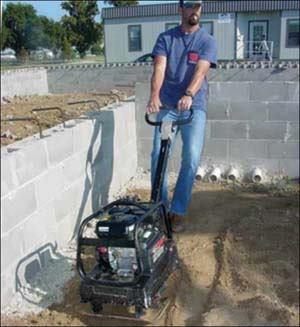
Practical details. Although elevating the slab has proved practical in Florida, says Reichel, translating any new method to tradition-minded Louisiana can involve complications. To begin with, labor in the masonry trade proves much more expensive in Louisiana than in Florida, so a block stem wall becomes a more costly option. Also, the design specified for LaHouse by a local engineer called for L-shaped “header blocks” as a top course for the stem wall. This course serves as a form for the slab, but the details hit a snag when it turned out that local masonry suppliers did not stock this specialty block. The builder adapted by manually cutting standard block out into the required shape (Figure 3), but that was a time-consuming work-around.
Figure 3. Lacking locally available L-blocks, a builder in Louisiana resorted to cutting standard-size blocks to create the slab form. While effective, this work-around increased the cost of completion.
Nevertheless, the LaHouse project serves to demonstrate some important principles for the Gulf region. Protection against ground moisture is key in wet, rainy Louisiana; for the LaHouse, a strong poly membrane was placed between the slab and the subgrade, and the top surfaces of the perimeter block wall were waterproofed by hand with a liquid waterproofing compound. Traditional practice in Louisiana, even for slabs placed directly on ground with no stem wall, has been to place poly beneath the slab area, says Reichel. But rarely does this moisture barrier extend beneath the thickened slab edge. Because moisture can wick along slabs from the edge and add to interior air moisture loads as well as stress flooring materials, a capillary break must be provided under the entire slab to keep the living space dry. Installing a capillary break and moisture barrier may be simpler with Lstiburek’s “cap slab” method than with header blocks, Reichel notes.
Termites are another serious issue in Louisiana, and the LaHouse program emphasizes a strategy of multiple lines of defense. All the cores in the perimeter block stem wall were filled to block the insects’ travel path (Figure 4). Besides traditional soil treatments, the LaHouse also uses mesh termite screens around pipe penetrations, and the entire framed structure uses borate-treated framing lumber.
Figure 4. In termite-infested locations, every core in any block wall should be fully grouted.
Will the elevated slab technique catch on in Louisiana? Despite local supply and labor hurdles, some Louisiana builders are already using the method, says Reichel. But even with the simpler Florida-style cap slab process favored by Lstiburek, she observes, the scarcity of masonry labor makes the stem-wall/slab combination a relatively high-cost option. “The higher-end homes favor that way to elevate,” she reports, but the more conventional, more economical pier-and-beam foundation system is more common. Very few stem-wall crawlspaces are being built, she reports, because with masonry labor, that is also more costly.
For now, at least, the elevated slab is one more chapter in the Gulf Coast’s long saga of recovery — a story in which there are many good ideas but no easy answers.
North-Coast Slabs
In the Northeast, slab foundations, in general, are much less common. But Massachusetts-based design/builder Andrew DiGiammo has been building slab-on-grade in this basement market for many years, when it fits. On a recent multifamily project of 12 one-story duplex homes, for example, he used slab foundations because it was economical.
“Even when you build a basement, you still have to pour a slab,” he notes. A slab-on-grade does double duty as foundation and first floor. Plus, the design brings the living space closer to the outside grade. “As soon as you go to a wood-framed floor deck on top of a foundation wall, you raise your floor at least another foot above grade,” DiGiammo points out. “Now you have to build stoops and stairs, and some of our older customers don’t like that — they don’t want to negotiate three steps to get inside. With a slab-on-grade, it’s one step and in — just enough to keep the snow out.”
Slab foundations also allow DiGiammo to avoid the risk of wet basements where water tables are high. “It’s one thing if we’re building someone’s $2 million dream home on a wet site; we’ll engineer a solution to keep the water out of the basement. The customer’s willing to pay for that,” says DiGiammo. “But when we do a whole set of duplexes or town homes, we don’t want to create 60 units with water in the basement — or come up with a $12,000 solution for each unit to keep the water out.”
Elevating the concept. Suitably sited, the slab-on-grade solution can also work well for homes in the Coastal A zone, where builders are required to place the first-floor living area above the base flood elevation for the site. “In the A zone, I often do a slab-on-grade only because you can’t have a living area or mechanical area below the base flood elevation,” says DiGiammo. “A full basement doesn’t have much value if the homeowners can’t use it.”
Figure 5. In cold climates where the risk of flood is not as great as the risk of frost heave, slab foundations require stem walls that extend below frost depth. Massachusetts-based design/builder Andy DiGiammo uses this detail where the budget and scale call for an affordable foundation. When the flood risk is high, the stem-wall height can be increased. But if the water table and flood risk are low, DiGiammo prefers to keep the slab near grade for accessibility.
In the relatively cold climate of Massachusetts and Rhode Island, foundations must rest below the frost line for stability, and insulating the slab perimeter is the trickiest part of the foundation design. “I’ve seen it with infrared photography,” says DiGiammo. “If you don’t create a thermal break at the edge of the slab, all your heat just screams for that spot.” DiGiammo’s preferred method is to create a base of compacted structural fill inside the poured-concrete frost wall, and install a mudsill made of four treated-wood 2×6 members directly on top of the wall. Then he installs 2 inches of rigid foam insulation on top of the gravel, and tacks 1 inch of the foam to the treated-wood sill to form the edge of the slab (Figure 5). “The foam serves as a thermal break, and it’s also our expansion joint,” he explains.
Contributing editor Ted Cushman has been covering construction business and technology since 1993.