by William Zoeller
Following the 2004 hurricane season, Florida-based Mercedes Homes set out to design and build a truly hurricane-resistant home. But as researchers and builders have come to understand only too well, a home that provides complete protection from an intense tropical storm must offer not just superior structural strength but also afford both greater resistance to wind-driven rain and improved post-storm recovery.
Early Efforts
The prototype to this hurricane-resistant home began in 2000, when Mercedes Homes started working with Building America research teams to develop an advanced wall system to replace the concrete masonry unit (CMU) construction typically used in Florida. After experimenting with a variety of test systems, including two different types of precast concrete wall systems, Mercedes Homes selected a cast-in-place concrete wall system, which it dubbed the Solid Wall System (SWS), and began providing it as a standard offering on its homes in Central Florida.
Beginning in 2001, with funding provided by the Federal Emergency Management Agency (FEMA), the Mercedes concrete wall system was rigorously examined and engineered for hurricane resistance by researchers from University of Florida’s Program for Resource Efficient Communities and Steven Winter Associates, Inc. Engineering analysis of this initial wall system showed a potential for marked improvements in structural integrity over a CMU wall. However, the 2004 hurricane season provided a different lesson about hurricane protection: after a record number of tropical storms pounded Florida and the Southeast, the majority of damage to buildings was not so much structural failure but damage from wind-driven rain intrusion. In order to be truly hurricane resistant, the new wall system would have to provide not only enhanced wind-load protection but also significantly reduced incidence of water intrusion.
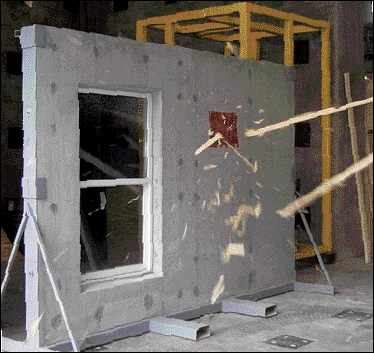
The 2×4 used in the “large missile test,” which has become the standard measure for impact resistance, completely shatters upon impact with solid concrete, causing no damage whatsoever to the advanced wall system developed by Mercedes Homes and the Department of Energy’s Building America program.
Structural Protection
In much of Florida, the typical single-family home is built with CMU walls. Although stronger and more durable than standard frame construction when subjected to a tropical storm, these homes are still susceptible to lateral and uplift wind-load failures as well as to penetration damage caused by wind-blown debris (“missiles”). The Mercedes SWS cast-in-place concrete wall developed with the help of the Building America program performs better than a CMU wall (and monumentally better than a wood-framed wall) at resisting these forces (Figure 1).
Figure 1. Windows that meet the ASTM E 1886 and ASTM E 1996 impact standards shatter but do not present an opening that will either pressurize the interior or allow undue amounts of water into the home (above). However, most conventional wall systems do not fare as well under the same test. A typical vinyl-sided wood-frame wall is obliterated by the large missile test (bottom left). A concrete block wall performs a bit better but still allows a sizable hole for wind and water to penetrate (bottom right).
The science of SWS. The SWS system uses 3,500-psi concrete placed in modular aluminum forms to create its 6-inch walls. The concrete encloses a steel reinforcing cage of 6x6x1/8-inch “road mesh” combined with vertical 5/8-inch reinforcing bars placed at 4-foot intervals (Figure 2).
Figure 2. The heart of the Solid Wall System (SWS) is a steel reinforcing cage of 6x6x1/8-inch “road mesh” combined with vertical 5/8-inch reinforcing bars placed at 4-foot intervals (above). The cage is specifically designed to evenly distribute lateral wind loads and minimize point stresses imposed by missile impacts, which can lead to failure. The steel cage also connects to steel in the footings. Wet-set tiedowns (hurricane straps) are embedded every 2 feet in the concrete as the walls are poured, providing a continuous path to resist uplift.
This steel-reinforced concrete wall assembly acts as a monolithic composite system with superior resistance to hurricane-induced forces. When a point impact load or a sustained lateral load is imposed against the wall surface, the composite system acts to spread the forces through the system, thereby reducing the “stress” — and the potential for failure. The concrete (strong in compression, but not in tension) and the steel mesh (strong in tension, but not in compression) work in tandem, creating a wall assembly that is strong in both tension and compression.
Typical wind speeds for a Category 5 tropical storm range up to 155 mph, with wind-borne debris traveling well upward of 100 mph. Engineering analysis shows that the cast-in-place system can withstand missiles fired up to 200 mph. Uplift forces are also more efficiently resolved with SWS walls. In typical CMU construction, the upper course of block masonry is usually a grout-filled “bond beam” into which the roof truss tiedowns are set. Failure of this system can occur when the uplift wind forces exceed the limits of the bond-beam structural connections, which are most often solid-grouted CMU cores with rebars at every 4 feet on-center. Because the uplift load is resistant on a CMU wall at concentrated points, the potential for failure is greater than for the SWS walls. As with the impact-load resistance, the SWS walls effectively “spread” the applied forces, reducing opportunities for failure.
Other performance improvements. Structural strength is not the only benefit of the cast-in-place system. Concrete walls have high thermal mass, reducing energy transfer between interior and exterior surfaces and reducing homeowners’ energy bills. The continuously poured system minimizes interior temperature fluctuations and drafts, and it also reduces noise transmission. Concrete inherently resists mold, termites, and rot because it contains no organic mater. The moisture that can enter CMU walls at joints, especially when deformed by structural loads, is eliminated in the monolithic system, as is the potential for flood water storage within the hollow CMU cavities. Additionally, the houses are safe from more than just hurricane disasters: the SWS structure, with its 6-inch solid concrete walls, offers up to a three-hour Class-A fire rating, making the home safer from wildfires.
Wind-Driven Rain Protection
In addition to some structural vulnerability, the CMU walls typically found in much of Florida are also susceptible to water intrusion when subjected to a tropical storm. The Building America team focused on improving the resistance to water intrusion through the SWS in a number of vulnerable points.
Ground-level intrusions. In the aftermath of the 2004 storm season, researchers found that high-wind forces on in-swing entry doors can allow water to enter the home in significant quantities because the weather-stripping gaskets rely on pressure in the opposite direction. Complete blow-in failure of an in-swing door during hurricane-force winds can result in significant water damage and even changes in internal pressure that contribute to roof uplift and structural damage. Following Hurricane Wilma in October 2005, Mercedes found that owners who had opted for in-swing doors (rather than the now-standard out-swing configuration) suffered more instances of damage.
Ground-level water intrusion can be mitigated by creating shallow indentations or recessed seats in the foundation slab to prevent rain from being driven or sucked into the home under the exterior doors and walls (Figure 3). The recessed seats work well in conjunction with out-swing entry doors — a somewhat unconventional but practical solution to a common source of damage. For additional protection for openings, the builder also offers removable hurricane shutters as an option to all home buyers.
Figure 3. During the 2004 hurricanes, wind-driven rain and excessive ground-level runoff leaked under exterior doors and through the cold joint at the base of CMU walls. Mercedes Homes solved these issues during slab forming: A recess formed in the slab, in conjunction with out-swing doors, limits water intrusion beneath doors (top). At the perimeter of the slab, a recessed step provides a key for the poured walls that effectively cuts off a direct pathway for ground-level water (bottom).
Sealing walls. Although concrete is poured continuously across multiple forms, the change in texture at vertical form joints and tie connections creates a vulnerability to water infiltration. To eliminate this potential pathway for water intrusion, the exterior wall surfaces of the Mercedes SWS are protected with elastomeric sealant at form joints and at the concrete form snap-tie locations (Figure 4).
Figure 4. Form joints and snap ties are possible water entry points for wind-driven moisture. Applying sealant to these potential pathways is a simple, effective way to prevent water damage to the interior.
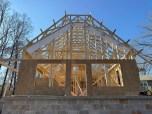
A continuous drainage plane covers roof trusses on gable ends to prevent sheeting water from entering the building assembly at the truss-to-wall transition. In addition to the typical housewrap layer over the vertical wall sheathing, a separate building-paper-backed wire mesh is installed over the housewrap prior to the synthetic stucco finish. Without this added layer, moisture penetrating the stucco can seep right through a single layer of housewrap. The extra layer provides a foolproof drainage plane and allows for proper stucco adhesion.
Finally, SWS wall surfaces are finished with a high-performance acrylic coating capable of flexure and bridging small gaps to prevent the exterior walls from absorbing water during sustained heavy rainstorms.
Roof protection. At the roof level, researchers recommended several strategies to protect against water intrusion. In Mercedes houses, a peel-and-stick underlayment product adhers directly to the roof decking beneath the shingles to create a secondary roof drainage plane. This provides backup protection in the case of lost or damaged shingles — a common casualty of tropical storms.
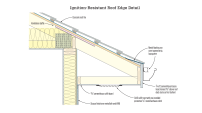
In another frequent envelope failure, water sheeting off the roof spills down the fascia board and is driven by wind or surface tension into the soffit vent openings. To alleviate this mode of water entry, a redesigned fascia extends an inch below the soffit to form a drip edge, directing water down and away. A perforated soffit panel by Alcoa (www.alcoa.com), with recessed rather than surface openings, limits water intrusion while encouraging greater air circulation and faster drying within the eaves assembly (Figure 5). A simple change to baffled ridge and roof vents is also used to mitigate a common, and often significant, water-entry mechanism.
Figure 5. The perforations in Alcoa Hidden Vent are recessed in the panel grooves. The manufacturer claims this design provides plenty of ventilation airflow, but when combined with a fascia that extends a full inch below the soffit, the potential for water sheeting off the roof and getting driven by wind or surface tension into the vent openings is greatly reduced as well.
Post-Storm Recovery
Most of the losses from the 2004 hurricane season resulted from water intrusion, and mold played a significant role. Mold can grow undetected within the home for long periods of time, compromising indoor air quality and causing significant long-term damage to the home. When power outages prevent homeowners from drying out their homes quickly following a storm, water damage and mold growth become severe.
Backup power as a means of mold mitigation. To aid in post-storm recovery, Mercedes Homes offers a natural gas-fueled generator as an option to home buyers throughout the Florida market. The unit allows homeowners to use shop-vacs, fans, and dryers during post-storm recovery, when power outages are common, thereby greatly reducing the risk of mold growth and long-term damage.
Mercedes Homes also offers a generator-ready electrical service panel that can be easily connected to a portable generator. Even if a homeowner is initially unable to afford the upfront cost of a natural gas generator, each home will be prewired and equipped for a generator to be installed at a later date, or as needed (see “Blackout Power Solutions,” September/October 2007; available at www.coastalcontractor.net).
Companion strategy. Removing damaged drywall, and the mold it supports, was one of the most common storm-related repairs faced by homeowners following the 2004 hurricanes. To help remove the risk of mold, which grows particularly quickly on paper, adhesives, and other organic matter, Mercedes Homes uses non-organic finish materials. These storm-resistant homes use a new paperless drywall product offered by Georgia Pacific that has a glass reinforcing mat facing over a gypsum core, which resists mold growth better than traditional paper-faced products.
Concrete Results
The concrete SWS homes are now a standard product for several Mercedes Homes divisions in Central Florida. Although incrementally more expensive than the CMU construction it replaces, the benefits of the concrete construction to homeowners and to the builder (production time for the walls are reduced to two days from five) easily outweigh the costs. The now-standard water-intrusion and storm-recovery measures add about $2,200 to the cost of the homes, and the upgrade options (generator and shutters) add another $8,000. Of the 343 new homes built using the improved specifications between June and October 2005, only 16 reported any damage (all minor) following a near direct-hit from Hurricane Wilma in October 2005 (the last significant hurricane to hit the region, as of this writing). With ongoing improvements, Mercedes expects to see even less damage, and many more happy homeowners, in the future.
William Zoelleris an architect and senior associate with Steven Winter Associates, Inc., of Norwalk, Conn. Photos courtesy of Steven Winter Associates.