by Ted Cushman
High-end homes in prime locations often boast the best in exterior woodwork, including costly entry doors of oak, mahogany, teak, or even cherry. And that means potential trouble. Entry doors on a coastal home stand directly in harm’s way, sandwiched between the indoor and outdoor climates and often facing blazing sun, soaking rain, and drying wind.
One solution is to protect the entry door with durable solid-color paint. “I’ve worked on 200-year-old exterior doors and shutters whose wood was as fresh as new,” says veteran contractor Greg Sullivan of Marion, Mass., whose career has included high-end architectural woodwork and finishing as well as commercial and residential building and remodeling.
New Jersey door-finishing specialist Dave Anderson notes, “I sometimes mention paint to people.” Anderson finishes or refinishes about 70 top-end entry doors a year, many of them on multimillion-dollar houses facing the rivers, bays, and beaches near New York City. But Anderson finds that his clientele is not very interested in the paint option: “If they’re spending $25,000 on a custom-built mahogany door,” he observes, “they don’t want to hear about that.”
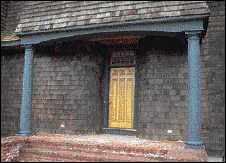
Another commonsense idea is to shelter the door under a broad overhang or portico (Figure 1). “I have one customer who owns a gigantic, 15,000-square-foot, house, with zero overhangs over a 25-foot door unit,” explains Anderson. “I’ve done his door two or three times already. Now he is going to build a big portico over it. Wood can be finished only so many times before all the cells on the surface are shot — at least as far as making finish adhere to them.”
Figure 1. Clear finishes last longer when sheltered from direct sun, as in the entry to this Rhode Island home by architect/builder Andrew DiGiammo. The more exposed wood trim has been painted on this house, and wood shingles have received an opaque stain.
If customers don’t want to hear about either paint or shelter, however, they are going to have to hear about maintenance and refinishing. Clear or translucent finishes need continual reapplication, because they don’t have anywhere near the durability, or the protective power, of paint. The same transparency that lets you see the beautiful wood grain also lets damaging rays of sunlight reach the wood — a factor far more damaging than wind or rain.
Solar Bombardment
Even through clouds, the sun is like a machine gunner taking all-day target practice on a house, showering the exterior with tiny ultraviolet (UV) bullets. And there’s only so much ultraviolet radiation that either wood or finishes can take. Photons of UV shatter the electrical bonds that hold molecules together and energize the remaining atoms to react with nearby materials or with oxygen from the air. The results: faded colors, torn and bleached wood fiber, and brittle, broken-down film coatings (Figure 2). Coatings may erode, split, crack, yellow, peel, buckle, bubble, or curl; what they won’t do is last.
Figure 2. At right, two doors on opposite sides of the same street show the effects of different solar exposures. The two-part polyurethane clear coat on a mahogany door on the sunny side of the street (left) is beginning to whiten and crack after just two years in the sun and will soon need to be stripped and reapplied. The same finish on a white oak door on the shady side of the street (right) is still going strong after five years in place. “Wind and rain don’t have that much to do with finish performance,” explains finisher Dave Anderson. “It’s mainly the sun.” However, once the finish begins to fail, water damage to the underlying wood becomes a risk, adding urgency to the need to refinish.
“I paint a doom-and-gloom picture for my customers because whoever sold them the door probably didn’t,” says Dave Anderson. “I tell them, ‘You put clear finish on wood outside, and you are going to have to maintain it. And that will be expensive and very time-consuming.’ “
Blocking UV
UV blocking turns out to be difficult because the coating has to defend not just the wood but also itself from the sun’s bombardment. Most formulas contain finely ground metallic compounds, such as titanium dioxide (TiO2) and iron oxides called “trans-oxides.” These tiny flakes are mostly transparent to visible light but reflective to the shorter-wave ultraviolet. They aren’t 100% transparent, however, so the more you apply, the more the wood grain is obscured.
In addition, there are UV-absorbing compounds — typically organic (carbon-based) molecules — that soak up the UV and release it as heat. Those are included in formulas to protect the coatings themselves as well as the wood beneath.
Neither the reflective nor the absorptive UV protectant is 100% effective. The absorbers eventually wear out and break down. The reflectors let enough UV through that the wood will ultimately get a sunburn. And while a heavy dose of UV protectant is the key to an effective coating, there’s no way to load up a coating with enough to provide perfect protection and still see the natural wood. “If you put enough material in to totally protect the wood, you’ve got paint,” explains Greg Sullivan.
A finisher applies a two-part (“2K”) clear polyurethane to a white oak entry door at the Jeld-Wen door factory (above). Door-finishing specialist Dave Anderson (left) touches up the edge of a distressed alder door from International Wood Products (a Jeld-Wen division) in his finishing shop after changing the handing on the door. Anderson says that whether factory-applied or field-applied, 2K urethanes are very tough when new but strip easily with paint stripper after several years of exposure to the sun. He expects a urethane finish to last anywhere from two to seven years without maintenance, depending on solar exposure, before the door needs to be completely stripped and refinished.
Paint chemist Steve Smith points to another helpful additive: “antioxidant” chemicals that help keep molecules from reacting with oxygen when they’re hit with UV photons. These additives can protect a urethane coating in much the same way that antioxidant vitamin E helps protect human skin, says Smith. But he notes that coatings that cure by oxidation, such as spar varnishes, can’t use antioxidants in the formula, because they inhibit the curing of the film.
Unfortunately, it’s hard to know how much UV blocker you’re buying in each can of finish. The type and quantity of UV blockers in a coating formula is the one secret that manufacturers guard most jealously. “I’m told that if they put one drop of UV inhibitor in the formula, they can label it as a UV-inhibiting coating,” says Dave Anderson. “But it takes a lot more than a drop to have any real effect.”
Steve Smith points out that the coverage of a given finish is typically what determines whether you’ve put enough blocker between the sun and the wood. Smith provides clear instructions specifying the volume of liquid to use for a given application. This way, he knows how much UV blocker will be sitting on each square foot of exposed surface. When you use a coating that doesn’t come with similar instructions, it may take some trial and error to develop a feel for how many coats are needed.
UV blockers and solid film-forming ingredients are the high-cost ingredients in a clear exterior finish. The better the quality and higher the concentration of those components, the better the finish will perform — and the more you’ll pay for it.
Clear-Coat Options
When evaluating a clear finish, the most important question is this: How well will it stop UV? To evaluate a product, the experience of boatbuilders proves much broader than that of home builders. Here’s a quick look at the top choices from the perspective of woodworkers with extensive marine experience:
Spar varnish. The traditional favorite is the yachtsman’s old standby, marine-grade spar varnish, made from a base of natural oils. (Tung oil, a nut oil from Asia, is typical, but linseed oil, soy oils, and other natural oils are also used.) The oil is chemically modified to form “alkyd” molecules and is mixed with metallic catalysts to speed drying (unmodified linseed oil, an old-fashioned boat finish, can take forever to dry). The alkyd films cure by reacting with oxygen from the air as well as by evaporation of solvents and thinners in the formula. The best spar varnishes have high concentrations of “long oil,” which forms long, flexible chains in the cured film. They also have heavy loadings of UV-blocking chemicals.
Boatbuilder Doug Randolph-Foster says he’s tried every finish out there, but he still prefers traditional spar varnish (Figure 3), despite the fact that it requires a laborious, painstaking application. He starts with a careful sanding that includes a final hand-sanding with 220-grit paper. He then wet-sands the wood using tung oil, linseed oil, or an Epifanes flow-enhancer called Easy-Flow, working the sawdusty slurry into the wood grain. Then he wipes it off with a clear rag and leaves the wood to dry overnight. Next comes a seal coat of Epifanes varnish thinned 50% with Epifanes thinner, let to dry, and sanded again with 220- or 320-grit paper. Finally, it’s time to brush on full-strength coats of varnish — as many as 10 of them, sanded between coats. Full-strength, the Epifanes varnish is thicker than most brands, says Randolph-Foster — “not necessarily harder to flow out, but different. Some guys hate it. I love it, and I hate everything else.”
The reason boat owners love spar varnish is shown above: a deep, rich, clear coat that repels water and reveals all the beauty of the wood. A finish like this takes 10 to 12 coats, however, and needs continual attention to maintain its good looks. Without a yearly sanding and refreshing, varnish fails by yellowing and peeling (left). When that happens, it’s time for sanding back to bare wood and starting over. Two-part polyurethane. The modern alternative to spar varnish is two-component (“2K”) polyurethane, a plastic that can be derived, like spar varnish, from natural oils but is often synthesized from petrochemicals. Two-part urethanes cure through reactions involving ingredients in the formula rather than by reacting with air. However, they also release evaporating solvents as well as volatile reaction products.
There are water-based polyurethanes that don’t release volatile organic compound (VOC) solvents, but they don’t have much of a track record on exteriors. Door-finishing specialist Dave Anderson notes, “I have tested a lot of water-based exterior urethanes, and I haven’t seen one last at all, so far.” Stricter regulations may yet force the use of water-based finishes; “That’s when I’ll retire,” says Anderson.
According to Anderson, 2K urethanes are “a nightmare” to strip when fresh, in case of a mistake, but they easily come off with paint thinner and a putty knife after several years of direct exposure to sun.
Cetol. Then there are the advanced and somewhat mysterious offerings of modern chemistry. Popular among both boat owners and land-locked wood finishers is Cetol, an advanced system from Sikkens (widely available from professional paint stores; a good online source is www.jamestowndistributors.com). Greg Sullivan prefers the Cetol system because of its relatively low-build film, which is easily rejuvenated on site without major stripping. The topcoat dusts off gradually but can be renewed with light sanding, followed by reapplication with a brush.
The Sikkens Cetol system includes a primer/sealer base coat and a selection of clear and lightly pigmented topcoats. The formulas are a trade secret, but the coatings have a lot in common with better-known recipes — the base coat seems to behave somewhat like a penetrating epoxy, finishers say, while the renewable topcoat acts a lot like a modified oil-based alkyd spar varnish. An orangish cast in the Cetol topcoats seems to suggest some sort of iron oxide-based UV blocker. But as Steve Smith, the owner of rival (and much smaller) California-based coating maker Smith and Co. (800-234-0330; www.smithandcompany.org), notes, no coating maker will gladly divulge what’s really inside the can — or in what proportions. “We paint chemists have our secrets,” says Smith.
Clear epoxy. Smith is the developer, 30 years ago, of one version of another popular coating option: clear epoxy. Smith and Co.’s Clear Epoxy Penetrating Sealer or CEPS (also marketed as MultiPrimer), has a die-hard following among boat owners who use it as a base for multiple topcoats of conventional spar varnish. (Five Year Clear, a recently introduced two-part polyurethane from Smith and Co., has yet to develop the same fan base, but it has performed well in boating magazine comparison tests, and Smith claims some owners have gotten as much as 10 years out of it.) MultiPrimer is almost as thin as water, and Smith says it penetrates wood more deeply than typical thicker epoxy coatings. But some boat owners still stick with a thicker epoxy such as Gougeon Brothers’ West System (866-937-8797; www.westsystem.com), sometimes using added thinner to aid flow and penetration.
Best of both worlds. “The epoxy base, with traditional spar varnish on top of it, is almost the best of both worlds,” says Doug Randolph-Foster. “The epoxy will essentially last forever as long as you keep a good UV-inhibiting varnish on top of it.” ~
Ted Cushman reports on the building industry from his base in Great Barrington, Mass.