
Jim Gialamas
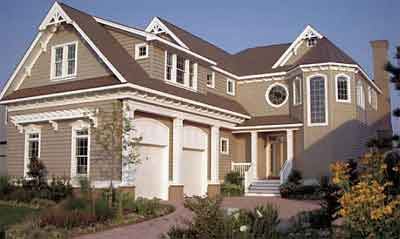
A $3.5-million beachfront home in Longport, N.J., exemplifies the work of Haffelfinger & Standeven Construction, which has made elegant, durable exteriors a prime selling feature of its homes.
The partnership of Haffelfinger & Standeven Construction has been in the business of building large single-family beach houses, duplexes, and commercial properties in the Ocean City, N.J., area for the past 12 years. In the midst of a busy summer season that includes construction of four custom singles, two duplexes, two commercial properties, and a 149-unit “55 and over” age-qualified community, Anthony “Smokey” Saduk recently took time to discuss the New Jersey shore market, his business, and how a background in exterior siding and trim turned into a valuable business relationship.
As on the exterior, so in the interior. Precision detail and elegant woodwork are the hallmarks that win the company its referrals.
HOW BIG IS THE PARTNERSHIP RIGHT NOW?
We’re somewhere between a $3 million to $4 million company. We usually have at least six projects running at once, but these jobs take a while. Last year we only did two really big customs. One we owned as a spec project, so for five months a lot of our effort went into that one house. The permitting process has a huge impact on how many projects we can do each year. They’re really trying to slow it down at the state and local levels because expansion has been so great. Around here, you can be held up for four or five weeks on the permitting end for no reason.
WHO ARE YOUR MAIN CLIENTS?
Everyone from lawyers in their 30s to retired stockbrokers. Most of what we do is for second-home use. We do 40% end-user, about 60% speculative. Once a year, we’ll do a big rehab job, upward of $300,000.
DO YOU GET THE BULK OF YOUR WORK ON REFERRAL?
Probably half. If end-users or developers come in, the real estate agent will put them in contact with us. During the bidding process, we’ll walk customers through houses that are in different stages of construction, from rough to finish. Basically, we’ll take them through the entire building process, so they can see every stage for themselves.
HOW MANY CREWS DO YOU WORK WITH?
We have eleven full-time employees, essentially broken down into three crews. The makeup of those crews depends on the type of work we have at any given time. In effect, we have two framing crews and what we call a “pickup crew.” Pickup includes anything technical with framing — packing for exterior cornices or windows, prep out for interior stairs, the frame for an interior shower, special soffits, columns — that kind of work. But our lead framers are great at the siding and interior trim work as well. So as a job progresses, we may move a lead over to the exterior and the interior work, as needed, and give him the laborers that can handle that work.
Typically, we like to have a job getting framed at the same time that one is being finished, and other jobs may fall somewhere between, at all stages, so we can move the people around where we need them. That becomes a goal in how we schedule the work.
HOW DO YOU GET YOUR CREWS UP TO SPEED?
Normally, we start new employees out with the framing crew. After they do so many houses, we’ll move them over to exteriors and eventually to the interior work.
We want them to learn it all. Once they’ve proved they can handle some framing, I usually pull them in with me and stay with them throughout an entire house, sometimes more, until they’re capable of working on their own.
I’ll generally lay out everything, either on paper or directly on the building. I make it clear what we’re getting to in the end. For example, all the recessed lights would be exactly centered; ceiling fans, ductwork, grilles, and cabinet lights should align with the interior spaces. The soffit should be consistent with the door trim and window trim. The framing and the interior and exterior details all relate. Eventually, we want our guys to understand this and be well versed in every part of the job. That’s a big part of what distinguishes a custom home from a production home. In custom work, everything is geared to the exact finish from the very start.
Attention to fine carpentry runs through the entire house, including the kitchen, where a classical cabinet design sets a traditional tone for a modern kitchen.
YOUR BACKGROUND IS FIELD PRODUCTION?
When I first started in business for myself, I was a contractor/builder — mostly framing and siding. I have lot of site-work background. My grandfather and father were both builders. Before my dad semiretired, I was general contracting with him. I’ve been on my own for 10 years.
HOW DID YOU DECIDE TO JOIN THE PARTNERSHIP?
John Haffelfinger and Bob Standeven have been partners for about 12 years. John focuses primarily on the operations and sales, and Bob is in the field, managing production.
I was a subcontractor for these guys for five or six years, starting with interior trim and tile setting, then taking on framing and exterior work. I was taking on more and more work with them, and eventually most of my subcontractor work was with them. I liked what they were doing and where they were going. So joining them as a second field manager was easy.
Financially, it made sense. Obviously, when I was independent, I had my own insurance, my own workers’ comp. I would have to charge for all those expenses. John and Bob were required to have the same insurance and workers’ comp, too. I’m sure you’re aware that New Jersey has some of the highest insurance rates in the country. And they’re really not subcontractor friendly — the premiums are huge. So two years ago, I joined their team full time. I basically shut down my business and went directly to work for them.
With more field management, the company has been able to take on more work. And we’ve been able to keep costs down, not only by reducing the insurance overhead but also by sharing labor. By now I’ve been working with Bob so long, we’ve learned each other’s systems, and we try to optimize each stage of the job for the next crew that comes in. We might both work on the same projects but in different ways. Who takes what just depends on the logistics of a particular job.
EXTERIORS ARE STILL A BIG PART OF YOUR BUSINESS?
Yes, we’ve made exteriors a large part of the business. On some of our houses, the exterior alone may be $80,000 or more. We’re able to offer a durable exterior — something that can hold up to the constant wetting and drying, the salt, the sun — without sacrificing detail or compromising the look.
Five or six years ago, everything had to be cedar to get fine detail. That’s when I started experimenting with different trim boards. With the cellular PVC, like Azek, we were able to do things like fluted columns or 3/4-inch beads on fascias — details that we couldn’t do with other composites. I like to do full window surrounds, a lot of arches, circle windows, arched walk-through openings in cabanas, porticoes; anything that would have been constructed in cedar that had a lot detail, any overlay and cornice work, we can now do in some type of composite or vinyl. We also use Fypon foam moldings, fiberglass columns, vinyl railings, decking, and siding — all materials that can hold up in the constant damp and high humidity. And they will hold paint longer, if they need to be painted at all.
IT SOUNDS LIKE YOU’RE ALWAYS LOOKING AT WHAT DIFFERENT MANUFACTURERS HAVE TO OFFER.
I do a lot of research. Lately, I’ve been using the new Jeld-Wen solid-core composite doors instead of a true pine solid door. In the custom market, everyone wants a solid-core panel door, but in this climate, pine tends to warp. The Jeld-Wen composites are more stable in the humidity. They have the feel and weight of a solid door, but they’re actually honeycombed material so they won’t warp or bend.
We also own a separate business that does Rhino Lining, the material you use to rubberize a truck bed. We use it for decks and shower stalls. We own a machine that sprays it on. Instead of using fiberglass for a shore house deck, we’ve been using this rubber product that leaves a 1/4-inch solid rubber shell on regular plywood. You end up with a permanent rubberized finish. By comparison, fiberglass is temperamental: For one, it loses its texture in two to three years, and for another, after about five or six years, it cracks or the gel coat will come loose.
All of our interior showers are encased with this rubber spray, too. Instead of using tar paper or backerboard, we’ll plywood the interior shower, then totally encapsulate it in rubber. You can texture it, as well, so it will hold the tile mastic.
WHAT ADVICE WOULD YOU GIVE OTHER CONTRACTORS WHO WOULD LIKE TO EXPAND THEIR BUSINESSES?
Just stick it out with the time and money. We went through a lot of pains figuring out what works and what doesn’t work. When I started out on exteriors, I sacrificed more profit because everything was brand-new. I had to stay competitive with guys who were wrapping fascias in coil stock in order to grow a market for the PVC. Now it’s getting very popular, but three or four years ago, it was brand-new and I was eating a lot of that expense in order to grow the business. Eventually, it became profitable. There is a growing number of siders and contractors who are using it now, but only a few of us taking it to the extent of a full exterior trim package.
HOW HAS THIS REAL ESTATE MARKET AFFECTED YOUR BUSINESS?
From a developer’s standpoint, the margins got a lot slimmer because now the ground prices are so high. We have to build more of a house to justify the sale price. Seven or eight years ago, it was “build as many as you can, as fast as you can.” You were still providing a good product, but there was that definite financial cutoff: If you built a duplex, the most you would be able to get would be $300,000 per floor. Now our average duplex floor sells for $1.5 and $2.2 million. With a sale price at that level, obviously the interiors have to be up three or four notches. That means that even if we’re not using a totally clear oak trim, all the joints have to be immaculate, all the reveals are perfect, even the paint has to be perfect. Everything down to the carpet is planned out ahead of time. The craftsmanship has to be there. ~
All photos by Anthony Saduk.


