by Clayton DeKorne
Working in and around Wrightsville Beach, N.C., a good number of the projects that D.P. Thomas Construction complete each year are on or near the water — whether it’s the beach, tidal saltwater creeks, or the Cape Fear River. Projects range in cost from $150K to well past the million-dollar mark, but owner Dave Thomas likes to continue to service past clients and friends, so he’s not at all adverse to the smaller jobs. Above all, Thomas looks to creating a good business relationship. If the chemistry is right, says Thomas, the price doesn’t matter so much.
I dropped in by phone to ask Dave how he’s grown his business from a small remodeling firm in the 1970s to become a local authority on the restoration of North Carolina’s architectural history. He explains how historic preservation work can complicate a project. But he’s learned that the rewards, both in the end product and in the market, are substantial.
WHO ARE YOUR CLIENTS, AND HOW DO YOU DEFINE THE TYPE OF WORK YOU DO?
We serve investors, CEOs, engineers, sales executives, and physicians as well as people who have retired from these fields. All our clients seem to have one thing in common: they appreciate and demand quality. In remodeling, it’s not enough just to have quality workmanship by the crew and the subcontractors. There must also be quality in the communication, in attitude and manners, in delivery on schedule, in responsiveness to questions and complaints, and in understanding a client’s special needs. In remodeling, it is especially important to minimize the impact on the family and to fit in to clients’ lives as much as possible.
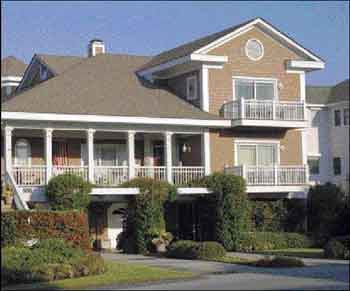
Face-lift. D.P. Thomas Construction completely removed the failing EIFS exterior on what was once a modern stucco home overlooking the water. The transformation involved the modification of all the exterior woodwork, including columns and balustrades.
Historical restorations, remodeling, and additions have been our trademark for success. But we have built five custom homes on or near the water — three of which look like historic homes, while the other two are more modern. Currently, we’re developing a plan for another waterfront home.
HOW IS A HISTORIC RESTORATION DIFFERENT THAN A CONVENTIONAL REMODEL?
The equipment, the skill level and creative thinking of carpenters, and the ability to communicate well are very important and demand greater attention than is common in most remodeling or new construction. There must be a great deal of trust developed with the client, as unknowns are the norm and costs continually escalate. A versatile engineer is also an important part of the team. Along with this you must have an eye for the various elements that make up the home’s style.
As you know, the focus on historic work is to keep with a particular period of traditional, or historic, architecture. But it’s more than just reproducing a period style. Often, the historic planners want anything new that is added onto a historic home to be readily discernible, so that architects, historians, and preservationists trying to document the history of the house will see fine differences that let them know it wasn’t all done at once. If an existing home has 2×6 window casing on the exterior with a special back band added on to it, for example, we might take a half inch off of that casing, or a half inch off of the reveal on the back band. We’d alter it subtly so it’s in keeping with the building. But a real technician who was evaluating the house would readily see that this was done at a later time.
HOW DO YOU CERTIFY HISTORIC PROJECTS?
The paperwork and number of hoops you need to jump through to certify historic projects are not to be taken lightly. In our area, if you do work in the historic district, you have to process that certificate before you can pull your building permit. It’s critical that we have good rapport with local and state historic preservation offices. For small things — adding a storm door, for instance — we might be able to just show a sketch of what we’re doing, and we can get an administrative bypass from the chief historic planning officer. But if it’s a significant exterior change, then we’ve got to go before the full board.
The board meets once a month, so at least 60 days ahead of time it’s necessary to send copies of the plans and the scope of work you propose to the historic planning commission as well as provide stamped, addressed envelopes for each adjoining neighbor. The commission will use these envelopes to send out notices to the neighbors, letting them know that you plan significant changes to a home and that they can attend a public hearing and voice their objections. The planning office will then send someone out to evaluate the project, and they’ll make a presentation to the historic planning commission, which will vote on whether or not to give you that certificate of appropriateness. So on a local level, it’s critical to have rapport with the office and commission. I’ve seen them get quite heated.
The state office is where you file for tax credits. These credits are so important today for revitalizing our cities. If the property will be rented out, the owner gets a 30% credit taken directly off his federal taxes. The owner can use as much of that as he wants this year and then roll over whatever isn’t needed to the next year. The trick is, you’ve got to get approval for the project before you start. You can’t come in afterward and say, “I did this. I want a tax credit.”
D.P. Thomas Construction. Top row, left to right: Dennis Nardulli, Pat Milcendeau, David Thomas, Frosty Tolan. Second row, left to right: Monty Steed, Dave Wright, Doug Craighead, Randy Nardulli. Bottom row, left to right: Gary Newman, Scott Hamm, Windell Long, Jeff Rogers, Tom Gibson.
You need to start early, because it goes first to the state preservation office, which sends out its own representative. Once the state approves the proposal, it’s sent on to the Department of the Interior in Washington under the National Parks program. This agency ratifies the proposal and agrees to extend the tax credit. The state agency usually acts as the inspector. The state office can also extend a state’s credits if the building’s a residence, which amounts to a 20% credit on an owner’s state taxes.
These credits, while burdensome to implement, are a tremendous marketing tool for us. When we meet with clients to discuss a project that might qualify as a historic preservation, we can sell our experience of getting them through the project and in reaping this reward.
Preservation award. Thomas’s client received a National Preservation Award for the restoration of the H.B. Eilers house (1852), an Italianate home (left) and carriage house (above). The award is given each year by the National Trust for Historic Preservation to individuals and organizations whose contributions demonstrate excellence in historic preservation.
YOU MENTIONED EARLIER THE TRUST BETWEEN YOU AND THE CLIENT.
Yes. There’s an enormous amount of trust involved. There are some people who right away you know it’s not worth getting into a relationship with. On the outside, I think it starts with establishing honest communication. For example, at the beginning of a project, clients might not have much of a plan. They’ve got some pictures out of some magazines and they might have a sketch that a friend of theirs, who took a couple of semesters of drafting, did. And they’ll ask me, “What’s the project going to cost?” Well, what can I say? I always tell people, “I’m giving you a SWAG — the scientific wild-ass guess.” I don’t mind giving it straight up. It’s not a promise of anything. It’s just honesty in communication, and the rest is what it is. If we can come up with a complete, detailed plan of this house, we can give a much better SWAG. But it’s just like a doctor going in to do surgery on a patient. The doctor might open the patient up and go, “Holy moley! We got to have three more surgeries.” Or he might say, “Hey, this is a piece of cake. You’re going to be fine.” And whack, whack, whack, he does it.
Opening up an older structure is similar. You don’t know exactly what in the world you’re going to find. You do know you’re going to make a hell of a mess, and you have an obligation to tell the client that. You do commit to cleaning up that mess as much as the client wants to pay for it. I’ve had clients who have said, “I don’t want to pay you and your crew to pick up all those little bitty blocks of wood. We can do that when we get home from work.” Those clients saved themselves a few thousand dollars over the course of a couple of months. On the other hand, I’ve had clients insist that we vacuum the yard every afternoon, literally.
Since we work on a cost-plus basis, that level of attention is going to cost the client. The important thing is to get across up front that this will cost more. Certainly the clients need to communicate their expectations, but it is far more important for us to communicate honestly how we’re going to turn their life upside down. We tell them: “We’re going to invade your space and take away a lot of your privacy. You’re going to be stressing out on what you’re going to spend and you’ll be stressing out on whether it’s going to look good. You’ll be asked to make decisions, some of which will need to be made quickly. All this is going to increase the stress in your life and make you miserable.”
Queen Anne Victorian. Impeccably maintained by its owner, a retired nuclear engineer, the Williams Holiday House (1900) was gutted and completely restored, inside and out, by D.P. Thomas Construction. Architectural changes to the rear and interior were designed by Charles Boney Jr. of Boney Architects in Wilmington, N.C.
If you get all that stuff out at first, then you can start talking about how you can deal with the challenges. But if somebody is too suspicious or too distrustful at this point, I don’t want to work for him.
WHAT ARE SOME OF THE RED FLAGS?
It’s chemistry, and it’s subtle. We’re looking for people who have reasonable expectations about the price and schedule, but there’s more than that: when we look in each other’s eyes, do we feel good? I watch the way a man treats his wife, treats his children, treats his dog, and takes care of his car, his house, and everything else. You’ve got to spot the jerks, because I have failed to spot them and had my ears boxed a couple of times.
HOW DO YOU REACH THE KIND OF CLIENTS YOU WANT TO WORK FOR?
Nothing beats word of mouth. Most of our work is based on referrals. Some people see our sign on significant projects, and we sponsor some community events, which gets our name in front of our selected audience. But a large number of jobs come from acquaintances of our past clients. Either they know about us from a personal contact or they know the work we’ve done.
I don’t keep an ad in the Yellow Pages anymore. I used to, but it only attracted tire kickers — often people who had had bad experiences with other contractors, and there was a whole lot of baggage involved.
Occasionally, we’ll get a call from an architect, and those projects are pretty much ours if we want them because they’ve already determined that they want us based on our past performance and their feeling that the project is a good match for our company. There may be another company equally qualified that is also approached, and then the chemistry, presentation, and schedule take on even more importance.
New construction. The new home overlooking Hewletts Creek (a tidal channel east of the city of Wilmington) reveals Thomas’s penchant for traditional detailing.
SO MUCH DEPENDS ON EXPERIENCE. WHAT ADVICE DO YOU HAVE FOR SOMEONE STARTING OUT?
I’d say be straight up from day one. A lot of times you’re going to give up a little something, especially when you’re starting out, because you’ve got to build that status. People do look at a person who’s 30 years old a whole lot differently than they look at a man who’s 55 years old. What is it about wrinkles and gray hairs and a potbelly that give you any status in life? I don’t feel they enhance my stature at all. I guess it’s a consolation prize we’re given when youth is taken away. Certainly a 20-year track record also helps. ~