by Jim Gialamas
Robert Criner, president of Criner Construction Co. in Yorktown, Va., has been in the business of residential remodeling for 27 years. With a full-time staff of nine, many of whom are longtime employees, his company operates on a volume of just under a million dollars per year in a territory spread among the communities of Newport News, Hampton, Poquoson, Yorktown, James City County, and the “Colonial Triangle” of Williamsburg, Yorktown, and Jamestown. With plenty of summer recreation around Virginia Beach and the Chesapeake Bay and snow skiing an hour and a half west, homeowners in this area are accustomed to year-round leisure activities. But when Hurricane Isabel hit on September 18, 2003, all of these abundant pastimes came to a thudding halt and the focus turned to basic needs. Robert Criner offers a few lessons for coastal contractors on how to manage client relationships and carry out business in the aftermath of a devastating hurricane.
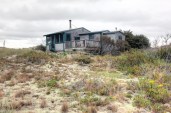
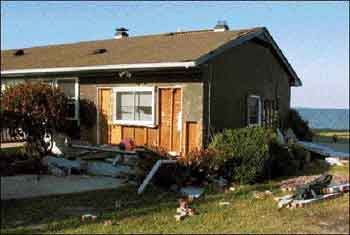
The surge from Hurricane Isabel (bottom) in contractor Robert Criner’s hometown of Yorktown, Va., was powerful enough to strip this home (top) of its brick veneer.
YOU’VE BEEN ENTRENCHED IN A CLOSE-KNIT COMMUNITY FOR 27 YEARS. HOW DID THAT AFFECT YOUR STANDING WHEN ISABEL HIT?
It probably produced as much pain as comfort because once Isabel hit, the biggest concern for us was deciding who to take care of first. That’s a huge lesson to be learned in the first 48 to 72 hours of a hurricane: Who do you work for? The demand is endless and your resources are limited. For example, with power out, I had to have my business calls forwarded to my cell phone, where someone could leave a message. But to pick up a message, I had to drive five miles away just to get a cell phone connection to get my cell phone to work. Once we got the lines of communications opened, we were fielding probably 80 calls a day. And these weren’t people who said, “Listen, I’ve got a hole in my roof.” It was: “Listen, a tree fell through my house, which is now lying in two. I’d like you to come fix it, please.”
Storm angels from Criner Construction Co. (left to right): Julie Thibodeau, Herbie Desseyn, Brian Hickman, Tony Domingos, Aggie Criner, Robert Criner, Frank Gray, Michael Bradley, and Terry Thomas.
If we took even one of those jobs, our entire crew would have been tied up for months. So we brainstormed and decided to narrow it down to a geographic area and just take calls within a few zip codes. [He laughs.] I quickly went from three zip codes down to one zip code, and before the end of the day, I wasn’t even taking those.
HOW DID YOU DECIDE WHICH CUSTOMERS TO TAKE ON?
We went with past clients. We took care of the people who took care of us. Think of it, 27 years of past clients! Where I run the business, I have five acres, an office building, and my home on the same property. There were people lined up at my office door.
THAT’S AN EXTRAORDINARY DEMAND. HOW DID YOU HANDLE IT?
We went into repair mode. If we could get a tarp on a roof or get a leak under control, we could stop future damage. That was our focus.
But we were savvy not to get burned, too. When we started to do the paperwork, we added a clause that made it blatantly clear that we were not accepting any insurance payments. Our contract was with the homeowner. If the insurance decided not to pay the homeowner, the client was still responsible for paying us.
WAS THAT A GOOD MOVE, IN HINDSIGHT?
It was the best move I could have made. I had some competitors who didn’t use that clause, and they got themselves in hot water because some of the insurance companies just wouldn’t pay.
THEY ENDED UP WORKING FOR FREE?
Right. Or they had all their money tied up. I’m not very good to my clients if I’m out of business. As a commitment to them and as a fiduciary responsibility to my company, we had to make sure we stayed in business and that the cash flowed.
Before the storm: This previously drab and crowded kitchen is shown here shortly after its stunning makeover by Criner Construction Co.
After the storm: The same kitchen shortly after a more unfortunate transformation by Hurricane Isabel stunned its occupants in a completely different way.
JUST TO GO BACK TO THE FIRST 48 TO 72 HOURS — DID THE NEW STRATEGY OF USING PAST CLIENTS RESOLVE ITSELF?
We thought we’d be able to handle it all, but then we got inundated and had to prioritize the calls. It worked out in the end, but what I found to be most helpful was understanding that with limited resources, we didn’t have the ability to fix everyone’s house. But we did have the ability to pass along information. I made myself stay on the phone something like 12 hours a day, just to console people. People were devastated. They didn’t know to take the wet carpets off the floor or to bleach things down; they didn’t even know how to contact their insurance companies.
The most precious commodities after the first day of the storm were water and ice. Ice, to try to save anything you may have had in the refrigerator, even if it’s a pack of lunch meat. And water, because what comes out of the spigot might be contaminated. Well, before the storm, I bought cases of bottled water. I had a freezer in the shop that I hooked up to a generator. So I froze all the water bottles and delivered them to my clients. I cannot tell you the impact that small gesture had on these people.
IT SOUNDS LIKE YOU CONVERTED YOUR COMPANY INTO A COMBINATION REMODELING BUSINESS, RELIEF ORGANIZATION, NEWS BUREAU, AND ADVICE COLUMN.
Pretty much. The advice column was how we could help the largest number of people the quickest. We had all our guys doing everything we could, but giving sound, real-time helpful information was the most valuable service of all.
THAT KIND OF WORK DOESN’T PAY DIRECTLY, DOES IT?
I could have made a lot more money doing other things, but we had an obligation to the community. Eventually, the municipalities contacted me to speak to larger groups. They put together Hurricane Isabel Recovery Information meetings at all the high schools. They had representatives from the insurance and power companies and a representative from the repair and remodeling industry, which was me. We all got up in front and talked to what was a group of very angry consumers. Think about it: A hurricane hits. A week has passed. People have been trying for a week to get hold of a contractor and they’re not getting anywhere. You get 400 of them in an auditorium and they get me [he laughs] to answer all their questions for them. Well, I just laid it on the line for them, and I was surprised at how much respect I got after that.
WHAT WAS THE BIGGEST SOURCE OF FRUSTRATION?
When a hurricane hits, every insurance company brings in a catastrophe team of adjusters. These people — hundreds of them — inundate our community, every one of them going at lightning speed to visit homeowners. They come to town and tell every person they talk to: “Get three estimates.” Well, nobody sent me an estimator! Nobody came from out of town to help me give out estimates! Now I have to give three times the number of estimates as there are jobs out there?
WE DON’T HAVE TO REVIEW A PAST ISSUE OF JLC OR REMODELING TO REALIZE HOW MUCH TIME IS INVOLVED IN PUTTING TOGETHER AN ESTIMATE.
And these are big estimates. So you have a choice. Sit there for three weeks and do estimates, or cover up the roofs of past clients. I think I’m going to go for the “cover up the roof” part. But as time passes, people are getting more and more desperate for estimates. So you have to help them. It’s a concept that you don’t realize until you’re in the middle of one of these things.
Having digital cameras helped us a lot. Everyone had to document the damage for their insurance companies. We were out making field visits and documenting not only for our benefit but also for our customers’ needs. We were able to give them a copy of a disk or burn a CD. You don’t realize how valuable these little things are that you take for granted every day.
IN THE END, HOW WOULD YOU ADVISE A CONTRACTOR IN SIMILAR CIRCUMSTANCES?
The secret is to watch the weather and take it seriously. The really smart contractors go to the companies that sell blue tarps and buy every single one in stock. After the storm, you couldn’t go out and get one to fix your own roof. The contractors had them all. At my company, we used every tarp we had. We also had some tar paper in the shop. We patched roofs any way we could.
The other smart, savvy contractors went out to the rental companies before the storm and reserved chain saws, pumps, and dehumidifiers. They didn’t buy them. They didn’t rent them. They reserved them. If the storm didn’t hit, they canceled the reservation.
The damage to the kitchen came from this 60-foot tree uprooted by the hurricane. Because of the sheer volume of repair needs throughout the community, Criner Construction’s first response involved only chain saws and blue tarps. The actual repair work took place many months later.
BRILLIANT
Isn’t it? There are certain things that are such high priorities once the storm hits. A generator is number one. Fans and dehumidifiers are next, so you can start drying the houses out. Chain saws are important, too (and remember, you need gasoline for chain saws), because there is more tree work after a hurricane than you can imagine.
SOUNDS AS IF IMPROVISING IS A BIG THEME WHEN IT COMES TO DISASTER RECOVERY.
The little town of Poquoson, which I live right next to, was probably the hardest hit of all towns by Isabel. Up until a couple of years ago, it was a one-stoplight town, mostly waterfront, all low-lying. It just got hammered. The only way you could communicate in Poquoson was with a piece of plywood at the major intersection. Information was spray-painted there. That was your newspaper.
I have an annual pig roast every year; usually 250 people show. A week after the storm was my scheduled pig roast. Even though every event in the area had been canceled, my mindset was that with all the hell all these people had been through, a hot meal would probably be a good thing. What happened that morning? There was a rumor — a rumor, mind you — that an ice truck was coming. On the road near my house, the cars started to line up. We’re talking hundreds of cars in a single-file line, all the way down my road, both sides of the road. Everyone was parked there for hours. The police department eventually came out and confirmed the ice delivery. They let everyone wait in line so they could drive into Poquoson. Here I’m expecting a hundred people to come to my house and there’s no place for me to park.
That’s the impact of this kind of storm — it doesn’t hit home until you realize that you will drive somewhere, with your last gallon of gas, and wait for two hours in the hot sun just for the thought of getting a bag of ice.