
Mitch Buroker
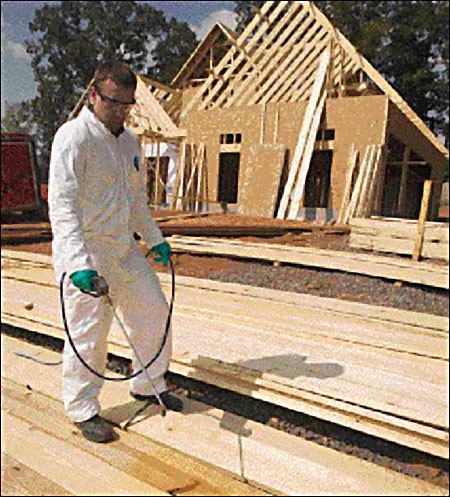
Borates applied to wood framing (above) provide one of the most effective treatments against the super-aggressive Formosan termite. Pretreated lumber is available, but typically a pest-control specialist must spray all the framing and sheathing with a borate solution at the “dried-in” stage of construction.
To build a home that will solidly rebuff nature, builders and remodelers in the southeastern U.S. have their share of adversaries. A potent mix of tropical storms and excessive moisture is bad enough, but it’s ruinous insects that account for the most consistent source of home damage. Year in, year out, the termite is a king (and queen) of destruction, costing billions of dollars in damages every year in the U.S.
Eradication of subterranean termites is nowhere in sight. In fact, during the last 40 years, new, more aggressive termites have increasingly invaded the U.S., requiring vigilant monitoring and increased use of lethal deterrents. The Eastern subterranean termite remains the most common pest, but since the 1960s, the Formosan subterranean termite has become the more devastating and difficult adversary. A typical colony of Formosan termites will consume 100 times more wood per year than an Eastern subterranean termite colony. This level of destruction can cause substantial structural damage within a year. The Formosan variety is also able to nest aboveground, rendering soil treatments ineffective.
And now there is yet a third termite species to contend with. According to Dr. Nan-Yao Su, professor of entomology at the University of Florida’s Institute of Food and Agricultural Sciences, a new Asian subterranean termite has arrived on Florida’s East Coast near Fort Lauderdale from Thailand and Malaysia by way of Brazil and the West Indies. Dr. Su says it’s too early to speculate on how widespread a problem this new species will become, but warns that it bears watching: It’s as aggressive as the Formosan and has the potential to become equally as destructive.
Asain |
Formosan |
Eastern |
Subterranean termites are found from New England to the Gulf of Mexico (insets), posing a significant threat to homes along coastal waterways and just in from the shore, where damp clay and silt soils provide prime conditions for termite survival.
While contractors are not exterminators, a knowledgeable builder or remodeler still plays an important role in long-term termite control. The ability to start the termite conversation and guide clients toward the best method of protecting their homes is a value-added skill that’s increasingly vital to customer satisfaction. Once the slab is poured and the walls are closed in, the job of keeping termites out becomes harder.
First Line of Defense
Deterring termites starts with sound building practice. Because termites primarily search for food by the scent of rotten or decaying wood, it’s important to remove potential food sources from the job site to every extent possible and to protect wood on the house from moisture:
• Do not bury stumps and wood debris on site, and keep cutoffs and cardboard scrap out of the backfill.
• Remove wood concrete forms and stakes, and peel back the ends of Sonotube forms from the tops of poured piers.
• Control runoff with gutters and downspouts, backfill with well-draining material, provide good foundation drainage, and control site drainage. These practices will keep soil drier, robbing termites of the high soil moisture content they need for survival.
• Use only pressure-treated wood in contact with the ground.
• Be sure to hold siding and trim at least 8 inches above grade.
Crawlspaces
Keep floor joists at least 18 inches above the soil in a crawlspace. Most important, do not leave soil exposed beneath floor structures; cover with poly, caulked or foamed to the foundation.
Porches, Decks, and Steps
Raise concrete footings for porches, decks, and steps out of the soil to force termites out into the open, and keep wood at least 6 inches above the soil. Even better, build the latticework around a porch or deck from a cellular PVC or other nonwood material.
Control strategies are twofold: (1) Keep wood structures dry, and (2) eliminate entry points where termites can sneak into a building undetected from underground. It’s extremely difficult to block the entry points, as a termite can squeeze itself through a 1/16-inch gap. The best control measures involve designing structures that keep wood as far away from wet soil as possible and eliminating underground entry points, as detailed in the illustrations on this page and on page 4. At the very least, these details will force termites to build their mud passageways where they can be more easily detected.
Traditional Preventives
Shields. The traditional method of termite control has been the termite shield — sheet metal installed at the top of piers or foundations. Termite shields won’t stop an infestation, though. When installed properly, they only force termites to build passageways out in the open, around the shield, where they can be detected.
Unfortunately, shields are very difficult to install properly. Lengths should overlap and be caulked or soldered together, and any penetration (around anchor bolts, for example) must be sealed as well.
Termiticides. The most common control strategy for deterring subterranean termites has been termiticides. Many argue this was easier with Chlordane and Heptachlor — potent organochlorines that remained active for very long periods. However, these chemical treatments were banned in 1988, and for good reason: They are neurotoxins that readily leach into water systems. When ingested, even trace amounts have been found to disrupt central nervous functions and cause liver damage in mammals.
Stucco
Never run stucco below grade. Instead, it should always terminate at a weep screed held at least 4 inches above grade.
Modern organophosphates and synthetic pyrethroids — the most common replacements for the more toxic organochlorines — pose less of a threat to the community and are much less irritating to applicators. However, they are still toxic to some species, primarily fish, so their application is often restricted along waterways.
The biggest problem with post-Chlordane chemicals is that they are far less persistent, so homes must be treated as often as every five years. To be effective, there must be a continuous chemical barrier in the soil surrounding a structure, which is easier said than done. Treatment is best when applied during construction to create a continuous horizontal barrier of treated soil beneath slabs and vertical barriers through the backfill along foundation walls and around piers. Post-construction treatment, while common, is much less effective, and continual monitoring is critical.
Termite Shield
A metal termite shield is simply a barrier to force termites into the open. To be effective, all joints should be soldered and all penetrations, such as anchor bolts, caulked. The Borate Alternative
Treating the structural wood to rob termites of a food supply is probably the most obvious method of home protection. It is particularly effective against the Formosan termite, which may nest aboveground. For interior residential use, borates are the new standard. They have been used for 50 years in New Zealand, and borate-treated lumber is now required in all new home construction in Hawaii to combat the Formosan termite.
Though not poisonous to humans or animals, borates are a fatal stomach poison to termites, inhibiting their ability to digest cellulose. These chemicals are also effective against other pests, such as carpenter ants and wood borers, and against fungi that cause wood decay. Borates do not corrode hardware (unlike ACQ, which is recommended for exterior use, but which accelerates the corrosion of metal fasteners and hardware). However, borate-treated wood is not recommended for exterior use or ground contact, since constant wetting will leach it away from wood and decrease its effectiveness.
Borate-treated lumber. There are a few methods to get the borates into and onto the wood. U.S. Borax, the leading manufacturer of borate products in the U.S., distributes Tim-bor for large-scale industrial use, and licenses the same formula to Osmose Corp. (a leading manufacturer of ACQ- and CCA-treated lumber, as well). Osmose Corp. markets borate-
treated dimensional under the Advance Guard brand name, which is sold ready to use, fully treated like any pressure-treated wood (www.osmose.com/wood/usa/preserved/advanceguard). Treated OSB and other sheet goods, as well as trim stock and moldings, are available.
Spray-applied borates. More commonly, untreated wood is used for framing, and a pest-control specialist arrives with a small crew at the dried-in stage and before drywall to treat the job site in one evening. Tim-bor and and Bora-Care, both distributed by Nisus Corp. (100 Nisus Dr., Rockford, TN 37853; 800-264-0870; www.nisuscorp.com), are the most common materials for these spraying applications.
Borates penetrate wood well and, applied in suitable concentrations, should be effective for at least 20 years. Treatment at the job site requires that all wood/cellulose products be sprayed, including all framing and flooring. The cost of borate treatments averages $1 to $2 per square foot of floor space.
Borate applications are now available with warranties protecting the homeowner against termite loss, making the treatment competitive with traditional soil barriers, which have long come with guarantees.
A Better Barrier
One of the most promising new termite protections in recent years is the Termimesh System. Developed in Australia and tested by U.S. Dept. of Agriculture Forest Service in Gulfport, Miss., for over a decade, Termimesh consists of a stainless-steel screen that is installed at entry points.
Like metal shields, Termimesh installed beneath sill plates and at the base of wall systems only prevents termites from entering a building through hidden gaps. Termites may still build a passageway around the barrier, but if installed correctly, this will force termites to areas where their activity can be detected.
Like a metal shield, Termimesh can be installed at the base of wall systems to prevent termites from entering a building through hidden gaps. Unlike metal shields, Termimesh is easy to fold around corners, and the stainless-steel screen can be bonded to concrete with a cementitious bonding agent.
However, Termimesh offers a critical control that metal shields can’t provide: It’s the only system that effectively seals the tiny gaps in slabs, such as those around plumbing and conduit penetrations. Termimesh flanges are sealed to pipes with stainless-steel clamps, or laid beneath plumbing blockouts, then embedded in concrete about halfway through the slab section, as shown in the photos at left. Termimesh can be bonded using a cementitious bonding agent that is painted over the mesh. This will seal the screen to the masonry and concrete to create a barrier at the base of veneer brick cladding.
For slab-on-grade foundations, Termimesh provides a barrier around plumbing penetrations. When concrete cures, it may shrink back from the pipe, allowing a tiny gap for termites to squeeze through. The stainless-steel mesh can be secured to plumbing with stainless-steel clamps (left) or installed beneath a foam blockout (right).
According to Mike Boyd, vice president of Termimesh USA, which has recently begun distributing the system from its headquarters in Spring, Texas (Termimesh USA, 6046 FM 2920, Suite 506; Spring, TX 77379; 281-257-6558; www.termi-mesh.com), the screen material is far easier to work with than metal flashing. It can be cut with scissors or shears and folded. Corners are typically formed by folding, then creasing the material with a small roller. The biggest drawback to this system is the level of detail required for successful installation. While termites may never be able to chew through the mesh, they can crawl through the tiniest gap.
Currently, Termimesh offers detailed installation instructions and specifications developed for the Australian market, but the system has been evaluated and approved by the Southern Building Code Congress International (NER 9713B).
Bait Systems
For post-construction control, bait systems offer the most promising alternative to spray-applied termiticides. Popular ones include the Sentricon Colony Elimination System (Dow Elanco), Firstline (FMC), and Exterra Termite Interception and Baiting System (Ensystex). Of these, the Sentricon system (Dow AgroSciences; 317-337-3000; www.dowagro.com/sentricon) is the most expensive, but has the longest track record of success.
Most in-ground bait systems require periodic inspection of plastic monitoring stations that are loaded with a tasty piece of wood. There may be 20 to 30 monitoring stations around a home. When an exterminator (professionally called a “pest-control operator,” or PCO) finds evidence of termite activity or feeding on this wood, he will place a small amount of bait containing a termiticide. Sentricon uses one gram of Hexaflumuron in each station. The termites take the bait back to the colony, where the poison is shared, wiping out the entire colony.
The Sentricon baiting system consists of plastic monitoring stations holding baited wooden stakes. It’s not uncommon to need 20 to 30 stations around a house, which then must be electronically monitored. If termite activity is discovered, the stations are loaded with termiticide that termites carry back to the colony to wipe out the entire nest. While effective, this system may leave the home unprotected until termites discover the bait.
Most bait systems require brand-specific PCO training and certification, which adds to the cost. While some do-it-yourself bait systems are sold in home centers, there is very little evidence that these are effective, and there have been some complaints filed against makers claiming false advertising.
Bait systems are attractive for existing homes, particularly when the homeowner no longer wants to rely on continuous applications of toxic soil barriers. According to Dr. Michael Potter, an extension entomologist at the University of Kentucky’s College of Agriculture, clients are usually relieved to learn that with a bait system their carpeting won’t have to be pulled back, their floors drilled, or stored items moved.
However, critics of baiting systems argue that protection depends on the termites being attracted to the monitoring stations. As a result, it may take a long time for termites to actually swallow the bait, which leaves the structure unnecessarily at risk. Moreover, bait systems require ongoing monitoring. Michael Potter urges that baiting systems be sold as programs, for which the client pays an on-going subscription. “Failure to maintain the annual service agreement is a prescription for disaster with baits,” notes Potter. “There is no residual pesticide left in the soil after the termites have been eliminated, so ongoing protection depends upon diligent monitoring.” ~
Mitch Buroker writes on science and technology from New York City and Trumbull, Conn.


