FOR MORE INFORMATION
FEMA Technical Bulletin 7-93, “Wet Floodproofing Requirements”
FEMA Technical Bulletin 2-93, “Flood-Resistant Materials Requirements”
“Wet Floodproofing: Reducing Damage from Floods”
Tropical storms and hurricanes damage coastal housing in multiple ways. As building scientist Joe Lstiburek observed in a November 2005 ASHRAE Journal article, “We learn our lessons from disaster. Hurricane Andrew (1992) taught us about wind. Hurricanes Charley, Frances, and Jeanne (2004) taught us about rain. The Red River of the North Basin taught us about floods. Hurricane Katrina had it all: wind, rain, and flood.”
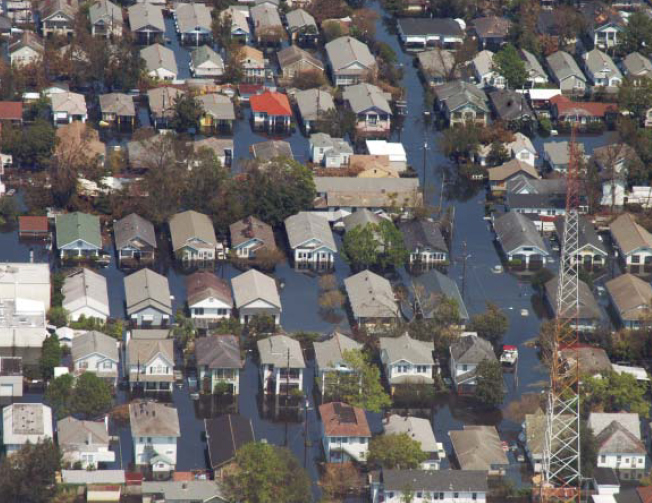
But insurance companies consider the Katrina disaster to be primarily a flood event (although the storm reached Category 5 intensity at sea, winds in most affected land areas were no higher than a Category 2 storm, and wind damage was relatively light). And as Joe Lstiburek points out, Katrina’s flooding was to some extent predictable, and some of its effects could have been avoided.
Even as floodwaters rose in New Orleans in late summer 2005, Lstiburek predicted in an interview, “The buildings in the older part of New Orleans that were built elevated, using water-tolerant materials like masonry and cement plaster, and with no cavity insulation, will be relatively less damaged and will be able to be cleaned up and put back into service. But houses that are flooded that were built more recently using wood frames, gypsum wallboard, and fiber cavity insulation are going to be much worse damaged, and many of them will never be usable again.”
Almost a year after Katrina, Lstiburek’s predictions are borne out by experience. Many older buildings in New Orleans (especially in higher terrain) have been put back into service, while most of the newer structures in lower-lying areas are candidates for demolition. And if the lessons of Katrina could have been known in advance of the storm, says Lstiburek, they should certainly be learned now.
There are modern materials and assemblies as water-tolerant, drainable, and dryable as the traditional methods used on some older Louisiana buildings, he observes, “and if we build houses in places that we know are at risk of being flooded, it’s just common sense to build them so that they can survive repeated wettings.”
Lessons of a Real-Life Test
New Orleans represents a citywide experiment on the effects of flooding on contemporary structures and materials, Lstiburek noted in March 2006. “All you have to do is spend a couple of weeks down there and look at what they are tearing out,” he says. “Paper-faced gypsum is destroyed and has to be removed. Fiberglass insulation is saturated and it’s damaging the rest of the structure — it has to come out. Wherever they have a failure, that’s what they have to remove. Well, the obvious lesson is that none of that should be put back.”
Whether restoring old buildings or constructing new ones, says Lstiburek, construction in flood areas should use drainable, dryable assemblies built with water-tolerant materials. “And what’s neat about this,” he adds, “is that there is no code prohibition telling us we can’t do it that way. The code is not preventing us from doing the right thing, for a change.”
“Wet floodproofing” and FEMA. The concept Lstiburek advances is not new: In fact, as he noted in the November 2005 ASHRAE Journal article, “The Federal Emergency Management Agency (FEMA) has all of the basics correct and has had them correct for a long time.” PDF documents available on the FEMA Web site outline the agency’s wet-floodproofing and flood-resistant materials requirements for structures in low-lying areas.
But for FEMA, wet floodproofing is a second-tier defense: The primary requirement is to elevate the building on a pier foundation. Flood insurance coverage for buildings that are not elevated but only wet-floodproofed is restricted to certain cases. For example, a detached garage that is built below the level of the main house is allowed to be wet-floodproofed (elevating a garage is obviously impractical). Historic buildings whose character would be altered by elevating may sometimes be wet-floodproofed instead. And some commercial structures on the waterfront whose function requires them to be built at grade may be wet-floodproofed rather than elevated. Despite these allowances, FEMA has yet to sanction wet floodproofing as an alternative to elevating a conventional new home.
A sensible precaution. In Louisiana, and perhaps Mississippi, wet floodproofing can be a wise idea for many people who aren’t even required to elevate — or as an additional backup precaution for those who are. That’s the message from experts at the Louisiana State University (LSU) Extension. Says LSU’s Claudette Reichel, “In Katrina and Rita, many houses that were built above the Base Flood Elevation got flooded.” Currently undergoing a nationwide revision, FEMA’s floodplain maps are far from up-to-date; in any case, says Reichel, “one of the things about Louisiana is that the Base Flood Elevation does not stay put. Our flood patterns are not the same over time. So if a house lasts 50 years or more, during that time flood patterns are quite likely to change because of development. There are many people in Louisiana whose homes were built in areas that have never flooded for 30 years, and now, lo and behold, they flood.”
Chuck Lockhart
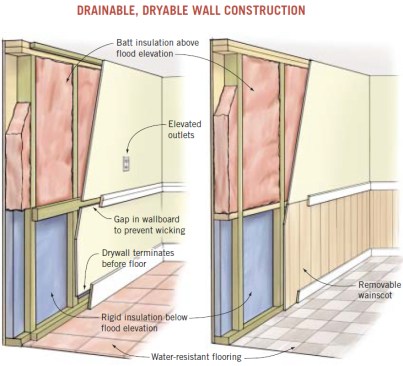
Wet floodproofing relies on the same principles that are effective when used for exterior rainwater management: drainability and dryability. The drawing at right shows recommendations provided by the LSU Extension program for flood-tolerant interior assemblies. When this concept has been applied, interior walls can be opened up after a flood event to drain and air-dry. Water-tolerant materials such as non-paper-faced gypsum board, treated lumber, and closed-cell extruded polystyrene insulation are used so that the building components can be returned to service after they are thoroughly cleaned and dried, rather than having to be totally demolished.
Even the best floodplain map, explains the LSU Extension’s Pat Skinner, is by no means a guarantee. “The regulatory elevation is a statistical thing,” she observes. “In any given year, the probability of flooding above it is 1%. But the chances that you may see a flood are multiplied over the 25 or 30 years of a home mortgage, or the 50 or 100 years that the house is occupied. So there are many houses that were elevated above the Base Flood Elevation that did flood in this last storm, 1 or 2 feet into the part of the house that was expected to stay high and dry. That’s why we recommend, ‘Build this high, and then also wet-floodproof.’ That way, if you get that bigger-than-expected flood, your house will be less susceptible to damage”.
Recommendations for Rebuilding
Basic information on wet floodproofing can be found on the FEMA Web site (see “For More Information,” above). But FEMA’s general guidelines do not provide flood-tolerant assembly details. To help remedy that, Joe Lstiburek has drawn up a set of suggested floor and wall assemblies that represent simple, practical modifications of commonly used details.
Chuck Lockhart
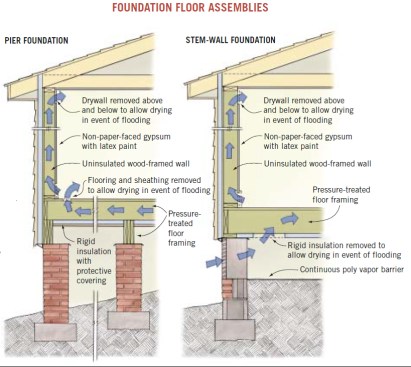
Building scientist Joseph Lstiburek (www.buildingscience.com) offers these construction details for flood-tolerant foundation and first-floor assemblies. The method uses water-tolerant materials and creates drainable components that can be opened up to air-dry after a flood event. According to Lstiburek, these options are compatible with existing codes and can be adopted immediately for rebuilding or repairs in flooded areas.
In new construction, Lstiburek calls for elevated floor frames to be built with treated lumber and insulated with non-water-absorbent rigid sheet materials such as extruded polystyrene. Lower-story cavity walls should use treated wood or steel and get exterior-applied rigid insulation; siding should be vinyl or fiber-cement. Interior walls should receive non-paper-faced gypsum wallboard, such as Georgia-Pacific’s DensArmor Plus (http://www.gp.com), which is free of paper facings as well as starches and other ingredients within the board that could support mold growth. In the event of a flood, strips of wallboard can be removed at wall top and bottom to allow convective air drying, says Lstiburek. In the case of contaminated floodwaters, enough wallboard may need to be stripped to allow power-washing.
Chuck Lockhart
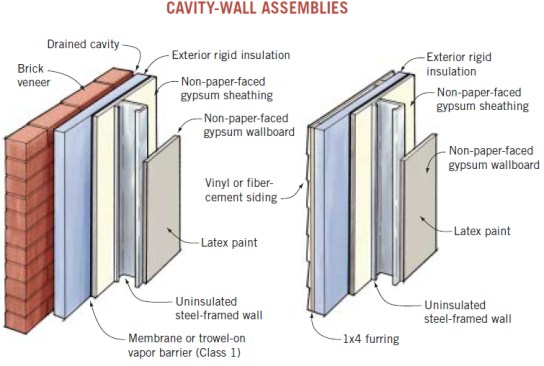
Shown here are two options for drainable and dryable cavity-wall assemblies suggested by building scientist Joseph Lstiburek. The wall designs share several key characteristics: (1) No water-sensitive materials are used; (2) exterior cavities are vented to the exterior; (3) interior cavities can be opened to allow passive air-drying in the event of a flood by removing strips of wall material at top and bottom to encourage convective airflow.
Chuck Lockhart
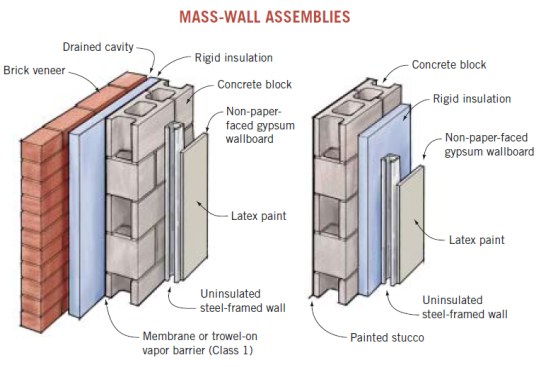
Like the cavitywall assemblies suggested by Lstiburek, these mass-wall assemblies are designed to dry by vapor diffusion toward both the interior and the exterior: The most moisture-impervious material (closed-cell rigid insulation board) has been located at the center of the wall profile.
Lstiburek also offers a masonry mass-wall detail. Rigid insulation is installed on all masonry walls, walls are framed without cavity insulation, and the water-tolerant gypsum board is applied in the same fashion as for the steel- or wood-frame assemblies, to allow air-drying after a flood event.
Appliances like ovens, water heaters, and washing machines should be installed on elevated platforms — a simple measure that the LSU Extension recommends for all homes in potentially flood-prone areas.
For retrofits of flood-damaged homes, damaged gypsum board and fiber insulation should be replaced with more appropriate materials. If installing exterior rigid foam insulation on walls is impractical, Lstiburek suggests a 11/2- to 2-inch spray application of a closed-cell, high-density polyurethane foam between the studs. For additional protection of wood framing, he suggests a borate-salt wood preservative treatment and maybe a coat or two of latex paint. And in the case of retrofits of recently flooded homes, it’s obvious where the new materials are necessary. “You can see how high the water came last time,” Lstiburek says. “Just replace everything from there down.”