Maine Passive House: Transition Details ~
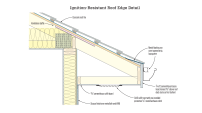
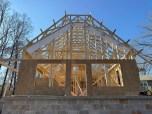
Hurricane Irene’s drama bypassed Downeast Maine, as the storm tracked farther to the west, bringing only moderate winds and rains to coastal areas between Portland and the Canadian Maritimes. So while other parts of New England suffered disruption and power outages, the EcoCor crew working on a Passive House in Knox, Maine, carried on with its work uninterrupted by the weather. Coastal Connection has been following the job, and this week we bring you an update. The building’s innovative “hybrid wall” system has an inner structure of typical OSB-sheathed 2×4 framing, with sheathing edges taped for air-tightness. A continuous sheet of heavy poly under the foundation slab is wrapped up and taped to the sheathing as well, perfecting the airtight envelope at the wall base. At the top of the wall, tape and membrane seals the joint between the wall sheathing and an OSB layer applied on the ceiling face of the roof trusses. Then, an exterior wall shell made with wood I-joists is fastened over the interior sheathed wall frame, to create space for a foot-thick blanket of blown-in cellulose insulation. At the base of this outer wall frame, the I-joists rest on the foundation’s insulating apron, consisting of giant wedges of high-performance Type IX (2 pounds per cubic foot) expanded polystyrene that also served as the slab’s forming system. Here’s a closer look at the protection and flashing details for that perimeter foam element, along with a look at the I-joist framing in progress. The foot-thick insulating foam perimeter, which also served as a form for the 8-inch-thick foundation slab pour, is getting careful protection and drainage details. On the vertical face, the crew has attached half-inch Durock fiber-cement backer board using foam adhesive and screws (once the adhesive sets up, the screws are removed). The cement board receives a parget of ThoroSeal polymer-modified cement; eventually this will get a top coat of elastomeric paint. On the horizontal face, the crew applies the same fiberboard sheathing used to sheathe the exterior walls: BP BH structural fiber board. “That wasn’t my first choice of fiber boards,” says Corson: “Celotex was. But this is the only product I can find locally. Which is ironic, because up until recently Celotex fiberboard was manufactured near here, in Lisbon, Maine.” The fiber board is highly permeable (with a perm around 38), says Corson, and has an R-value not much less than the cellulose insulation he plans to use in the framing cavities. “There’s no thermal bridge where the I-joists sit on the sill,” he points out. The vertically oriented I-joists provide a foot-thick cavity for blown insulation. But before they go on, the crew has to pay attention to the air sealing details for the wall’s inner OSB envelope. All joints between OSB panels are getting two kinds of air-sealing tape: a flexible 3M flashing tape, and a layer of bituminous Vycor flashing tape. (The Vycor requires a primer for good adhesion, which you can see as the white paint-like substance in the photos.) After every joint is taped, the crew can start installing I-joists. They attach these with self-tapping Simpson structural screws; the point of the Vycor is to seal the screw holes around the screws, preventing even the tiniest air leakage at that fastening penetration (although as Corson points out, the screws are fully buried in wood anyway). As the outer I-joist frame is completed, the crew installs fiberboard sheathing, then applies a Tyvek drainage plane, which will also protect the insulated cavities from wind-washing — although the dense-blown cellulose planned for insulation is already relatively resistant to air movement. Windows were delivered to the job this month, and will be installed as the walls are completed. Coastal Connection is keeping tabs on the job, and we’ll bring you another update in October.