by Ted Cushman
When used with care, plastic is proving to be a material that can hold its own in a tough environment.
For coastal decks, looking good is always a desirable option, but rugged is the rule. To withstand an incessant attack of sun, rain, ice, and fungus, decking materials must be especially tough.
Season in and season out, we’re asking deck boards on coastal homes to do some very hard work, and no material handles the challenge perfectly. Pressure-treated lumber may last for decades, but it often develops splits, warps, checks, and splinters — sometimes after only a few years. By contrast, naturally rot-resistant redwood and cedar start out beautiful and age gracefully, but they’re soft enough that even normal foot traffic can dent them. Rot-resistant tropical hardwoods are tough and attractive, but they may come from endangered woodlands. Plus, these hardwoods can be brutal on saw blades, and some, like the Brazilian hardwood Ipe, are toxic enough to irritate a carpenter’s skin, eyes, and breathing passages.
Facing this lineup, contractors have good reason to take a look at plastic and composite decking. Product literature promises a consistent, attractive board that won’t rot, swell, or warp. Plastic lumber contains no toxic preservatives, and it needs no painting or staining. Many brands have impeccable “green” credentials: They’re made from recycled material that would otherwise pile up at the dump.
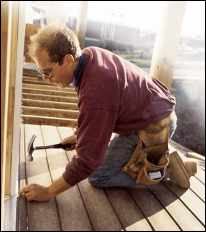
Plastic cuts like wood and screws like wood. But it isn’t wood — and to succeed with it, contractors have to understand how it’s different. What you can expect when you switch from wood to a plastic or a wood-plastic composite will depend on the particular material you select.
What’s in That Stick?
Plastic lumber isn’t all the same. Different brands may be made with different plastics; some brands contain fiber from wood, agricultural waste, or other natural sources and some don’t (although even the “all plastic” brands may use pigments, foaming agents, lubricants, or other additives in the manufacturing process). And though the same building codes apply to all — and all must meet certain basic performance criteria — these different ingredients result in very different performance characteristics over the material’s service life.
Types of plastic. Trash is the cheapest source of plastic. Consequently, most plastic wood is made with polyethylene or polypropylene from recycled packaging like shrink-wrap films, milk bottles, and grocery bags. These “thermoplastics” get soft when they get warm; melt and flow (or even vaporize) when hot; and will burn if heated to the ignition point. Plastic scrap is a friendly raw material that is relatively easy to melt and re-extrude.
Some decking products are made with PVC (polyvinyl chloride), the same polymer used for vinyl siding and plastic drainpipes. PVC is stiffer and stronger than polypropylene or polyethylene, but it’s also more brittle. It’s hard to ignite and it doesn’t burn well, but when it does burn, the fumes contain toxic compounds of chlorine. PVC products contain mostly virgin material, so PVC is not exactly “green” — in fact, because of its chlorine content, it’s on the enemies list of most environmental watch groups.
Fiber content. A number of products contain only plastic — either polyethylene or PVC — and a handful are reinforced with fiberglass (an expensive option). But the biggest slice of today’s market belongs to composite products that mix plastic with processed natural fiber (Figure 1). The fiber source varies: It can be wood flour, longer wood fibers, rice husks, or even paper-mill sludge. Usually the plastic portion is polyethylene, less often polypropylene; only one major brand, CertainTeed’s Boardwalk, combines wood fiber with PVC.
Figure 1. Not all plastic and composite decking products are the same, and performance characteristics can vary as widely as the materials and configurations with which they’re made. In the absence of established performance standards, contractors will be best served by using products from companies that have made a name for themselves in the plastic or wood-plastic decking category.
Lab Wars
Whatever their ingredients, plastic deck boards are billed as an alternate material for treated-wood decking on decks and boardwalks. But because they don’t act quite like wood, they need their own performance standard. In fact, plastic deck boards have two standards, created by two different committees of the American Society for Testing and Materials (ASTM). There’s ASTM Standard D6662, for boards containing 50% natural fiber or less, and Standard D7032, for boards that contain more than 50% natural fiber.
Unfortunately, the two committees don’t always agree. “Turf battles” (a term used by both committee chairs) are waged politely for the most part, but they’re not just about procedure: The wording of the rules could make an important difference in whether or not products are accepted by state and local codes, how the products are made, what they cost, and how they perform. There’s money on the table for manufacturers, and potential risks for installers who don’t understand what the standards do — or don’t — require.
Composite chemistry. Tom Nosker, a professor at Rutgers University in New Jersey, serves on the subcommittee that created ASTM Standard D6662. Nosker is not a fan of wood-plastic composites: “I have never promoted taking polyethylene and mixing it with wood, because I don’t think it will last very long,” he notes.
According to Nosker’s analysis, wood cellulose, a “polar” molecule that attracts water, does not bond chemically with polyethylene or similar “nonpolar” plastic polymers. Stress transfer between the materials is limited, Nosker says, so adding wood fiber to plastic lumber doesn’t do much for its structural properties. And Nosker claims that the affinity of the wood fiber for water causes composite boards to soak up moisture, support fungal growth, and suffer freeze/thaw damage.
Plastic cuts like wood and screws like wood. But it isn’t wood — and to succeed with it, contractors have to understand how it’s different. |
Nosker helped create a test method for Standard D6662 that is intended to expose this potential weakness. “I designed it so that the products that I know failed out in the field would fail that test,” he explains. The test method calls for a specimen to be tested for mechanical properties, weighed and labeled, then submerged for 24 hours and re-weighed. If the sample has gained 1% or more water by weight, it goes back in the water for another 24-hour soak — and it keeps going back until its 24-hour water uptake drops below 1% of dry weight. When that happens (at saturation), the piece is frozen for 24 hours, thawed out, and sent back for another weigh-soak-weigh cycle. After three cycles of soaking and freezing, the sample gets a second test of its mechanical strength and stiffness. If the physical properties have dropped by 10% or more, the product fails.
“It’s a trivial experiment for an all-plastic material that doesn’t take up water,” notes Nosker. But he says it can devastate composite boards: “If water gets in and saturates some area, then, when it freezes, the ice expands and creates a crack, and that allows a lot of new paths for more water to go in and wet more particles,” Nosker explains. “Some of these boards will take up 20% or 30% of their weight in water.”
Where’s the data? Robert Tichy of Washington State University is chairman of the committee that wrote ASTM Standard D7032. He notes that he’s been hearing these claims for years, but Nosker has never shown him any data. The D7032 standard has a much less extensive version of Nosker’s test: The samples are soaked and frozen three times, but they get just a single 24-hour soak each time. According to Tichy, that’s because the time spent in repeat soakings is a waste — he says that the boards max out at about 4% moisture content, and never suffer the strength decline that Nosker alleges.
“I did 50 cycles of Nosker’s procedure on samples from the three products that make up about 80% of the market,” notes Tichy. “After the first few soaks, they took up almost no additional water, and after a year, none of the samples had lost as much as 10% of their structural strength.” Tichy says that he also tested boards from a New Jersey boardwalk that had been exposed on the beach for seven years, comparing them with boards that had been stored inside a warehouse. “There was no significant difference,” reports Tichy.
As for stress transfer, Tichy agrees that wood fiber and plastic don’t bond chemically. But he says that the mechanical interlock between the materials achieves much the same effect. In fact, the fiber content improves the strength because the fiber has a higher bending stress than the plastic. “If you take half the plastic out of a board and replace it with wood fiber,” notes Tichy, “you can double or triple the flexural strength and stiffness.”
Standards and the code. At this point, neither Nosker’s nor Tichy’s assertions are easy for outsiders to verify. When grading standards for wood lumber were revised in the 1990s, there was an open process of stress-testing for all the wood species, with data shared through the entire industry. But the companies producing manufactured plastic or wood-plastic deck boards are not currently releasing any data from the testing of their products for freeze/thaw resistance, flexural stress properties, or resistance to weathering. And neither D7032 nor D6662 yet has the force of code: The International Code Council’s acceptance criteria document for deck boards, AC-174, has been recently revised to incorporate the D7032 standard by reference, but the revised AC-174 has not yet gained official acceptance itself.
When the new AC-174 does take effect, even products that already have code approval will have to requalify. Bob Tichy is looking forward to it: “We hope it will make a difference,” he says, “and weed out any bad actors in the industry.”
Plastic Lumber in the Real World
So, what can you expect when you handle plastic or composite boards outside the laboratory? Characteristics relating to strength, stiffness, durability, weathering, moisture intrusion, and dimensional movement will vary from product to product, depending on the material’s makeup. They can all be significant, but they can be handled if you know what you’re doing.
Strong like … plastic? Pound for pound, plastic and composites can’t match the span capability of wood. “With either an all-plastic material or the wood-plastic composite materials, your strength is comparable to wood, but your stiffness, or flexural [elastic] modulus, is quite a bit lower,” explains U.S. Army Corps of Engineers researcher Richard Lampo, who chairs the committee that created ASTM Standard D6662. “So your design is not strength controlled but deflection controlled.”
Joist spans will vary widely, depending on the thickness of the material. While 1-inch and 5/4-inch decking is common, many manufacturers offer a stiffer 2x material to improve deflection. Use the manufacturer’s recommended spacing as a minimum, and consider using a closer spacing.
Pound for pound, plastic and composites can’t match the span capability of wood |
“You’re not supposed to span more than 16 inches with it,” noted one contractor on the JLC-Online forums (www.jlconline.com) about a 5/4-inch-thick product. “Often, we cut the span down to 12 inches.” Another participant concurred that composite boards felt “a little loose underfoot” at 16-inch spans. Joist spacing will also have to be narrower when the decking runs diagonally, since the decking itself is spanning a greater distance (Figure 2).
| Sample Joist Spanning Requirements | |||
| Residential Decks, Light Duty Docks Residential/Daycare Playground | Commercial Decks, Boardwalks & Marinas | |
Loading | 100 psf | 100 psf | 200 psf |
5/4 x 6 | 16″ | 16″ | 12″ |
2 x 4, 6, 8 | 20″ | 20″ | 16″ |
2 x 6 Stairs | 12″ | 12″ | 12″ |
Figure 2. Each manufacturer publishes its own guidelines for joist spans. This sample from Trex illustrates how joist spacing will vary with the thickness of the materials and with the orientation of the decking. In general, the strength of Trex is not much different from that of wood, but this is not the case with all the available products.
In addition, plastic or composite decking is more likely to deform slowly under a sustained loading (the phenomenon known as “creep”). One forum contributor observed, “It’s heavy, without a lot of rigidity, so try to store it as flat as possible.” Stacked on uneven ground on site, or left unsupported, plastic deck boards tend to gradually conform to the contours under them, like wet noodles (Figure 3). At the usual light, transient loads of a deck, creep won’t tend to show up once installed, but it may be a problem if heavy materials are stored on the deck, particularly in warm weather.
Figure 3.If left unsupported, plastic and wood-plastic lumber may droop, particularly in hot weather. On the other hand, a slightly higher elasticity can be used to advantage to create curved features, such as this stairway built with Trex (middle).
Another vulnerable deck detail involves the overhang. When you install the deck boards, minimize the overhang at the edge of the deck; otherwise, the edges will sag, or even lift under load between the first few joists. As the plastic softens in hot sun, the condition is aggravated, particularly in high-traffic locations such as beach walkways. If possible, keep the ends flush with the edge of the last joist, or limit the overhang to an inch.
PVC is stiffer and stronger than polyethylene or polypropylene, but it’s also costlier. So, PVC-based products typically use a hollow or channeled structure to achieve equivalent spans with less material. Because of PVC’s relative brittleness, however, those products may be more prone to shear failure under high stress — a high-heeled shoe may punch through a top surface, for instance, or a fastener may crack through the board. As with the poly products, it’s wise to keep spans short and to take particular care while nailing or screwing.
Sun, snow, rain, and dirt. On the coast, the primary threat to plastics is sunlight: Ultraviolet rays can break the bonds in the polymer’s molecular chain. However, the sun’s effect on plastic deck boards is only skin deep. According to Nosker, the sun penetrates only a few thousandths of an inch, and while it degrades the surface layer, this layer of damaged plastic blocks further penetration. Products exposed to sunlight may show some surface fading or discoloration but will remain serviceable (Figure 4).
Figure 4. In the long run, composite decking will likely weather the sun, rain, and ice much better than pressure-treated lumber. Ultraviolet light will fade the top surface of composite materials (shown new at left), but the material remains serviceable and does not usually continue to degrade after initial weathering.
A more common complaint is staining from dirt, liquids, or even from the material itself. Some composite boards use wood fibers that contain “extractives” — pigments or resins that can migrate and may change color. “When the extractives oxidize, it can show up as small black dots that look like mildew on some products,” explains Tichy.
Aesthetic surface problems have not escaped the notice of contractors. One recent post at a JLC-Online forum described a delivery of composite boards from the lumberyard, already stained with black splotches that wouldn’t wash off. Another contractor replied with the story of building a large deck, only to have the customer’s dogs stain it with footprints on the day it was completed — and of “blotchy spots like bleach spots” showing up soon thereafter. A third chimed in, “Watch out for Coke, catsup, grease, and mustard stains. Barbecues make a mess.”
According to Seattle-based home inspector and remodeling contractor Mike O’Handley, such stains can be cleaned off using a garden sprayer filled with a 50:50 solution of bleach and water. Spray it on heavy, let it sit for 10 minutes or longer, then pressure-wash at no more than 1,500 psi (Figure 5).
Figure 5. While composite decking is susceptible to staining, most blemishes can be cleaned off — first using a garden sprayer filled with a cleaning solution. After letting this soak in, the deck is pressure-washed to restore a “like new” appearance.
Several cleaning solutions containing sodium percarbonate (oxygen bleach) tend to be even more effective than chlorine bleach, and oxalic acid-based cleaners work best for heavy stains and rust around fasteners. Contractor Joe Wood, a specialist in high-end decks in San Diego, recommends Deck-Prep from Behr (www.behr.com) for Trex decks: “Makes it look good as new,” Wood reports.
“We had a load of TimberTech delivered with ground in dirt and mud stains,” reports exteriors contractor Jamie Hill. “We used Armor All brand deck cleaner [www.armorallhomecare.com/products/ezspraydeckwash.html] and it worked great. We now wash every deck with it when we are done.” Keep the material covered on the job site, he advises: “The strangest things will stain it. The time messing with the tarps is better spent than trying 10 different cleaners to get leaf stains off a porch.”
To avoid stains altogether, the best bet may be an all-plastic material. Polyethylene’s water-repellent chemistry blocks any waterborne stain and resists most grease and oil formulas, too. Remodeling contractor James Work has had good luck with U.S. Plastic Lumber’s Carefree Xteriors decking: “I installed a light sand color with white railings where a walnut tree had previously killed anything I put under it. Now I wash it down every once in a while and blast it off once a year with a power washer. It looks brand-new.”
Dimensional movement. All-plastic products have a higher coefficient of thermal expansion than products containing wood. And even with composite products, dimensional movement related to temperature changes is a problem. In this regard, the product’s uniformity is a drawback: Plastic expands and contracts as much along the long dimension as it does across the width.
The problem cropped up on a job for Mike O’Handley: “The challenge came when trimming to fit around protrusions,” he explains. “One evening as I was getting ready to leave for the day, I measured, marked, and cut the outside perimeter boards for a nice fit around the balustrade supports. Boy, did I get a surprise the next morning! I didn’t get there until the bright morning sun had been baking that nice dark plastic for about an hour. I picked up that perimeter board to set it in place and found that it had expanded lengthways more than half an inch and the slots I’d cut, which fit so nicely the evening before, were nowhere near where they needed to be to line up with the balusters!”
Most manufacturers recommend spacing board ends 1/8 to 1/4 inch from each other, and up to 1/2 inch from solid objects (Figure 6). However, the best spacing may depend on the outdoor temperature at the time of installation. In hot weather, James Work cuts the material “a fuzz longer,” then “springs them into place — like you might spring some baseboard into a corner.” This way, says Work, when everything shrinks up in colder weather, it won’t open up a huge gap. However, in cold weather, the material must be gapped to avoid problems from the material expanding later.
Figure 6. Deck boards must be spaced from solid objects or the material may expand and crack, as did this extruded PVC used on a boardwalk in Cape Canaveral, Fla. (top). Splits in decking used on the same boardwalk demonstrate one of the reasons why hidden deck fasteners should be considered with all decking materials, even plastics and composites.
Cost and Availability
Plastic lumber is a growth industry, with many new players and a wide range of products. But a few established companies dominate: At lumberyards, you’re likely to find one or two brands of composite board, and maybe one brand of all-plastic decking. The more costly PVC-based brands may be available only by special order — and the same is true of any specialty fasteners needed to install them.
Even the most common varieties aren’t cheap. Plastic lumber is priced comparably with tropical hardwoods but not competitively with pressure-treated wood. Factor in the learning curve, and many contractors are inclined to stick with wood. “I’ll install synthetic decking if my customer asks for it; I don’t suggest it,” said one coastal builder. “But a lot of them do ask for it, because it is advertised so much.”
Contractors shouldn’t be surprised to see more and more demand for plastic-based materials from their customers. And as with any unfamiliar material, contractors should expect some unexpected twists and turns the first few times they use it. But when used with care, plastic is proving to be a material that can hold its own in a tough environment. ~
Ted Cushman reports on the building industry from his home in Great Barrington, Mass.