
by Mike Guertin
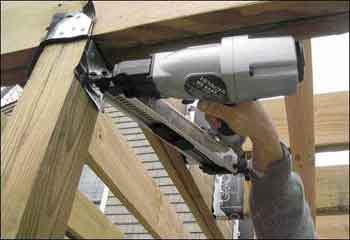
As building codes address wind-zone construction with extra vigor, more metal hardware is being required to tie buildings together from foundation to ridge than ever before. Framing anchors, ties, hold-downs, braces, tie-downs, hangers, connectors, straps — every year I need more steel to build and remodel houses. And all this hardware must be fastened to wood framing with nails — hundreds or even thousands of nails on each building. Ordinarily, that takes a lot of old-fashioned hammer swinging … unless you own a metal connector nailer.
This class of nailers drives 1 1/2- to 2 1/2-inch-long by 0.131- to 0.162-inch-diameter nails through holes in metal hardware with pinpoint accuracy. But they’re not all created equal. Toolmakers take different approaches to power, size, operation mode, and hole indexing, so each model has its strengths and weaknesses. Choosing one to suit the range of connecting tasks you encounter may be difficult. My crew actually runs three different models to meet the challenges of each connector situation.
To help you sort through the group and find the tool(s) to fill your nailing needs, we tested 14 different tools to see how they operate and to evaluate how they perform.
Right out of the gate, the field can be divided into two categories based on drive mode: multi-blow (like a palm nailer) and single-shot (like a regular framing nailer). The tools can be further broken down by the nail length they drive: those limited to 1 1/2-inch nails, and others that drive 11/2- and 21/2-inch (and sometimes longer) nails. Manufacturers also employ two approaches to aim and guide nails into connector holes: an integral metal probe/safety actuator at the tool nose, or the nail point itself. Other less obvious design details come to light when you examine the tools more closely.
Figure 1. The big advantages of multi-blow hammers are safety and control: there’s no chance of a ricochet off the hardware, and it’s easy to seat the nail properly.
Multi-Blow Tools
These six tools look unique. Imagine a tool about the size of a finish nailer with a palm nailer replacing the single-blow motor. Senco, Grip-Rite, and lesser-known PneuTools Inc. offer two multi-blow nailers each. Only branding and cosmetic differences set the tools from each company apart, because all models are made by PneuTools (Figure 1). One group of models (Grip-Rite GR150, Senco HN150, and PneuTools RN-150) drives 1 1/2-inch nails, and the other group (GR250, HN250, and RN-250) runs both 1 1/2- and 2 1/2-inch nails through an adjustable nose tube assembly.
The magazines are rear loading and handle one strip of 31- to 34-degree paper-collated 0.131-, 0.148-, and 0.162-inch-diameter nails. The point of the leading nail in the strip is clearly exposed at the tip and easy to index in a connector hole. Just like palm nailers, there’s no firing trigger on multi-blow tools. Instead, you push the body of the tool (handle and head) toward the work to initiate the blows. The body travels about an inch before driving begins and continues to slide along the driver cylinder with each blow until it bottoms out. It’s important to keep pressure on the handle and follow the driver until the tool stops firing; otherwise, the nail head will be left standing proud (Figure 2, page 4). Don’t push the tool forward against the nail or the driver will slide off the nail head.
It takes several practice drives to get the knack for using multi-blow tools. The tools work best when you stand in line with the tool. When reaching, or when your arm is out of line with the driver, it’s tiring to maintain pressure against the nose and ensure productive blows to complete driving.
Some users warm up to the multi-blow tools and others don’t even want to hear them — literally. Operate more than one tool at a time on a job, and the neighbors will think they’ve been invaded by a flock of woodpeckers during mating season. Hearing protection is a necessity for the operator and anyone working nearby.
The 250 series tools have an adjustable nail tube to switch between 1 1/2-inch and 2 1/2-inch nails. You just press the nose down against a surface and slide the adjusting pin to the forward position for 2 1/2-inch nails and back for 1 1/2-inch nails. So if you drive both 1 1/2- and 2 1/2-inch nails, it pays to get a 250 series nailer rather than a 150 series.
The primary advantage of these multi-blow tools is safety. There’s no chance of a ricochet off the steel of a piece of hardware. In order for the driver to reach the nails, the tool body needs to travel at least one inch along the nail tube to activate the blows, which acts as a safety for preventing misfires. Occasionally, when we connected the air hose, a tool would pop once or twice, but a nail was never broken from the collation.
Multi-Blow Nailer Specs
Features (1 1/2-inch models):
Weight: 4 lb. 7 oz.
Height: 9 1/2 inches
Loading: Rear
Capacity: 1 strips
Street Price: $179 to $239
Features (2 1/2-inch models):
Weight: 4 lb. 12.5 oz.
Height: 101/2 inches
Loading: Rear
Capacity: 1 strip
Street Price: $199 to $249
Strengths:
• Safe — no chance for ricochet with multi-blow operation
• Nails do not have to be heat treated
• Consistently seats nails properly on the connector surface except when operating at a shallow angle
• Lightweight, compact
• Low price
• Fits into cramped quarters
Weaknesses:
• Noise
• Slow drive speed
Figure 2. Nailers that drove the nail to the correct depth seated the nail as shown (photo center). When overdriven (photo left), the nail deformed the hardware, which is just as bad as underdriven nails (photo right). Deformed hardware and underdriven nails both result in an inferior structural connection that will not pass inspection.
1 1/2-inch Single-Shot Tools
The two tools in this group use the nail point to index the connector holes.
They have an obvious limitation in the type of anchors they can be used with. But what they lack in versatility, they make up for in maneuverability.
Bostitch MCN150 StrapShot
Sightlines on the nail point are very clear because Bostitch uses a unique surface-sensing nose that remains retracted until you pull the trigger. The nose slides out to touch the work surface when you squeeze the trigger; if it senses a surface, the nailer fires. The sliding nose also acts as a shield to reduce the chances of a piece of paper tape, or an errant nail, flying back in your face. The small notches in the side of the nosepiece increase sightlines to the nail tip when you’re positioned behind the tool.
By design, there’s a limited range where the sliding nose permits the tool to fire. The first time I used the MCN150, I placed the nail tip against a stud and it wouldn’t fire. That’s because Bostitch has designed a very sensitive nosepiece that can sense the thickness of the steel hardware. It’s designed to prevent misfires on the surface of the hardware. The tool will fire only when the nail drops down into the hole. Also, tipping the tool too far left, right, or forward also reduces the distance the sliding nose can travel. Tip the tool beyond about 30 degrees from plumb and the nose won’t slide far enough to let the tool fire. This prevents users from driving nails at low angles to the work surface and reduces the chance nails will glance off a connector.
The compact size makes sneaking the MCN150 into tight spaces a breeze. It’s lightweight and powerful enough to sink 1 1/2- by 0.148-inch nails into dry SYP and LVL, though there’s noticeable recoil when driving nails into these dense materials.
Bostitch MCN150 StrapShot Specs
Features:
Weight: 4 lb. 10 oz.
Height: 10 3/4 inches
Loading: Rear
Capacity: 2 strips
Street Price: $229
Strengths:
• Seats nails properly
• Good sightlines for indexing
• Sliding nose safety feature functions well
• Good weight/balance
• Fits into cramped quarters
• Dry-fire lock
Weaknesses:
• Recoils when driving into dense materials
• Drives only 1 1/2-inch nails
PneuTools Inc. RNS-150
The “safety” on this squat-looking tool isn’t built into a nose feature but relies on the body traveling about half an inch along the nose tube like the multi-blow tools. You need to make sure the nail is positioned in the hole and that the tool body doesn’t catch on anything nearby when sliding toward the work, or the nailer won’t fire.
Avoid placing any forward pressure on the handle, or the nail strip can slide backward in the magazine, resulting in a misfire, a nail jam, or a nail driven at a backward angle.
There’s a forked “yoke” at the nose that raises the nail point out of the hole when the tool is tilted too far left or right (Figure 3).
PneuTools Inc. RNS-150 Specs
Features:
Weight: 5 lb. 0 oz.
Height: 10 1/4 inches
Loading: Rear
Capacity: 1 strip
Street Price: $209
Strengths:
• Seats nails properly
• Good sightlines for indexing
• Fits into cramped quarters
• Belt hook on body
• Dry-fire lock
Weaknesses:
• Recoils when driving into dense materials
• Left nail head proud of workpiece in dense woods
• Nails slide backward when forward pressure applied to tool
• Drives only 1 1/2-inch nails
Figure 3. To prevent ricochets off the metal connector, manufacturers rely on a variety of different nose designs. The Bostitch StrapShot tool (left photo) has a streamlined barrel that moves the thickness of a metal connector. The gun won’t fire unless the nail is in the hole, and the geometry of this barrel prevents the tool from firing at a steep angle. PneuTools relies on the travel of the whole front end, not just the nosepiece, but includes a forked yoke that will prevent a misfire at a steep angle (right photo, left image). Hitachi relies on both: a wide yoke prevents angled misfires and a sensing finger that can “feel” the nail in the hole will prevent firing outside of the hole (right photo, right image).
2 1/2-inch / 1 1/2-inch Single-Shot Tools
Five tools fit in this group, the Paslode F 250S-PP, Bostitch MCN250, Hitachi NR65AK, Max HN65J, and PneuTools RNS-250. Most are slightly larger than the 1 1/2-inch-only nailers and almost as maneuverable and small enough to fit between rafters spaced 16 inches on-center. All of the tools set nails fully when driving into dimensional framing lumber, but only one — the Max HN65J — had the power to drive a 2 1/2-inch galvanized nail into LVL stock.
Paslode Positive Placement F 250S-P
The first connector nailer we bought (and still have) was an older version of this tool. The Paslode is a full-size framing nailer with a special magazine and long probe safety tip (Figure 4). The probe gives good sightlines to see around the body of the tool and locate the connector holes. It’s one of only two nailers with an adjustable depth-of-drive control (hex wrench needed), and it has quick-release magazine for clearing nail jams (though we never had to use it). The tool fits between 16-inch framing. You can mix nail lengths in the drop-in style magazine without causing a jam.
The tool is the heaviest of the lot at almost 9 pounds, which takes its toll when you have to fill hundreds of holes. And despite it being a full-sized nailer, it had trouble sinking a 2 1/2-inch nail into LVL even with the nose adjusted to the maximum depth setting.
Paslode Positive Placement F 250S-PP Specs
Features:
Weight: 8 lb. 13 oz.
Height: 13 inches
Loading: Drop-in
Capacity: 2 strips
Street Price: $349
Strengths:
• Good sightlines for indexing
• Fits between 16-inch framing
• Probe easily locates hole
• Adjustable depth of drive
Weaknesses:
• Heavy
• Sometimes left nail head proud of workpiece in dense woods
• Price
Figure 4. Paslode (left) and Max (right) use a safety probe that both indexes the hole and prevents the tool from firing if it’s not in a hole. This probe pivots out of the way when the nail fires.
Bostitch MCN250 StrapShot
Big brother to the MCN150, this model has the same safety nose feature. These are the only tools with a nail-point-type indexing system that prevents the nails from back-sliding when forward pressure is applied (Figure 5). Two spring-loaded one-way check pawls flip out behind the leading two nails on a strip and lock them in place.
We tested the long magazine model that holds two strips of nails. A short magazine (one nail strip) is also available. The magazine has two rear loading slots, one for 11/2-inch nails and one for 21/2 inch. Be sure to remove the remaining 21/2-inch nails when switching to the 1 1/2-inch length. Difficult-to-clear nail jams occur when 11/2-inch nails are loaded behind 2 1/2-inch ones. The shorter nails seem to throw off the angle of the last two or three longer nails in the magazine as they enter the firing chamber, resulting in two nails being driven at once — with a jam resulting. It’s tricky to unload nails from the magazine; you have to squeeze two tiny buttons to disengage the check pawls, and then push the nails backward until they pass by the pusher.
The nailer always set nails flush with connector surfaces, except when driving 2 1/2-inch nails into LVL, leaving them 3/4 inch proud.
Bostitch MCN250 StrapShot Specs
Features:
Weight: 6 lb. 0 oz.
Height: 13 3/4 inches
Loading: Rear
Capacity: 2 strips
Street Price: $359
Strengths:
• Nails don’t back-slide in magazine
• Good sightlines for indexing
• Sliding nose safety feature functions well
• Good weight/balance
• Fits between 16 o.c. rafters
• Dry-fire lock
• Rafter hook
Weaknesses:
• Recoils when driving into dense materials
• Nail jams when 1 1/2-inch nails loaded behind 2 1/2-inch nails
• Leaves 2 1/2-inch nails 1 inch proud in LVL and sometimes dry SYP
• Hard to unload remaining few nails when changing sizes
Figure 5. A tool that uses the nail to index the holes can potentially jam if the tool is pressed forward while the nail is in the hole. This causes the collation to back out slightly, so the nail is misaligned with the driver blade. Only the Bostitch StrapShot (left) prevented this with a pawl that slips down between nails and prevents the collation strip from backing out.
PneuTools RNS-250
This nailer is nearly the same as the RNS-150, with a bigger cap and wider magazine. As with the Bostitch MCN250, don’t load 11/2-inch nails behind 2 1/2-inch nails, or the nailer may jam. The RNS-250 sets nails flush with the metal connector when driving into most softwood but leaves the nails proud in LVL and dry SYP.
PneuTools RNS-250 Specs
Features:
Weight: 5 lb. 12 oz.
Height: 14 1/4 inches
Loading: Rear
Capacity: 1 strip
Street Price: $249
Strengths:
• Drives nails flush
• Good sightlines for indexing
• Dry-fire lock
Weaknesses:
• Recoils when driving into dense materials
• Leaves nail head proud of work piece in dense woods
• Nails slide backward when forward pressure is applied to the tool
Hitachi NR65AK(S)
The Hitachi uses a surface sensing “push lever” similar to the sliding nosepiece on the Bostitch nailers. The lever remains retracted until the trigger is squeezed. When it contacts the surface, the tool fires. The nail points index the connector holes, so don’t push the tool forward, or the nails will slide backward, throwing off the drive angle. Though the nails never jammed when the magazine was pushed forward, some nails were driven at a backward angle and others didn’t fully sink.
Hitachi avoids the jamming problems the Bostitch and PneuTools nailers have when mixing nail lengths by adding a nail length gate at the back of the magazine that prevents you from doing so. Before you can slide the gate between the 1 1/2-inch and 2 1/2-inch settings, the pusher must be released and slid forward. The action prompts you to remove the remaining nails before loading new ones.
There’s a yoke at the nose similar to the PneuTools RNS tools that prevents firing when the tool is tilted far to the left or right.
We tested the S model with the short track that held one strip of nails. The standard NR65AK weighs slightly more and holds two strips of nails.
Hitachi NR65AK(S) Specs
Features:
Weight: 5 lb. 12 oz.
Height: 13 inches
Loading: Rear
Capacity: 1 strip (S model) / 2 strip (regular model)
Street Price: $375 to $425
Strengths:
• Drives nails flush
• Good sightlines for indexing
• Magazine gate prevents loading different length nails at same time
• Dry-fire lock
Weaknesses:
• Recoils and leaves nail head 3/4 inch proud when driving into dry SYP and LVL
• Nails slide backward when forward pressure is applied to the tool
Max HN65J
There’s no describing how pleasurable this tool is to use. Compact, lightweight (lightest of the lot), good sightlines, and able to sink 21/2-inch nails into LVL without any kickback. And since it loads coil nails rather than strips, it has more than twice the capacity of other nailers. The coil swing-out door opens up the nail chamber for jam clearing (but we never needed to use the feature). The tool uses a probe that looks blunt at first glance but has a small molded point at the tip to index connector holes well. There’s a built-in air filter, a lock-out switch next to the trigger, and a depth-of-drive adjustment in front of the trigger.
The only hitch is it operates at 170 to 380 psi, so you’ll need Max’s high-pressure compressor ($1,250) to run it. If you already have the compressor, you’re only looking at $850 for the nailer (gulp). Make sure you can readily get nails locally. My local tool shop has to special-order nails (taking three to four days).
Max HN65J Specs
Features:
Weight: 4 lb. 6 oz.
Height: 11 1/4 inches
Loading: Coil
Capacity: 100
Street Price: $850
Strengths:
• Drives nails flush even in dense material
• Good sightlines for indexing
• Coil capacity
• Light weight
• Depth-of-drive adjustment
Weaknesses:
• Price
• Nail availability
Convertible Single-Shot Tool
Bostitch F 33 PT
This is a full-sized framing nailer, but when the regular contact nosepiece is replaced with a probe-tipped nose, the tool becomes a metal connector nailer (Figure 6). The transformation takes just six seconds with the squeeze of a button.
There is no depth-of-drive setting, but despite the full power behind the driver, this tool doesn’t overdrive short 1 1/2-inch nails. And for users who need to drive “double shear” diagonal nails into connectors, this tool has the capacity and power to shoot full-length 10d nails.
Figure 6. The Bostitch F 33 — a full-size framing nailer — converts to a metal connector nailer by switching out the nosepiece. This is the only metal connector nailer that can handle the 3-inch-long nails required for the “double-shear” or diagonal location required in some hangers.
The Bostitch has no problem sinking nails into the hardest woods, including LVL. But the full-size nailer has a couple of drawbacks: it’s hard to locate connector holes with the small probe tip in tight spaces where sightlines are restricted, and it’s heavy to work with in tight quarters and overhead for extended periods.
The dual function makes this Bostitch a good tool for users who work with metal hardware occasionally and don’t need a dedicated tool. And for users who prefer 21-degree plastic collated nailers, the Bostitch F 21 PL has the same convertible metal connector feature. ~
Bostitch F 33 PT Specs
Features:
Weight: 8 lb. 8 oz.
Height: 14 1/2 inches
Loading: Drop-in
Capacity: 2 strips but only 1 recommended at a time
Street Price: $289
Strengths:
• Drives nails flush even in LVL
• Can mix nail length without jams
• Drives 3-inch to 3 1/4-inch nails
• Dual-use tool (framing and metal connector)
• Rafter hook
• Price
Weaknesses:
• Heavy
• Tight fit between 16-inch o.c. spaced rafters.
Mike Guertin (www.mikeguertin.com) is a custom home builder and remodeler in East Greenwich, R.I., and a member of the JLC LIVE Construction Demonstration Team leading sidewall shingling workshops. All photos by the author.


