
by Aaron Hoover
Many big builders are all too familiar with the erosion-control plans required by the feds, while many small builders have never heard of these requirements. Site controls to prevent sediment from washing away into nearby waterways are mandatory for every building site larger than an acre, and as the availability of buildable coastal lots tightens, it’s becoming increasingly harder to pass under the radar.
Even for those familiar with the regs, implementing an effective erosion-control plan is no slam dunk. Common elements of the plans, such as putting up silt fences intended to capture and trap waterborne soil, can be expensive and time consuming. And many builders complain that the measures and accompanying paperwork often don’t seem effective. One critic put it this way: “Muddy water in, muddy water out, and a lot of money in between.”
Regulators and advocates, on the other hand, insist erosion and sediment control is effective when done right. And they have no shortage of cheerleaders. Muddy roads and cloudy streams tied to a decade-long nationwide building boom have left many residents eager for a clampdown, especially in coastal areas where water quality is a crucial issue. For contractors, the upshot is steadily increasing pressure to do a better job, alongside stricter and stricter regulatory standards.
An effective erosion-control plan includes maintenance to adjust and strengthen measures as work progresses.
Helping to bridge the disconnect between the builder’s understanding of what works and the regulator’s compliance standards is an increasing body of research on how to wring the best performance from common erosion-control plans and measures. This is key, since incorrect or slipshod installation and maintenance are by far the most prevalent reasons why erosion- and sediment-control plans fail, experts say.
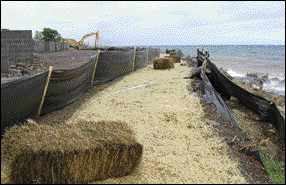
The goal of an effective erosion-control plan is to retain soil on site and prevent it from washing down storm drains and ditches into local waterways. Silt fences are a common technique, but these are vulnerable to damage from wind, and they must be maintained (above). A good silt fence should be staked every 4 to 6 feet with the geofabric buried at least 4 inches into the soil below. Straw bales will help to reinforce the fence line (top right). Even better is to build a “super silt fence” using woven wire reinforcing (bottom right).
A Shock to Waterways
Few dispute that construction-site erosion poses a significant problem. Stormwater runoff from residential, commercial, and industrial areas, including construction sites, is responsible for 21% of impaired lakes and 45% of impaired estuaries, according to the U.S. Environmental Protection Agency (EPA). While agriculture is a common source of erosion in rural areas, erosion from construction sites contributes by far the largest amount of sediment in urban waterways, the EPA reports.
Anne Kitchell is program manager of implementation for the Center for Watershed Protection, a nonprofit education and advocacy group. She says eroding soils sop up nutrients, pesticides, and other chemicals, then shuttle them into waterways. There, sediments cloud streams and rivers, preventing sunlight from reaching aquatic plants and making it hard for fish and other aquatic wildlife to breathe and forage.
Because rain sets the process in motion, storms can have a dramatic and rapid impact, Kitchell notes. “It’s sort of like the shock to the system from a tropical storm,” she explains. “The most damage can happen in a short time during the construction phase.” Coastal regions are often flat, which leads some to conclude that coastal erosion is not an issue, Kitchell says. To the contrary, sediment-filled water buries plants and shellfish in sensitive estuaries, she notes.
To address the threat, the EPA developed the National Pollutant Discharge Elimination System, or NPDES, issuing its first phase of stormwater regulations in 1990. Initially, the agency required “Best Management Practices” (BMPs) and so-called “Storm Water Pollution Prevention Plans” (SWPPPs) only for construction sites of five acres or more. But that figure was reduced to one acre in 2003, effectively putting all but the smallest construction jobs under federal regulatory oversight.
Tougher Regulations
Many states have followed the federal government’s lead. Nationally, East Coast states and cities tend to have the toughest rules and enforcement, though others may be catching up, says John Peterson, chairman of the governmental relations committee for the International Erosion Control Association (IECA).
Meanwhile, under pressure from residents who want to clean up local waterways, more and more municipalities have either already adopted or are considering their own more-stringent guidelines. “As communities are finding themselves accountable and on the hook for improving their water quality, they are looking to see how they can prevent problems from happening in the first place,” Kitchell explains.
As a result, municipalities often clamp down hardest. North Carolina’s Charlotte, which the IECA cites as a national model, is a good example. Going beyond federal regulations, the Queen City’s erosion-control rules, adopted in 2002, impose immediate fines for grading without a permit and causing off-site sedimentation, with no grace period to correct the situation. Charlotte also has eight full-time erosion-control inspectors who visit sites every two weeks, leading to more frequent enforcement than elsewhere. And the city holds contractors, not just property owners or managers, accountable for failures of erosion control.
The ability to fine contractors has had a huge impact, says Steve Gucciardi, Charlotte’s senior erosion-control coordinator. “Once we wrote contractor accountability into the ordinance, things became very different,” he notes. “We’ve assessed a lot of civil penalties. It’s had a tremendous effect.”
He adds that numerous cities and counties in North Carolina, Tennessee, and elsewhere in the Southeast routinely seek his assistance in strengthening their own erosion-control ordinances.
Costly Mistakes
Faced with tough rules bound to get tougher, what’s the best strategy for contractors? Learn the rules, learn and practice proper installation and maintenance techniques, and tap new and more advanced technologies when available and appropriate.
Best-management practices for protecting curbside inlets include the use of products such as absorbent inserts and straw wattle (top left). It’s critical to anchor these protections. Gravel bags alone (top right) might help keep large construction debris out of drains, but they won’t be very effective at keeping sediment out, and the bags are subject to damage in storms (above).
None of this is cheap, however. Today, erosion and sediment control represents between 3% and 6% of total development costs, according to the Center for Watershed Protection. Stormwater regulations of all sorts add from $1,400 to $4,500 to the cost of every lot, the National Association of Home Builders says.
But failing to “do it right” can be even more expensive for contractors who face fines. Gucciardi, the Charlotte inspector, says that the city “routinely, almost on a daily basis,” levies its maximum fine of $5,000 per day for infractions.
In his experience, major home builders are less at risk of violations than small builders.
“It all comes down to dollars. The major home builder is going to have the money to hire the grading company that has a tremendous amount of resources and equipment to install and maintain erosion-control measures,” he says. “The smaller guy, he’s really got to pay attention to his budget more closely, and the smaller guys are the ones I have the hardest time getting to come into compliance.”
At Coastal Contractor’s request, Gucciardi provided a list of the five biggest mistakes made by small builders and contractors:
1. Not understanding erosion-control rules.
2. Not understanding that mud in the street is considered off-site sedimentation. Muddy roads trigger the most citizen complaints, Gucciardi says.
3. Not realizing a storm drainage system usually ties into a stream or water body.
4. Allowing post-construction drainage into adjacent properties. (It’s not a construction-site erosion issue per se, but rather a stormwater management issue.)
5. Having the misperception that sites under an acre are exempt from the erosion-control ordinance.
To be sure, contractors of all sizes have their own problems with regulators. An extremely common one is inconsistent enforcement. “One of the things I guess I am most rabid about is getting some consistency in terms of inspection and enforcement,” says the IECA’s Peterson, adding that it’s not uncommon for contractors to receive vastly different treatments even within the same municipality.
Storm sewer catch basins and yard drains must be protected on all sides. Straw bales (above right) are commonly used, but they provide limited filtering effect and are seldom buried, so water simply passes through them. Best practice calls for a staked-in box inlet surrounded by reinforced silt fencing (left).
In 2006, Congress considered a bill, the Stormwater Enforcement and Permitting Act, that proponents — including the National Association of Home Builders — said would help streamline the process. But the bill did not pass, and its future prospects are murky.
Though installation and maintenance remain major problems, changes are also needed at the community planning level, according to “Muddy Water In – Muddy Water Out?,” a report published by the Center for Watershed Protection.
Detention vs. Retention: Detention measures aimed at slowing the rate of discharge include sediment traps (above). Retention measures, such as a sediment basin (right) are meant to reduce the quantity of stormwater by creating a pond for sediment to settle out, allowing some of the water to evaporate off.
Erosion- and sediment-control plans fail for two general reasons, the report states. Too often, they’re not integrated with a community’s other stream-protection guidelines, such as stream buffers and wetlands conservation. And they are often based on “cookie-cutter” manuals that may be outdated or lacking detailed specifications.
Traditional and New Techniques
Contractors can choose from literally dozens of different erosion-control techniques and products for varying terrains and circumstances. But the general, two-pronged strategy boils down to this: prevent soil from eroding in the first place, then contain whatever soil does wash free.
On the prevention side, smart planning is one of the first and most effective steps, Kitchell says. Contractors can keep the possibility of erosion to an absolute minimum through planning “phased clearing,” or clearing only land they plan to build on right away. With developments — even small developments containing a small number of houses — developers and builders can also forestall headaches through planning clustered housing and leaving most natural space undisturbed, she says.
An ineffective construction entrance spreads mud into the public roadway — a common occurrence that allows sediment to wash down storm sewers and raises the ire of neighbors.
Beyond that, both traditional and new techniques can be effective. Once soil is exposed, the most common traditional method is temporary stabilization through planting grass or other plants. Recent or emerging technologies, meanwhile, include spray-on “tackifiers” that grip loose soil, and environmentally friendly turf reinforcement mats that both hold soil in place and provide substrate for plants.
On the containment side, there are several common techniques, all of which are problematic in Kitchell’s eyes:
Silt fences. Contractors often fail to bury them deep enough, causing waterborne sediment to flow under or over them. They also incorrectly install them parallel to water flows, which has little or no impact. For better results, says Kitchell, bury silt fences deep and use them only in areas of light flow. Contractors might also turn to relatively new tubular socks filled with water-filtering compounds touted by manufacturers as more effective.
Construction pad entrances. Contractors often fail to install filter fabric beneath gravel entrances to construction sites intended to help remove dirt and mud from exiting trucks, Kitchell says. As a result, the trucks tamp the gravel into the mud, rendering the pad useless and spreading mud onto the roads, Kitchell says.
Straw bales. Contractors use straw bales to divert water away from a drain but often fail to bury the bales to ensure they have the desired effect. More typically, water flows under or directly through the bales. Better to use more sophisticated techniques like absorbent sacks and filter inserts for drains, Kitchell says, adding that many communities are outlawing straw bales.
Ideally, contractors who successfully control erosion will keep inspectors at bay while preserving the waterways that contribute to the value of their neighborhoods and subdivisions. But they may also see a financial benefit. Gucciardi, the Charlotte inspector, says one developer told him that he noticed an uptick in home sales after he began consistently keeping streets clean and free of dirt in his new developments. ~
Aaron Hoover writes about science and the environment from his home in Gainesville, Fla. He is a regular contributor to Coastal Contractor.
ResourcesThe University of Georgia’s Construction Site Storm Water Runoff Control (http://www.engr.uga.edu/service/outreach/Stormwater%20BMP/Construction%20Site%20Storm%20Water%20Runoff%20Control.pdf) provides a compendium of fact sheets covering effective techniques for runoff, erosion, and sediment control as well as good construction-site management procedures. The NAHB Research Center’s Toolbase Design Guide, Low-Impact Development Design Strategies: An Integrated Design Approach (http://www.toolbase.org/PDF/DesignGuides/LIDstrategies.pdf), Chapter 5: “Erosion and Sediment Control Considerations for Low-Impact Development,” provides a step-by-step guide to setting up and implementing a plan for erosion and sediment control on job sites. |


