by Ted Cushman
Ocean City sits on a barrier island that ranges from two to seven blocks wide. With the Atlantic to the east and a narrow bay to the west, explains Smokey Saduk of Haffelfinger and Standeven Construction, homes are continually exposed to a salt wind that eats paint alive. “Some of the houses here cost $20,000 to paint,” he says, “and they’re painting them every couple of years.”
But even worse than salt spray is “sand pack” — wind-driven microscopic sand particles that sift into every crack and crevice. Over five or six years, notes Smokey, the fine sand accumulates in joints, where it holds moisture through capillary attraction and begins to rot sheathing, wood siding, and wood trim from the inside out. “I have pulled stuff apart in remodeling work,” he explains, “and found the back side of cedar trim and siding rotted out all around the windows, just punked out where it was plastered against the wall.”
That won’t fly in this coastal market. With an average sale price between $1.5 and $2.2 million per floor for duplexes, Smokey thinks customers come to expect something more. In Haffelfinger and Standeven homes, that “more” comes with attention to interior and exterior details. But in a coastal environment, it’s the exterior details that have undergone the biggest changes.
ICING ON THE CAKE
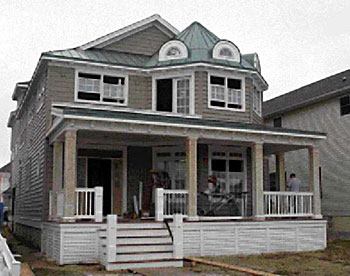
Although they recall the hand-crafted woodwork of centuries gone by, Smokey Saduk’s exterior details are accomplished with low-maintenance or no-maintenance synthetic materials. Siding and corner trim are Wolverine vinyl from CertainTeed (www.certainteed.com). Eaves, cornice, door, and window trim are built up with layers of custom-tooled Azek cellular PVC board (www.azek.com), which needs no paint. Porch columns are fiberglass-reinforced plastic Permacast from HB&G (www.hbgcolumns.com), and the large dentil blocks (or corbels) under the soffits are coated polyurethane composite Fypon from Style Solutions, Inc. (www.fypon.com). Deck boards are CorrectDeck, a polypropylene and hardwood composite (www.correctdeck.com), and the railings and balusters are a modular PVC system from Kroy Building Products (www.kroybp.com).
A Palette of PlasticsUntil about five years ago, says Smokey Saduk, he trimmed his houses out with cedar, painted white. “Then we had a house with arched garage doors, and the radius was so tight we couldn’t make the cedar work as a top jamb. So we tried a plastic composite — not Azek, but one of the earlier brands. And we found we could bend it around to fit the door head. I thought it was the greatest thing in the world.” From that start, Saduk has made the transition to using all synthetic trim materials. Here’s a quick look at the materials that are now part of his stock-in-trade. Azek. A cellular PVC material with a uniform consistency throughout, Azek comes in both boards and sheets. Boards range from 1×4 or 5/4×4 up to 1×12 or 5/4×12, in lengths up to 18 feet. Sheet stock comes in 1/2-, 5/8-, 3/4-, and 1-inch thicknesses, and in sheets from 4×8 up to 4×20. Virtually free of the bubbles or air pockets found in some plastic composites, Azek tools readily with the same tools used on wood, Smokey notes: “You can hit it with any router bit. But it is floppy, so it’s hard to run long pieces through a router table. We’ve made jigs for our routers, and we mount the 18-footers on long tables and run the router down the board.” TOOLING AZEK Holding a jig-mounted router in his left hand and blowing shavings away with a compressed air nozzle in his right, Smokey Saduk tools a custom Colonial bead into the bottom edge of a piece of Azek 3/4-inch stock. Next, he will quickly hand-sand the profile smooth using 180-grit and 220-grit sandpaper, so the surface won’t collect sand or dirt. The tools used on wood or MDF trim for the house interior work just as well for Azek board for weatherproof exterior trim, says Saduk. Dust and shavings will heat up and melt if they aren’t blown away from the spinning bit, says Smokey: “You hold the front of the jig and the air gun at the same time and blow the dust out as you go.” Easy to bend for vaults and arches, Azek can be bent even further if it’s heated: Saduk’s crew uses halogen lights to warm up pieces for arched casings or vaults. But it does have to be handled carefully: Grit or sand between two boards can scratch it. Typically, Saduk orders a whole house-load of Azek through his local lumberyard, and the entire order is shipped direct. “Whatever I’m getting doesn’t go through three or four hands,” he says: “It goes from the factory onto a pallet and straight to me.” And he says a new type of board with a wood-grain pattern embossed into one face is more scratch- and scuff-resistant: “It has a tougher shell on it, and it doesn’t show scratches.” At joints, Azek can be glued with PVC adhesive. Smokey’s crew uses Red Hot White Vinyl adhesive from T. Christy Enterprises, Inc. (www.tchristy.com). The adhesive chemically fuses the two pieces together, says Smokey: “It’s like welding — the joint actually becomes stronger than the board.” For the carpenters on site, Azek might as well be wood, says Smokey. “We use the exact same blades and saws when we go inside and start working with MDF or oak. On any given day if we’re trimming the outside, and we get bad weather or something, we can flip over and start trimming on the inside. A normal handsaw cuts it fine. A $14 hand plane from Home Depot cuts it beautifully. Coping saws, or any other traditional woodworking tool we use and carry, all work. From a business standpoint it’s great, because you don’t have to get set up with two different sets of tools.” Fypon. Ohio-based Style Solutions, Inc., bought out urethane millwork maker Fypon in November of 2004, keeping the Fypon name and adding Fypon’s product line to its own line of coated urethane millwork products. Still at the www.fypon.com Web site, the company now offers a broad array of architectural elements modeled on traditional moldings and trim accessories. The core of the product is polyurethane foam reinforced with a hard, tough adhesive; the primed, paintable eggshell exterior is a tough polyurethane. Though intended to be applied intact, Fypon millwork can be cut and tooled to some extent, says Smokey. For instance, he has sawn brackets in two, removed part of the thickness, and glued the sides back together. Seams, like nail or screw holes, can be filled with autobody filler like Bondo, then sanded and painted. Permacast. Alabama-based HG&B is one of several companies now making fiber-reinforced plastic architectural columns. Permacast columns are load rated for up to 14,000 pounds, although they are frequently installed around an inner column of wood, engineered wood, or steel. Base and capital moldings are supplied with the columns and are a polyurethane composite similar to Fypon. Permacast columns are supplied without coatings and are primed and painted on site. Because the columns are impervious to moisture and experience relatively little thermal expansion and contraction, they hold paint well, notes Saduk, but the rough coastal weather still takes its toll. “Paint should last seven years on these columns before they need repainting,” he says. |
EXTERIOR EVOLUTION
Haffelfinger and Standeven homes typically stand on tight lots in the mostly built-out existing neighborhoods of Ocean City. Homes often hug the lot lines, with only a few feet separating neighbors. Many of the houses are simple squares or rectangles to maximize lot coverage, but you wouldn’t necessarily pick this out from the street. The company makes the most of each building’s front exposure, incorporating polygon bump-outs, barrel vault dormers, carefully trimmed-out arches, and eyebrow windows (Figure 1), as well as decorative porch details (Figure 2). Eaves and cornices get layered trim treatments using profiled Azek, as do windows, doors, and porch beams (Figure 3).
VAULTED WINDOW DETAILS
Figure 1. Eyebrow or barrel windows on Saduk’s polygon turrets are carefully wrapped with asphalt paper (top left), then may receive a layered Azek face trim consisting of a single radius-routed face piece, capped by an Azek radius upper casing with a tooled-in bead (top right). Inside the house, barrel vault window bay ceilings (bottom left) are also formed with Azek, which can be painted like the other walls (on interiors, Azek is less subject to thermal expansion and contraction, and paint is also not exposed to weathering). Azek is also used to form vaulted interior door jambs and pass-through window jambs (bottom right).
DECORATING THE PORCH
Figure 2. The workability of Azek lets Smokey tool dadoes into the back sides of boards used to wrap porch beams (top left), so that the board beneath the beam can float free, trapped between the two side pieces. This allows for a clean, sharp, equal reveal and makes it easy to set the pieces flat. In this case (top right), a second piece of beaded Azek is applied tight to the ceiling of Azek beadboard. Inside corner joints where Azek boards meet are coped with an ordinary coping saw. The porch column is Permacast, and the capital applied tight up under the beam is Fypon (bottom left). The column and capital were supplied primed and will receive paint, which should last five to seven years. Inside the porch, an entry door receives a decorative trim treatment: The fluted door casings, head casing, small dentil blocks, and cap rail are all custom-cut and -tooled Azek (bottom right).
WINDOW HEAD AND EAVES DETAILS
Figure 3. Dodging raindrops on a showery New Jersey afternoon, Smokey Saduk mocks up a window head trim-detail option for his clients to visualize (bottom). A finished portion nearby (top right) shows the transition from window trim to eaves. This area uses a combination of materials: The frieze board and fascia are custom-tooled Azek, the soffit is vinyl porch-bead with a hidden vent slot, the pediment brackets beneath the soffit are Fypon, and the window casing is snap-in vinyl trim. Rakes and cornice returns are detailed using built-up layers of Azek with a tooled-in Colonial bead (top left). Against the house walls, Azek pieces are mounted on a hidden packer board of pressure-treated plywood, creating a dead-air pocket to receive the ends of siding pieces.
Although there’s not a single stick of wood showing, the finished homes hark back to the intricate woodwork of the Victorian or Georgian periods. “I picked up a lot of ideas from Colonial Williamsburg,” says Smokey. “And I’m only half an hour north of Cape May [a New Jersey seaside resort noted for its Victorian architecture], so I am always down there picking up ideas.”
Initially, Saduk’s attention was focused on reproducing traditional details in cedar. But in the last five or six years, he’s made the switch to all synthetic materials (see “A Palette of Plastics,” below): Azek cellular PVC board and sheet stock, Fypon coated-polyurethane decorative elements, and Permacast marble-and-resin synthetic columns. The Azek is never painted; the Fypon (which comes with a primer coat) and Permacast are painted on site.
Impervious package. Made of impervious materials and installed with tight, carefully worked joints (and even, in places, with adhesive-welded bonds), Saduk’s siding and trim package sheds the majority of water that strikes the building in the rainy shore climate. “We use no surface caulk on the building, because the beach sand sticks to it and makes a black outline,” explains Smokey. The building relies instead on water-management details buried beneath the siding and trim; this secondary weather barrier is carefully applied and flashed before any of the siding or finish materials are installed.
SECONDARY WEATHER BARRIER
The basic drainage plane material backing up the siding on each house is #30 asphalt-saturated felt paper, lapped 4 inches at horizontal joints and 2 or 3 feet at vertical joints. The crew double-wraps inside and outside wall corners, extending paper 2 feet around the corner from both sides. Saduk has reason to trust asphalt paper: “I’ve pulled off asphalt paper that was 50 years old, and it was beautiful — and the wood behind it looked brand-new,” he says.
Corners also receive a bent flashing, made from foot-wide vinyl-coated aluminum coil stock, which provides 6 inches of flashing on each side of the corner (Figure 4). Any nails driven through the metal (including the nails used to fasten mounting brackets for vinyl corner trim) create their own seals, says Smokey, so that wind-driven water under the siding can’t reach nail holes: “You’re pinching the asphalt paper between metal and wood, and you are essentially building a gasket around the nail shank.”
WATER-MANAGEMENT DETAILS
Figure 4. Impervious, no-maintenance claddings are backed up by asphalt paper and PVC-coated aluminum flashings on Smokey Saduk’s oceanfront home exteriors. At wall bases (top), asphalt paper underlies a pressure-treated nailer and beaded Azek trim board; flashing and paper also cover the top of the trim piece, capped by an Azek shelf. At wall tops, metal flashing is applied before the upper nailer and trim piece (middle). The nailer and frieze hold vinyl soffit material tight to the flashing and provide a dead space for the top termination of the siding. The vinyl siding clips into a mounting bracket at its bottom edge, nailed above the skirt board’s Azek shelf (bottom).
Windows. Window openings are also handled with asphalt paper, double-lapped. The crew sets strips of asphalt paper under the window, along the side, and (after setting the window) across the top. The bottom strip is left free so that paper can be stapled to the wall inboard of it; paper applied to the wall by the sides of the windows laps onto the outboard face of the vinyl window flanges.
As with the corner flashing, explains Saduk, mounting hardware for vinyl window trim pieces creates a gasket effect (Figure 5) — nails squash the asphalt paper tight between the mounting brackets and the wood wall sheathing, so that a tight seal is created surrounding each nail shaft.
WEATHERTIGHT WINDOW OPENINGS
Figure 5. Window openings are prepped with asphalt paper before flanged vinyl-clad windows are installed. Side flanges are sandwiched between layers of asphalt paper, while lower flanges lap outboard of all paper layers (top). Window casings snap into blind-nailed plastic mounting brackets (second); on the side away from the window, casing pieces form a J-channel pocket to receive siding ends. Casing pieces are notched at inside corners to create a positive overlapping drip edge (third and fourth).
Walls. At the tops of walls, the crew runs the asphalt paper up to the rafter seats, well into the area that will be buried within the soffit. Then a reverse flashing of bent vinyl-coated aluminum is nailed over the paper, at the right height to catch the vinyl porch-bead soffit material that the eaves will receive (Figure 4, above). When the vinyl is installed and a pressure-treated nailer is set tight up beneath it, the flashing will help block wind-driven rain from pushing up into the soffit or roof system.
At the wall base, Smokey typically installs a “water table” detail — a built-up skirt board with a narrow, sloped shelf resting on it (illustration below). The wall behind the skirt board is papered before the trim is applied. Flashing is installed above the skirt board, and an upper course of asphalt paper lapped over that, before the 12-degree sloping cap is installed above the skirt.
WALL SECTION A beautiful exterior relies on good water-management details beneath the siding and trim. Vinyl-coated aluminum flashing and #30 felt must be lapped to allow water to drain downward and to the exterior and out. Pressure-treated packing beneath finish trim is key to keeping the trim out in front of the materials lower down on the wall to promote good drainage.
AN EVOLVING TRADEMARK LOOK
The total look has taken years to evolve and is still evolving, says Saduk. “The first couple of years I wasn’t making a lot of money. But now, for a 4,000- or 5,000-square-foot house, we might be doing a $90,000 siding package out of vinyl.” The trim and siding package has become a trademark look, he says: “We’re start-to-finish builders — we’re general contractors — and this has become a key feature of our buildings that people are starting to recognize over and over again. It definitely kicks the entire project up a notch.”~
Ted Cushman reports on the building industry from his home in Great Barrington, Mass. All photos by the author.