
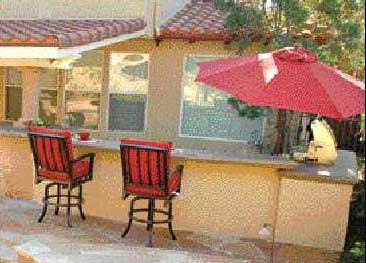
Though a few designers place kitchens some distance from the house, doing so could be quite inconvenient, because the cook will likely have to make numerous trips to and from the main kitchen. Next to the house is a better location.
Time was when the only requirement for a cookout was a grill, a good set of tongs, and a Styrofoam cooler to ice down the beer. Today, the grill might be built in, and it may be accompanied by a rotisserie, a refrigerator, a sink, a beer tap, warming drawers, and a pizza oven.
In fact, many high-end builders now offer well-designed outdoor kitchens to their customers, and some find that these spaces provide the stimulus for remodeling the entire backyard. “It’s one area where husband and wife agree that it’s a good place to invest money.
It’s a focal point for outdoor entertaining,” explains Scott Cohen, garden artisan for Green Scene, a Los Angeles-based landscape design and construction firm.
But builders on the hot, humid Gulf Coast who want to offer outdoor kitchens face the added challenges of high winds, tidal surges, extreme heat, and humid, salt-laden air. Anything outdoors needs to be able to withstand a beating. Crafting a great space and specifying durable materials are essential.
DESIGN CONSIDERATIONS
Home buyers in places like South Florida, Louisiana, or Texas naturally want to spend time outdoors, so the outdoor kitchen needs to be more than a place to cook. As an architectural element of the home, it should be “part of the whole outdoor living experience,” says Louis Nequette, principal of Dungan Nequette Architects in Birmingham, Ala. “People make a lot of their living and purchasing decisions based on their ability to connect with the outdoors. It’s a strong amenity.”
One reason this amenity has grown so popular is the growing list of options available for outdoor kitchens. “We have built-in beverage centers, captain’s tables, warming drawers, outdoor stereo equipment centers — almost none of which was available five years ago,” says Cohen. “Plus, outdoor furnishings have changed. We’re not dealing with strappy lounge chairs anymore.”
Cohen considers four primary design elements when designing an outdoor kitchen:
Proximity to the house. Some clients want the outdoor kitchen as far away from the house as possible, but he recommends against it because “you always end up making multiple trips inside. Placing the outdoor kitchen next to the indoor one is more practical. If you want to make the best use of the back corner of the yard, have it be a dining area or a fire pit.”
View. The view from the house and the outdoor kitchen needs to be taken into account. Simply put, make sure it’s attractive.
Prevailing winds. One caveat when locating an outdoor kitchen next to the house is that you don’t want to place the grill where smoke can be blown inside. This is more of an issue for homes directly on the beach, where winds tend to be stronger.
Countertops. The shape, size, and configuration of countertops are as important outdoors as they are inside the house.
Coastal designers report that outdoor kitchens are a hit with residents. Marieanne Khoury-Vogt, town architect for Alys Beach, a sustainable, Gulf-front community in the Florida Panhandle, has designed an outdoor kitchen for the second-floor terrace of one of its compounds as an amenity for residents. “It’s been used a tremendous amount,” Khoury-Vogt says. “Having the ability to cook and dine outside is a wonderful part of vacation living.”
Built against a 42-inch-high wall, the kitchen features a stainless steel stove, a sink that’s deep enough to handle large platters, an ice maker, a dishwasher built into a masonry enclosure, and ample counter and storage space. A 1-inch-thick shellstone countertop coordinates with the shellstone pavers on the floor.
With some advance planning, construction was fairly simple, Khoury-Vogt reports. When the house was built, the terrace was stubbed for water and gas
and wired for lights and outdoor speakers. “All construction had to do was build the frame. The appliances went in and that was it,” she says. “We mounted a couple of vapor lights on top of the wall.”
CHOOSING A GRILL
The core piece of any outdoor kitchen is, of course, the grill, and one of the most important issues to be aware of when choosing and locating a grill is heat. Most gas grills are built so that heat exits from the back of the unit, according to Michael Cartwright, a 20-year veteran of Gulf Coast landscaping who now owns Outdoor Polymer Systems in Houston, which builds heat-insulating grill islands. He advises against installing grills against the house. He says that some high-end manufacturers like Viking and Fisher & Paykel build enough insulation into their grills that, even when fully heated, they are just warm to the touch on the outside. But most grills need to be installed so that they are well ventilated on the sides and back and do not contact combustible surfaces.
On the Gulf shore where Cartwright works, the big issue for anything made of metal is corrosion. More than anything else, you need to know your steel, he notes. “All products are not created equal,” he explains, but adds that high-quality grills with good stainless steel can last a long time. “I have seen DCS grills installed on the Florida coast that were still performing well after several years.” His minimum specification for outdoors is 304 stainless steel.
Cartwright says to beware of powder-coating — it may be covering a lower-grade steel that won’t hold up in salt air. He also avoids grills with electronic gadgets, because the electrical connections tend to corrode after a short time in his environment. “If it has LED lights on it, I say no thank you. It’s not going to last when exposed to salt air.”
To avoid pitting from saltwater, the minimum specification for stainless steel on the beach is 304 stainless. Homeowners should be cautioned to clean and cover grills immediately after use.
This also goes for outdoor receptacles. Many customers want plug-in accessories, such as rotisseries, which require a plug near the grill. For this, Cartwright recommends an outdoor receptacle inside the grill box, or an extension cord run to the garage. “I’ve never seen an outdoor ground fault plug that survived more than six months on this coast,” he says.
Grill igniters also are “a huge issue,” Cartwright notes. Most homes on the coast will have LP gas. “Anytime you have LP gas connected to a gas appliance, if you don’t get instant ignition, gas collects in the bottom of the box. It’s an explosion issue. It’s the same kind of condition as on a boat. It needs to be incredibly cross-ventilated.” Also, he advises, make sure you have a gas connect shutoff right by the grill.
A drop-in cooler is a good alternative to a refrigerator. It’s a simple, insulated box that’s built into the counter and filled with ice and drinks.
Finally, you need to educate the homeowner about the need for cleaning and lubricating. “Even stainless will get surface rust,” he says, adding that a stainless grill should be wiped down after each use, and it should be washed and lubricated at least twice a season. He also reports that while there are plenty of products on the market for cleaning and lubricating stainless, he gets the best results by washing the grill with soap and water, then rubbing it down with good old WD-40. “In my experience, WD-40 works great for keeping rust off in salt environments.”
WATER AND ICE
Once people start cooking outdoors, they’re inclined to want a sink for food preparation and cleanup as well as a refrigerator to keep beverages cold.
Both can be problematic.
Adding an outdoor sink to a home built on piers or pilings is no simple matter. Many municipalities don’t allow utility construction on the ground floor, although some homeowners install kitchens there after they have moved in. Even where ground-level kitchens are permitted, the potential for tidal swells means that the supply lines should descend down from the house, not up from the ground.
Drains can be an even bigger challenge. Local code requirements for
drains can make ground-level sinks not worth the cost. Check the local building code. Some contractors have reported costs of over $3,000 for sewer connections. That’s an expensive sink. It’s a lot cheaper just to put a hose spigot into the barbecue center.
While refrigerators might work well for outdoor kitchens in much of the country, they’re not necessarily a good idea at the Gulf, according to Cartwright. The problem is the extreme summer heat. “These products are not made to operate in 110-degree weather,” he says. As an alternative, Cartwright and Cohen both recommend a beverage well. Also called a drop-in cooler, this is not a sink but an insulated box that’s built into the countertop and filled with ice and drinks. “The homeowners don’t have to plug it in, and if it’s a seasonal home they won’t have to worry about whether it will still be working when they return next season,” says Cartwright.
When clients insist on outdoor refrigeration, Cartwright advises an inexpensive minifridge that’s just big enough to chill the beer and keep the condiments from spoiling. “We get more callbacks on high-end refrigeration units than we do for the $99 units we buy at Home Depot.”
A refrigeration unit is a handy addition to an outdoor kitchen. It’s best to specify a small refrigerator made for outdoor use. Standard refrigerators are made to operate in relatively mild indoor temperatures, not the extremes of heat and cold found outdoors.
USING MARINE-GRADE MATERIALS
Some builders of high-end coastal homes prefer to use marine-grade materials outdoors for everything from flooring to hinges, despite the high cost. One of these is Daytona Beach, Fla.-based ICI Homes, which offers buyers summer kitchens placed under cover on lanais, says Steve Reeger, ICI’s building science specialist.
Reeger specifies stainless steel, UL-rated appliances that sit on cabinets constructed of marine-grade plywood covered with laminate, and countertops made of marine-grade plywood covered with ceramic tile. Another good cabinetry option, he says, would be concrete block covered with stucco, and stainless steel, cypress, or cedar doors. Ipe and teak also are excellent wood choices for flooring, cabinetry, and seating areas.
ICI Homes offers its Florida buyers a combination of inside and out with “summer kitchens” placed in screened-in lanai porches.
“There are a number of products that won’t last two years,” he says. “You need to use materials that will be durable and withstand harsh salinity.”
That includes cabinet hinges. Cartwright recommends hinges built for sailboat hatches, available in marine stores. Barring that, “buy the highest-grade European-style hinges and grease them up. Bottom line: don’t be afraid of lubricating to make sure things stay in good condition.”
Pat Curry is an Atlanta-area writer who specializes in building topics.


