A SIP-and-timberframe builder hits the beach
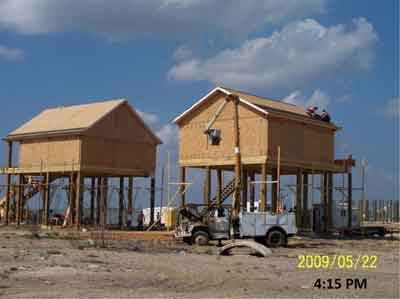
Hurricanes teach lessons. Residents of Bolivar Peninsula, ground zero for last fall’s Hurricane Ike, got a crash course — and for some diehard Bolivar residents who are determined to rebuild, the lesson was to bring the heat next time. Illinois-based Eagle Panel Systems has something for those Texans, says company CEO Ken Disch: A hybrid timber-frame and structural insulated panel (SIP) house framing system trademarked TRISIP Cat-5 (www.trisipcat5.com), engineered for 185-mph winds. Eagle Panel already had a souped-up SIP on the market before the storm — a panel with 2×4 or 2×6 framing embedded into the foam-and-OSB sandwich. And they already had a system for combining their panels with timber frames, developed in cooperation with Amish timber framer Ozark Timber Frames, LLC (www.ozarktimberframe.com). But when Ozark owner Danny Schwartz traveled to Texas for a relief mission on the Bolivar Peninsula, he came back with a new determination to kick it up a notch. As Ken Disch puts it, “Our position is that you can’t stop people from building on the beach — they love that location too much. But if you are going to build down there, those houses should be overbuilt, not underbuilt.” Like Ozark’s and Eagle’s existing systems, the new beachfront houses go up fast — it took four days to frame two houses on the peninsula this spring (see photos). And they’re energy efficient (houses typically earn the Energy Star label). What’s new is an increased emphasis on redundant wind-resistant structural details. The embedded studs in the wall panels are screwed to the OSB skins. They also serve as anchoring points for wind uplift strapping. This allows a complete load path from the pile foundation girders, through the wall studs, and up to the 6×6 horizontal timber beam at the wall top, without relying on any attachment to the OSB skin. “That top beam is the secret to the strapping, because you’re screwing into a 6×6 beam,” says Disch. Timber roof trusses are bolted to the wall sill beam also, and SIP roof panels are screwed to those trusses. But in addition, house corner trusses receive a 3/4-inch steel rod through the top of each truss, down through the wall, and bolted to the elevated house foundation’s deep timber piles. “It’s as hurricane-proof as anything that I’ve seen done, short of a concrete bomb shelter,” says Disch. Step one in a four-day, two house build: Standing SIP walls atop stick-framed floor systems on elevated pile foundations. Two-by-four framing embedded into the panels on 16-inch centers serves for attaching metal structural connectors as well as fiber-cement siding.
With corner posts and wall beams set, a pre-skinned gable-end timber truss is flown in by crane. A steel rod will tie the truss directly to the foundation.
Eight-inch roof panels with tongue-and-groove wood facing complete the assembly. Insulation levels and air-tightness in these homes will surpass Texas energy code requirements. Will the system take off in Bolivar? Disch is guardedly optimistic, given the difficult situation on the peninsula. “There are people who were uninsured, or are underinsured, or are still fighting with their insurance companies,” he notes, “and there are people just waiting to see what the hurricane season has for us this year.” But he says there’s a buzz growing for his product. “We got a lot of press and TV coverage for that two-house build,” he says. “I’ve got another one being delivered August 10th that is a two-day job.” Currently, Disch is looking for a local builder to represent the idea in Texas. “Builders generally aren’t the type to go out and promote new things,” he observes. “But my rep is going down there on the 10th too, and his purpose is to find a builder that will put up a model home, out there on the Bolivar. Once we have that in place, I think we’re going to sell a lot of houses down there. Cause there is no reason to rebuild the Bolivar back the way it was before — there’s no way it can stand.”