
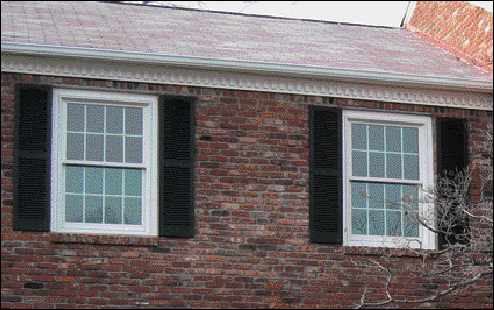
I have replaced hundreds of windows in brick-veneer homes across Long Island. The coastal environment requires a little extra care, but the procedure is essentially the same for any climate. The tricky part with brick is getting the flashing in the right place.
With most window replacement jobs, the ideal installation requires the removal of the siding, which allows the window to be integrated with the existing weather-resistive barrier (WRB). In a brick-veneer structure, however, that’s not so easy. Removing aged brick and mortar to access the window is certain to be noticed long after the job is done. The additional cost associated with surgical removal and the painstaking process of matching new brick and mortar is often prohibitive to most clients. So I resort to the methods described here. The procedures are a compromise, but they’re a lot better than leaving an old drafty, leaky window
Measurement Is Key
The selection of the proper window is the primary consideration in this environment. I prefer to use a “prime” window. One I use a lot is the Andersen replacement window; it can be custom sized to fit the openings perfectly, which makes all the difference. But any high-quality window with a nailing flange system will work if you can get the right size for the existing openings.
Pay attention to measuring for the new window. When the window opening is in place, the flange will be secured to the framed wall and will be recessed into the brick opening. To ensure a watertight installation, you need enough room to integrate the flashing with the existing WRB.
There are two measurements of concern here: the rough opening (RO) and the brick opening (BO). The RO is the interior dimension of the framed wall opening. This is the opening we are most familiar with when installing windows in a framed wall. The BO, on the exterior, must be big enough to give us room to maneuver with our flashing around the new window. This space will get covered with an exterior brick mold once the new window is in place.
If we’re lucky enough that the existing window has a wood-frame window with a brick-mold exterior trim, the existing RO can usually be used to order the new window. The old brick mold provides the room we need to integrate the flashing. But most of the applications I see involve old metal-frame windows (usually steel or aluminum) that were mounted to the RO prior to the application of the brick veneer. The edges of the window typically come right to the edge of the BO, and the flanges are buried behind the brick. Steel-frame double-hungs, which have a spring mechanism buried in the jambs, have an even larger RO. In any of these cases, we can’t use the existing RO to order new windows.
Instead, I first measure the BO from the exterior, then open the window and reference the available RO to the BO. The window should fit in the BO with enough room to allow at least 1 1/4 to 1 1/2 inches on both sides of the window and a minimum of 3/4 inch on the top. It may be necessary to pack out the old RO to create an opening that is this much smaller than the BO. Ideally, I like to have 2 inches on the bottom, too, but I rarely get that and will settle for less if necessary.
Integrating New Flashing and the Existing WRB
Almost every job I have done has had No. 30 felt or building paper over the framed walls as a WRB. When removing the old window, care must be taken to preserve the integrity of this existing WRB. After a number of years it can become dry and brittle, so we have to be gentle to keep from tearing it up when working the opening.
Once the old window is out, we focus our attention on preparing the opening, using a metal sill pan and flexible flashing, as outlined. It’s important to use a sill pan that gives you an upturned edge on the inside to block water draining to the interior, and to lap the flashing over the pan so water draining from higher up will be caught by the sill pan.
In some cases, however, there is not enough of a space behind the brick to push the flashing tape back there. Or, the mortar that squeezed out on the back side of the brick has clogged the space. This squeeze out may be chipped away at the edges, but if it’s really heavy, even that won’t be enough to provide clearance for flexible tape. In this case, I bend four aluminum or copper L-shaped strips, as shown. At a minimum, the legs of these L-strips should be 2 inches, but a 3- to 4-inch leg is preferable. Remember: The farther the water is deflected by the flashing from the edge of the BO, where the most water is likely to get blown in, the less likely the water will find its way back into the RO as it drains down the wall.
BUILDING SCIENCE BASICS
The goal in any window installation is to keep the outside environment where it belongs: outside.
The goal in any window installation is to keep the outside environment where it belongs: outside. By "outdoor environment" we mean several things: the outdoor moisture, the outdoor air, and the outdoor temperature. Moisture is the obvious element. Anyone who's been in the trade knows that all windows will leak eventually. For this reason, every window should have a sill pan that will catch water that leaks through the window unit itself, providing drainage to the outside. The flashing at the head and the sides is meant to deflect water that leaks past the siding and around the window trim, shedding it to the outside. Therefore, the order in which the flashing is installed is important, so lower courses will lap under the courses above. In a coastal environment where water is likely to be driven by the wind, it's especially important to use a self-healing butyl-based adhesive that will seal around the trim fasteners that will get driven through it. DuPont StraightFlash (www.dupont.com/construction), Grace Vycor (www.na.graceconstruction.com), and Pactiv GreenGuard (www.pactiv.com) are all butyl-based products.
Air sealing is less obvious to some builders but not less important to the performance and durability of a home. The gap around every window and door in a house represents a serious hole in the building enclosure, which not only will siphon off conditioned air from inside the home and pull outdoor air inside where it will displace conditioned air, but it can also carry moisture vapor that will condense on the first cold surface it encounters, leading to mold and rot. The greater the temperature difference between indoors and out, the more likely this will occur.
The exterior is not the place to deal with air leakage, however. Instead, seal the window from the interior with a low-expansion, closed-cell polyurethane foam sealant, such as Great Stuff Pro Window & Door (www.greatstuff.dow.com), Pur Fill 1G (www.todol.com), or Touch n' Seal Window & Door Sealant (www.touch-n-seal.com).
If you get the flashing and air sealing right, then all the high-performance features of a good window, such as low-E glass and gas-fills and nonconductive spacers, will be meaningful, and the chances of the home being able to keep the outside temperature outside are much greater. — M.S.
Installing the Window
Once the sides and the sill have been wrapped, it’s time to install the window. If the BO is tight, we may need to trim back the window flanges. I often have to completely remove the bottom flange to get the window in, as well. A jigsaw works for trimming off a formed vinyl flange. On some windows, it’s possible to pull the flange extrusion out of the frame, or it may require careful trimming with snips and a utility knife.
When installing the window, first apply caulking to the top and two side flanges. Without a bottom flange, we don’t need caulk there. But even when we have an intact nailing flange, we never caulk the bottom of a window. If water leaks through the windows, it must be able to drain out.
Shim and square the window, and check it for proper operation. In coastal zones, impact-resistant units usually must be installed with framing clips, as shown. This actually simplifies the installation, since the nailing flanges may be hard to get to, especially at the top. If the window manufacturer does not offer special metal clips for this purpose, I use a 20-gauge metal tie plate, such as a Simpson Strong-Tie TP15 or TP35, screwed to the window first and then folded over at the inside edge of the stud. If you’re unsure what the local codes require in high-wind zones, it’s prudent to check with the code inspector first to make sure this will work.
After the window is in place, I foam the gap between the window and the RO with a low-expanding foam to create an effective air seal (see “Building Science Basics”).
Final Flash
With the window installed, I go back outside and apply flashing tape over the flange. This can be difficult if the BO is tight. If possible, I push the tape behind the brick. However, if there is not enough room to get this final flashing behind the brick, I’ll leave it long, allowing it to flap alongside the brick (Figure 6). Then, after I install the brick mold (or other trim to fill out the masonry opening), I will trim this excess away and caulk the trim to the masonry at the sides and bottom of the BO. Across the head, though, I leave gaps in the caulk to allow any water that might get past the brick above to escape. Most brick veneer should also have weep holes above the lintel for exactly this purpose.
Photos by the author and his crew. Illustrations by Chuck Lockhart.


