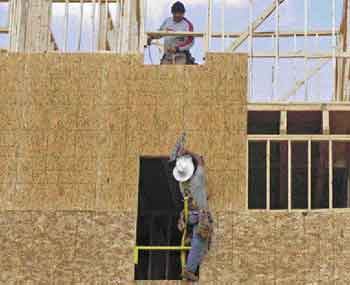
by Ted Cushman
Code Analysis
Any coastal builder knows that tough wind-related codes along the Atlantic and Gulf seaboards have made structural design more complicated. Where the codes once concentrated mostly on verifying that buildings could handle gravity loads, now — ever since Hurricane Andrew — coastal homes must also resolve the complicated load effects associated with high winds: uplift, shear (or “racking”), sliding, and overturning (Figure 1).
Figure 1. Engineers analyze the interactive effects of high winds on a building in terms of four types of building responses: (1) “uplift,” the suction of wind on the roof; (2) “shear” or “racking,” the tendency of rectangular building elements to deform into out-of-square parallelograms; (3) “sliding,” a sideways pushing force; and (4) “overturning,” lifting and toppling of the structure from the windward side. An engineered design has to provide for connections of predictable strength to resist all of these assumed load conditions.
In wind-speed zones up to 100 mph, the prescriptive requirements of the 2006 International Residential Code (IRC) are sufficient for wind-resistant design of most houses. In higher wind-speed zones, however, rules call for an engineer to specify the structural details — a process that may require a full, highly technical analysis of the wind loads on the specific structure. Typically, the resulting structural design will account for all the loads using a system of engineered shear walls and diaphragms — ignoring the possible strength contribution of other building elements and relying heavily on metal hardware.
But that full engineering process can be time consuming and costly; the hardware specified can be expensive; and for typical homes, neither the case-specific analysis nor the structural connectors are always necessary. As builders in coastal areas hit by Hurricane Katrina struggle to rebuild affordable housing for an unprecedented number of displaced residents, there is considerable pressure to moderate the cost burden of wind-related design and construction rules. To help reduce these costs, committees representing a cross-section of the industry have been putting a concerted effort into developing new codes, striving for cookbook-style guidelines that builders and designers — not just engineers — can understand and follow. In many cases, these new prescriptive solutions can be accomplished with less reliance on expensive hardware and more emphasis on ordinary wood framing and sheathing.
The Uplift Load Path
Let’s take a closer look at just one kind of loading: uplift. When a high wind strikes a house, the flow of air over the roof creates an upward suction, in the same way that wind creates lift on an airplane wing. Wind tries to lift shingles and sheathing off the roof, the roof sheathing pulls up on the roof rafters or trusses, the roof structure pulls up on the wall plates (trying to lift the walls), and the walls pull up on the floor deck or foundation that they rest on. If any connection anywhere along that load path fails, the structure can come apart. It’s just one of the ways that wind can destroy a house, but it’s an important one and has to be understood, designed for, and built for.
Engineers have spent countless hours designing hardware solutions for strengthening the uplift load path (Figure 2). A typical scenario looks like this: At the wall base, hold-downs and strap anchors tie the sill to the foundation, and U-shaped or T-shaped clips connect the wall plate to the studs. At the top of the wall, the same clips connect studs to the top plate. Flat straps tie lower-story wall studs to upper-story wall studs, bringing the uplift load across the floor frame. And where walls meet roofs, twist clips or other special straps tie down rafters and trusses. All of these connectors have been thoroughly tested and rated for their load capacity, so engineers have no trouble matching the connector to the estimated design load. But for builders, each metal connector adds cost and labor time.
Figure 2. In considering uplift, engineers start with the upward pull on the roof sheathing and estimate the uplift at each connection, including the rafter-to-wall joints, the stud-to-plate joints, and the sill-to-foundation joints. The integrity of the wall frame, acting as a unit against the upward tensile pull, can be provided by rated steel connectors and nailed sheathing, or a combination of the two.
Sheathing for uplift. Engineers working for APA – The Engineered Wood Association, a plywood and OSB industry group, have been pushing what they say is a less costly alternative to metal hardware: full plywood or OSB wall sheathing, carefully applied and heavily nailed in a way that lets the sheathing and nails pick up much of the uplift load. If the sheathing laps over the wall plates at top and bottom, and if the panels are nailed to a framing member or blocking along all panel edges, the sheathing and the nailed connection often have enough strength to resist the uplift loads without any help from hardware. Because coastal homes generally require structural wall sheathing to resist racking, the panel industry argues, it only makes sense to use the plywood or OSB to resist uplift as well, wherever feasible.
Steel still required. In most situations, steel framing hardware will still be required around window and door openings (Figure 3) and at other places where special load paths exist. Shear-wall elements typically still require hold-downs as well. But for many clear wall sections, builders who fully sheathe their walls may be able to skip the hardware (Figure 4). As Louisiana building code consultant and longtime builder Paul LaGrange points out, “It’s easier when you can do something with the sheathing instead of the metal connectors — easier, faster, and cheaper.”
Figure 3. Where plywood or OSB sheathing is relied on to resist uplift, holes in the wall structure such as window and door openings are a special case. Typically, load-rated steel connectors will have to be used at the base of the window jacks, at the points where headers rest on jack studs, and between the headers and the framing above them. Design engineering is often required, but a full wind-load analysis may not be necessary if specifications can be found in a prescriptive guide such as the Wood Frame Construction Manual (see “Resources,).
Figure 4. In two-story houses, uplift loads from an upper story to a lower story have to be transmitted across the second-floor frame. One solution to ensure successful transmission is to connect steel straps from upper-story to lower-story studs (above). Or, where the studs don’t line up, to connect studs from both stories into a band joist that is structurally adequate to transfer the loading. Plywood or OSB sheathing that spans across the floor system can also serve the purpose (left), as long as all the edges are nailed to solid framing or blocking. Guidance on sheathing-based techniques can be found in APA Publication E510 (see “Resources”).
Long sheets. The requirement for continuous perimeter blocking and nailing of wall sheathing in high-wind situations does involve some labor, so reducing the number of sheathing joints can save time and expense. Glimpsing opportunity, OSB manufacturer Norbord (www.norbord.com) is one company that’s developed a new line (www.windstormosb.com) of long OSB sheathing panels for those who want to use sheathing to handle uplift loads as well as building code braced-wall or shear-wall requirements. These panels are just like any other 7/16- or 15/32-inch-thick OSB, except for the length: the company supplies the material in 21 different lengths tailored to various wall styles.
A Builder Adjusts
Louisiana’s largest home builder, Southern Homes — one of the state’s few true “production” builders — switched to using Norbord panels in early 2007. Says vice president David Stanton, “Before that, we had U-straps on the bottom and top of the studs, which are now gone. We had header straps on all window and door headers; we’ve eliminated those too. And on the first floor of two-story homes, we’ve eliminated corner hold-downs as well.”
Uniform design. Southern Homes builds primarily in the 110-, 120-, and 130-mph wind-speed zones. Requirements in each zone are slightly different. But the company uses a factory-built panelized wall system and relies on the same two framing-trade contractors to frame houses in all its neighborhoods. So for simplicity’s sake, explains Stanton, “we’ve chosen to build to the 130-mph wind speed in all the communities we build in — whether it’s actually below 110 mph or up to 130 mph — just to keep our framers and our fabricators straight.” Codes require a design professional to specify the wind-resistant details in those high-wind areas. But Stanton notes, “With the Norbord sheathing, we’ve eliminated so much strapping that it’s just not that big a deal on site.”
The key detail is the nailing. “We’re putting nails 3 inches on-center on the edges of the panels and 6 inches on-center in the field,” says Stanton. Wall sections are delivered to the site fully sheathed but with only one piece of the double top plate installed: “So they are sending it out nailed in the first top plate at 3 inches on-center. Then our framer has to apply the second top plate with the proper laps and nail that 3 inches on-center, too.”
Tying in. The wall is not the whole picture, of course — it has to be anchored into the foundation below it and tied to the roof above it. Although Southern Homes’ outside engineer has not required hold-downs, he is calling for closely spaced foundation anchors: “We’re using 5/8- by 10-inch anchor bolts with 3-inch flat washers at 24 inches on-center,” explains Stanton, “plus we need two anchor bolts within the first 8 inches from the wall corner.”
Although wall sheathing can tie upper to lower stories adequately, Southern Homes’ wall-panelizing system doesn’t allow for sheathing to span between stories, notes Stanton: “The walls come out fully sheathed, and then we put our floor truss system between the stories and put sheathing on that.” So to transmit the uplift load between floors, crews still install straps between upper- and lower-story wall studs. “We’re putting straps on every stud across the floors,” says Stanton. And where roof trusses sit on wall plates, every truss is tied down to the wall plate or to a wall stud using a steel connector (Figure 5).
Figure 5. Plywood or OSB sheathing can resist uplift loads within a wall structure as long as the sheathing fully overlaps the plates and is sufficiently well nailed. But hardware is still needed to tie the wall to the roof above it. Connectors located on the outside plane of the wall line up with the sheathing to create a load path of high capacity (far left). But if the connectors simply tie the inside of the wall plate to the roof framing, the plate can twist under a load, reducing the strength of the connection (left). For that reason, truss or rafter ties located to the inside of the wall should tie the roof directly to the studs, not just to the wall plate.
Codes and Standards: Under Construction
As Gulf Coast builders take on the challenge of rebuilding, code and standard bodies are reworking the guidance they provide for structural design of houses.
The main authority for engineered building design is ASCE-7 (the American Society of Civil Engineers Standard 7), which lays out highly technical procedures for estimating all the loads on buildings, including wind loads. In specifying wood-frame solutions to meet those loads, engineers can turn to the National Design Specification for Wood Frame Construction, or NDS, published by the American Wood Council (www.awc.org). Engineers draw from the NDS their assumed values for the strength of sheathing nailed to studs.
But analyzing the specific loads on a building based on its size and shape, then adding up all the rated strengths of every nail in every stud, plate, or joist is a tedious way to create a design. To streamline the process for the bulk of homes — small, simple buildings with standard details — the industry has come up with prescriptive design manuals that apply to most ordinary buildings. The American Wood Council publishes the Wood Frame Construction Manual (WFCM), which has prescriptive solutions that are “deemed to comply” with ASCE-7 for seismic, wind, and gravity loads for a limited range of house sizes and shapes (see “Resources,” page 44). Even easier to use are the AWC’s new “WFCM guides” — five short handbooks geared to five different wind-speed zones (90 mph, 100 mph, 110 mph, 120 mph, and 130 mph), which provide drawings and tables specifying the main structural elements of a wood-frame house in a high-wind area. Published in cooperation with the International Code Council, the guides provide a relatively quick and simple path to code compliance. For now at least, says AWC engineer Jeffrey Stone, the council won’t be producing handbooks for 140-mph and higher wind zones: “Once you get to 140 mph, 150 mph, in order to do a cookbook you’re going to be too conservative. It would be a lot easier just to go to the Wood Frame Construction Manual and design it directly.”
There’s also a document called SSTD 10-99: “Standard for Hurricane Resistant Construction,” published in 1999 by the old Southern Building Code Conference International (SBCCI), which is now part of the International Code Council. SSTD 10-99, like the WFCM, has cookbook answers appropriate for a limited range of typical, moderate-size houses in hurricane wind zones. SSTD 10-99 is now being revised and updated by an ICC committee and will eventually be released as the ICC-600, “Standard for Residential Construction in High Wind Regions,” more or less in the same form as it already exists.
Unfortunately, neither the WFCM guides nor the SSTD 10-99 standard currently provide clear guidance on using wood structural panels to resist uplift. According to Stone, descriptions of the method were left out of those manuals because, while the theory based on the load capacity of nails in wall sheathing is sound, there was no laboratory research of full wall assemblies to verify the assumptions. Now, however, testing at the NAHB Research Center and at Clemson University has validated that OSB-sheathed wall sections really do perform as predicted based on the nailed connection values found in the NDS. So Stone, who serves on several of the relevant code committees, says he expects to see prescriptive guidance for sheathed walls that can handle shear loads as well as uplift loads included in future editions of the AWC and ICC standards.
In the meantime, says Stone, there’s plenty of documentation now available for builders to justify using wall sheathing to provide resistance to wind uplift. But an engineer will still have to specify the nailing (“usually it’s double what you would need for shear alone,” explains Stone) as well as the foundation anchor details and the roof tie-downs. In the case of shear walls, end hold-downs may also be necessary to meet code.
And for Louisiana builders, there’s specific interim guidance already available: the Institute for Business & Home Safety’s 2005 “Guidelines for Hurricane Resistant Residential Construction.” The IBHS guidelines are based on the SSTD 10-99 standard, but include provisions for using plywood and OSB sheathing to resist both shear and uplift in walls. The ICC-600 standard will include very similar provisions when that document is finally released. ~
A former frame and finish carpenter, writer Ted Cushman has been covering construction business and technology since 1993.
ResourcesThe American Wood Council’s Wood Frame Construction Manual (WFCM) provides prescriptive solutions for standard houses that are “deemed to comply” with ASCE-7 for seismic, wind, and gravity loads (www.awc.org/Standards/wfcm.html). Institute for Business & Home Safety’s Guidelines for Hurricane Resistant Residential Construction: Builders and design professionals can request a free copy of the manual by emailing [email protected] or calling 866/657-4247. SSTD 10-99: Standard for Hurricane Resistant Construction is available for $34 (or less to members) from the International Code Council (www.iccsafe.org/e/prodshow.html? prodid=9058S99). The APA – The Engineered Wood Association’s technical note, Using Wood Structural Panels for Combined Shear and Uplift, is available at association’s website (www.apawood.org). Search under Publications, using “Form E510” or “uplift” in the publication keyword search. Simpson Strong-Tie’s High Wind Framing Connection Guide (http://www.strongtie.com/ ftp/bulletins/T-HWFCG06.pdf) provides clear, comprehensive guidelines for selecting and using the company’s line of metal hardware to protect a building against all the effects of high winds. |