
Q: We have a lot of trouble with landscape lighting on the coast. The salt and moisture corrode the sockets and housings on low-voltage fixtures almost immediately. Plastic parts fade and crack. Steel “china hat” lights begin to rust at the seams, and the finish on most aluminum parts forms a chalky white powder within just a year. Can you steer us toward fixtures that will hold up to the salt air?
A: The combination of high humidity, harsh sunlight, and salt spray packs a powerful punch for exterior lighting. Ordinary bulb sockets and electrical connections corrode quickly in such extreme conditions, and many residential-grade fixtures, of which there is a huge variety on the market, are simply not suited to a coastal environment. It’s the sun that most often breaks down plastic and paints. UV treatment will extend the life but can’t stave off deterioration for long if it’s an inexpensive, low-grade polymer.
“Organic” finishes (paints or powder coatings) on aluminum depend a great deal on pretreatment, resin, and pigmentation. Only factory pretreatments really work on aluminum, but even still, the quality of the resin is the weak link, argues Penn McClatchey of Southern Aluminum Finishing Co. based in Atlanta, Ga. Some resins, such as polyvinylidene fluoride (PVDF) have outstanding weatherability, while epoxy coatings are meant only for interior use. However, McClatchey says, the best-grade aluminum is anodized. Anodizing — an electrochemical process that forms a protective coating of aluminum oxide on the surface — creates a harder surface than PVDF and is unaffected by sunlight. Generally, the thicker the anodized coating the better. Anything near 20 microns or better is good.
COPPER AND VASELINE
Plastic, painted steel, and aluminum are not the materials best suited for exterior lighting, says Bud Goolsby of Coastal Lighting in Wilmington, N.C. “We recommend solid copper fixtures. Most other materials break down in the sunlight, but copper weathers to a nice patina.” Though clear coats are sometimes used to preserve the copper color, Goolsby cautions against them. “One grain of sand under the finish and it’ll start to break down. I don’t recommend them.”
Goolsby does recommend bulbs with brass contacts, which will last a bit longer than steel. To extend the life of the socket, Goolsby advises coating it with a clean layer of Vaseline. This lubricant protects the metal from the air (and consequently the moisture and salt in the air). A marine jelly, such as Shipmate (Dulite Corp; www.dulite.com/shipmate.html) or NyoGel (Nye Lubricants; www.nyelubricants.com) might last a little longer than Vaseline, but cost a bit more, too. “A lubricant won’t stop the corrosion forever. Nothing will. But it does slow the rate of corrosion,” explains Goolsby. Wire connections are typically handled with Blazing, also called Snaploc, connectors (www.blazingproducts.com/products/connectors/), which rely on a silicon seal that you push the wire through.
When pressed, Goolsby wouldn’t recommend one brand of lighting fixture, noting that many lighting manufacturers offer a full range of product choices, some better suited to demanding climates than others. “It’s not the brand. It’s knowing what’s available in the product line,” Goolsby says.
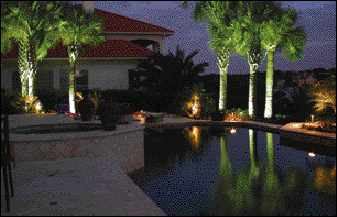
The best solution for landscape lighting is to rely on the experience of a professional lighting contractor. Lighting designer Ken Griess of Natural Concepts Landscape Lighting used a variety of in-ground canister lights and spot floods to cast light high into the canopies of the trees, creating a “moonlighting” effect to enhance both the safety and splendor of a pool area overlooking the water in Southeast Texas.
COMMERCIAL QUALITY
Carrie Roche, a landscape designer in St. Augustine, Fla., advises that a good lighting house can make all the difference. “They have to know you’re working on the beach, and that it’s not an economy job; then they can steer you straight.” But, Roche warns, don’t assume that if you work in a coastal community that any local supply house will give you a top grade suitable to the climate. “Locally, I buy from an electric specialty supply, and on my very first job, I ordered a bunch of stair lights that started rusting the very first winter. I was madder than hell about that, and they were like, ‘Well, why didn’t you tell us it was for a beach house?’ We laugh about it now, but I’ll never assume that just because it’s not Home Depot, that I’m getting taken care of. You’ve got to bring the suppliers in on the decision-making by giving them details about the job.”
Roche recommends going to a commercial-grade line when the budget allows. “The commercial world knows that fixtures need to weather storms, and will get flooded out and generally abused by Mother Nature. Commercial lights are built with sealed lenses in composite plastic canisters and hermetically sealed ballasts. On the other hand, these aren’t fixtures you power with a little cable buried in the dirt and stick some plastic spikes in the mulch to install.”
Many commercial fixtures run off line voltage, which Roche prefers to run through PVC conduit. She then stakes the conduit down with short lengths of epoxy-coated rebar and zip strip near inground fixtures. “I’ve never had a lighting fixture fall over, but I’ve come back to find canisters hanging out in the wind when the sand’s blown out around them. I feel a lot better when they’re anchored.”
Commercial fixtures may be much harder to get hold of, notes Roche, who often deals directly with a manufacturer’s rep for these. “I had to email a representative in Jacksonville, and he calls right away, wanting to come talk to me, until I tell him I’m working residential. If you’re not buying a whole truckload for putting in some mall or convention center, the rep may be a whole lot less inclined to talk.”
VISUALIZE THIS
Ian Ibbitson, general manager of Allscape Architectural Landscape Lighting, a manufacturer of high-grade commercial lighting, cautions that there are other differences in commercial fixtures to consider before speccing them on a residential project. Many commercial-grade products have more powerful lamps. HID (high-intensity discharge) metal halide bulbs are common. These deliver a greater amount of light for a given wattage than incandescents, but they also run hotter. Ibbitson points to an example of inground canisters installed as uplighting to illuminate trees and to wash walls. When installed as walk-over lighting near a pool, or along the edge of a patio, he suggests using a variety with a double lens that will help insulate the bulb. “You don’t want some kid burning his foot.”
Ibbitson also points out that many commercial fixtures have much better reflectors, so you get a much wider beam spread compared with a residential fixture of the same size. Combined with the more powerful lamps, says Ibbitson, most people tend to overlight.
Ibbitson suggets that any high-end contractor hook up with a professional lighting designer who knows the world of lumens and reflector angles and the wide range of lamps and lighting properties. But in the meantime, he points to the photometrics software, 3dOP, that can be downloaded free from the Allscape website (www.alllighting.com). The commercial lighting industry routinely uses IES (Illuminating Engineering Society) format files to describe the light output of fixtures. The 3dOP program provides a desktop interface that allows a user to position fixtures in one of three orientations and explore how light from a fixture is projected onto a wall, the ground, or a surface as the fixture position is changed. This can give a contractor a useful basis of comparison between fixtures and can be used for determining the setback from a wall for an inground spot or the height to mount a fixture on a wall.


