Clayton DeKorne
Q:
How do you detail a sealed crawlspace for a flood zone? Do we have to insulate the floor, or can we just insulate the crawlspace walls?
A:
Insulation in the floor is inevitably interrupted by wires, pipes, ductwork, and bridging. In a typical first floor, these interruptions make it next to impossible to get a tight air seal, which is often a more critical element to the energy and moisture performance of any building enclosure than the R-value the insulation provides. But depending on the flood zone, insulating the floor may be your only option.
Open Foundations
The National Flood Insurance Program (NFIP) requires open foundations in V zones and “strongly recommends” them in Coastal A zones. An open pile or column foundation will diffuse the intense force of a storm surge, allowing breaking waves to pass harmlessly beneath the first floor of the home. In this case, the thermal and air boundary of the house is defined by the first-floor framing. But I’ve yet to see a really good floor insulation detail that provides a tight air seal.
The best approach is to use foil-faced polyisocyanurate foam board on the bottom of the joists. Tape the seams with foil tape, then fill the joist cavity with unfaced fiberglass batts. To be effective, the insulation should be installed without gaps or compression and should be in full contact with the subfloor, which will require filling the entire joist depth with insulation. Also, some code jurisdiction may require the foam to be fire-rated or protected with a noncombustible material, such as an exterior gypsum sheathing.
Sealed Crawlspace Option
In areas outside the V zone and Coastal A zone that are subject to ponding or low-velocity flows, floodproofing efforts center on relieving hydrostatic loads on the crawlspace foundation, planning for removal of floodwater and sediment from the crawlspace area, elevating utilities, and using flood-resis-tant materials.
To relieve hydrostatic pressure on a stem-wall foundation, the NFIP requires vents that allow water to flow through the stem wall. While this suggests a vented crawlspace, it’s possible to create a sealed crawlspace using Smart Vent Flood Vents (www.smartvent.com). These vents remain closed under ordinary conditions, but when floodwaters rise, floats in the vents open a vent gate to alleviate hydrostatic pressure of the water that might cave in the foundation.
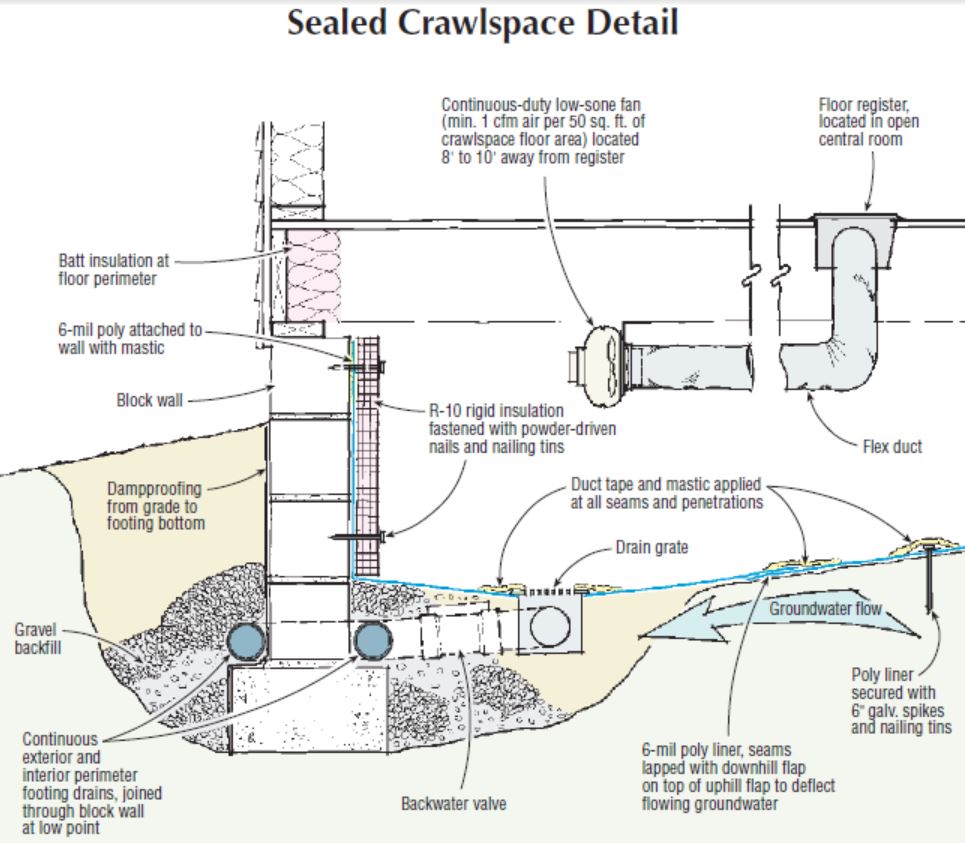
To build a sealed crawlspace, the best approach is to insulate the walls with a water-impervious insulation such as a closed-cell sprayed-in polyurethane or rigid extruded polystyrene (see illustration). Key details for controlling moisture in the crawlspace include covering the floor with heavy-duty poly sealed with mastic and providing plenty of drainage.
For drainage, exterior footing drains are a must. Much better are drains on both sides of the footing, connected across the footing at the low corner. The crawlspace floor should slope to that low corner, and a floor drain with a backwater valve should be installed. The drain inlet gets covered by a grate that’s sealed to the poly with mastic. Ideally, the high point of grade below the crawlspace would be above the surrounding grade, with the drain at or above the exterior grade height. If the crawlspace floor is below the surrounding grade, code requires dampproofing on the crawlspace walls.
Joints in the poly must be “shingled,” but in this case the sheets must be lapped to shed water beneath the poly. This means the laps are reversed from the way it would be done for roofing underlayment. If the sheet is lapped the right way, it will allow the water underneath to flow past the joint, but if the sheet is lapped the other way, it will scoop water and hold it against the mastic seam.
In termite country, the foundation insulation must be kept a couple of inches below the top of the foundation to create a clear area of masonry. This gap will allow for inspection, and if termites do invade, they must be dealt with using soil treatments or baiting systems (see “Keeping Termites at Bay,” Summer 2005; available online at www.coastalcontractor.net).
A sealed crawlspace is designed to bring the crawlspace area inside the conditioned space. To make this work, Jeff Tooley, a North Carolina contractor whose Healthy Building Company often takes on problem crawlspaces, prefers to actively condition the space with a dedicated, low-sone fan rated for continuous duty. Tooley typically installs the fan under the floor 8 or 10 feet away from a floor register, connected by a run of flex. Separating the register and the fan in this way makes for quieter operation. Other builders are content to passively condition this space with open floor registers to ensure that the air in the crawlspace and living areas “communicates.” In either case, the goal is to maintain the crawlspace at humidity levels roughly the same as the main living areas of the house.
The sealed crawlspace approach takes care of the day-to-day moisture and energy issues in the crawlspace. In the remote chance a flood occurs, it’s likely the drainage will be overwhelmed and the crawlspace will fill up like a bathtub. However, if flood-resistant materials are used (plastic insulation and masonry), the crawlspace can be pumped dry without lasting harm. In this case, the poly covering the floor may be covered in sediment, which could contain wastes and other toxic materials that you would not want to leave under the house, and will need to be replaced. — Clayton DeKorne