
: A customer wants a swimming pool next to a beach house. We need to elevate the house above the Base Flood Elevation, but what kind of choices do we have for siting and constructing the pool?
A:
Ted Cushman responds: The general goal when building a pool in an area subject to flooding from a storm surge is the same as for any structure: the pool should be built so as to minimize damage to itself and to nearby structures in the event of a 100-year storm. But the specific techniques for achieving that goal will vary depending on site conditions, as well as on state and local rules. A registered architect or engineer must also certify the final design.
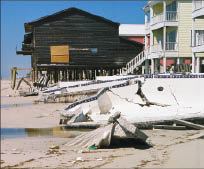
FEMA Hurricane Ivan wiped out these beachfront pools in coastal Alabama in 2004.
Mark Wolfe/FEMA The storm surge from Hurricane Isabel in 2003 destroyed this pool on the North Carolina Outer Banks.
Before starting a pool project, the designer and builder should consult all applicable local, state, and federal rules, advises Chris Jones, P.E., an engineer based in Durham, N.C., who specializes in coastal engineering and coastal zone management. “They need to find out whether pools are addressed by the local building code or a local ordinance. They also have to check for state regulations governing construction along the beachfront, and see if there are specific requirements for pools,” says Jones.
FEDERAL REQUIREMENTS
Jones says that federal requirements are specified by the federally backed National Flood Insurance Program (NFIP), the only flood insurance generally available to homeowners in flood-prone areas. NFIP will only offer insurance where the jurisdiction has adopted rules designed to reduce future flood risks to new construction.
For its pool construction requirements, NFIP refers to FEMA Technical Bulletin 5: Free-Of-Obstruction Requirements, which provides guidance for building accessory structures in flood-prone areas. Jones, who worked with FEMA to update Bulletin 5, says that the document lays out general guidelines for keeping the space between house pilings clear from any elements that might transfer the force of wave action to the pilings. That includes attached elements like stairs and decks, as well as unattached structures like outbuildings, privacy walls, septic systems, and pools. For instance, if a builder wants to put a pool or spa directly beneath the house, the top of the pool must be made flush with the existing grade.
Regardless of where the pool is located on the property — whether under the house or next to it — NFIP requires a design professional to certify that if waters do rise, it won’t float away and damage nearby buildings. This requirement leaves only two choices, says Jones. One is what’s called “frangible” construction: building the pool in the ground, assuming that it will be destroyed during a severe storm, and designing it so that when it does fail, it breaks up into small pieces that won’t cause much damage. The other option is to tie the pool to a pile or column foundation. (More on that below.)
FLORIDA REQUIREMENTS
One example of a state ordinance is Florida’s Coastal Construction Control Line (CCCL), which is drawn on a county-by-county basis throughout the state to protect sensitive dunes and beaches, and typically extends just a block or two back from the beach. Any construction activity seaward of that line requires permission from the state.
CCCL complicates the builder’s job by adding another layer of concern. “[FEMA’s technical bulletins] are mainly about minimizing damage to the buildings for insurance purposes,” says Tony McBeal, P.E., program administrator for Coastal Construction Control Line Permitting at the Florida Department of Environmental Protection (DEP). He says that while DEP rules related to the Control Line do include protection for buildings, they also seek to minimize damage to the environment.
DEP’s environmental rules have largely to do with dune protection. Specifically, they require the builder to limit damage to dunes during construction. The result may be that only minimal excavation is allowed, effectively forcing the builder to elevate the pool above grade level.
Where in-ground pools are allowed, McBeal says that frangible construction has fallen out of favor with builders, designers, and inspectors. Instead, the pool will probably need to be reinforced and pinned in place. How that is done depends on the engineer who certifies the project, but a common solution is to build a 6-inch-thick reinforced-concrete pool shell, tied to a deep concrete or treated-wood pile foundation. “If a storm exposes the pool and tries to move it, the pool will not float into the house,” he explains.
He says that all the concrete elements of this assembly must be tied together with reinforcing steel, and the pool is made thickest at the bottom, where it connects to the piles. That way, if waves scour the supporting soil away from the bottom of the shell and begin to pound on the sides or bottom, the piles won’t punch through the bottom of the shell. The pool shell may fracture, but the anchoring piles won’t allow it to float or drift as a unit toward the house, where waves could pound it against the home’s pilings.
ELEVATED POOLS
The design of an elevated pool will depend in part on how high it is elevated. If the builder doesn’t want to raise the house higher than the minimal required elevation, but wants the pool deck flush with the home’s first floor, then the base of the pool will still be in the zone of wave action. McBeal’s agency has approved that solution in some cases, but getting the approval required some heavy-duty engineering. “We required the bottom of the pool to be no lower than the FEMA Base Flood Elevation,” he says. “But because the pool would still be impacted by waves, it had to be designed to withstand wave loads at this elevation.”
He says that in most of these cases, the engineer’s solution was to design a structural pool shell, like a big coffer dam — heavily reinforced, and anywhere from 8 inches to 12 inches thick. A regular 6-inch pool shell was then dropped inside of the structural shell. The combined thickness sometimes totaled almost 20 inches.
Because these elevated pools would see stress from wave action, the DEP also required them to be structurally isolated from the house. “In most cases that meant leaving a gap or joint — again, specified by the certifying engineer — between the pool and the house, so that the stress caused by waves hitting the pool shell would not be transmitted to the house,” says McBeal.
Of course the designer could choose to elevate both structures — house and pool — high enough to raise them above the zone of wave action. That would avoid some of the engineering involved in making the pool strong enough to resist waves, and the two structures might not have to be made independent.
Approval of that design, like nearly everything else, will likely depend on the local building official. In Florida, for instance, when the state adopted a new statewide building code in 2002, it handed local building departments the task of reviewing and permitting pools, even seaward of the Control Line. Some local Florida officials say that DEP standards are still observed at the local level, but that’s not guaranteed. “You really have to ask local building officials how they are implementing the code,” says McBeal.
Bottom line, says McBeal: “You have to satisfy all the federal, state, and local criteria. And the most stringent of those will normally dictate the design of the structure.”


