
Q: We have been installing fiber-cement siding, which seems to hold paint much better than wood sidings near the ocean. However, the ends of each plank must be held off the corner boards by a quarter of an inch and caulked. After a year or two, the caulk cracks and shrinks back, and generally looks terrible, defeating the purpose of a durable siding material. How have others dealt with this problem?
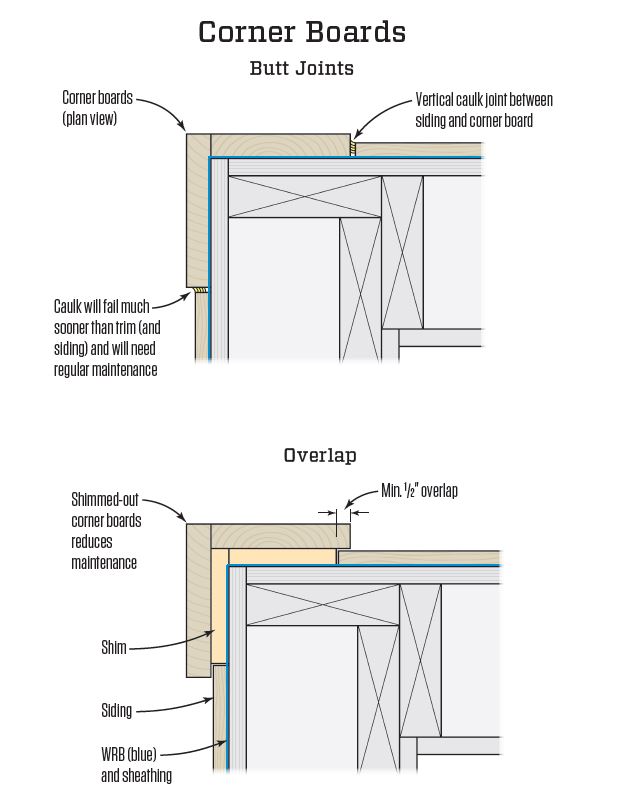
A: If you flash behind the corners, either with continuous lengths of double-thickness black paper or metal L-flashing, you shouldn’t need to caulk the vertical seams at all. However, homeowners don’t always like the look of this. It’s not very noticeable on inside corners, but at outside corners it looks like you cut all the siding short. So, for outside corners, it’s common practice to lap the seam with the downboard — by packing out an outside corner with 1x stock to match the lapped siding thickness, as shown in the illustration above. Theoretically, you can rabbet 5/4 stock, as well, but in practice, the overlapping leg of the rabbet isn’t very thick and can easily curl and crack.
Another alternative is to use a PVC corner post made for this purpose by Tamlyn & Sons (800-334-1676; www.tamlyn.com). Tamlyn makes a variety of styles of corner posts for both inside and outside corners: one type provides a channel to accept the siding ends and another type automatically flashes behind the seam so the caulk can be left out entirely. This PVC is much more durable than ordinary vinyl cornerposts and can be painted to match the siding. However, when you get right up to it, there’s no masking the fact that it’s plastic.
CORNER TREATMENT FOR FIBER-CEMENT SIDING
Corner boards shimmed out to overlap the ends of fiber-cement siding will last longer than a vertical caulk joint. (Illustration by Rick Vitullo)
Edge Detail for BUR
Q: We are cutting a shed dormer into a gable roof. Because the dormer faces the ocean, we don’t trust shingles on a low-slope roof, even with continuous peel-and-stick underneath. Instead, we have decided to make the dormer roof flat and use a built-up roof. How should the edges be detailed when a parapet wall is not used? A: A primed metal gravel stop should be installed along the roof’s perimeter to contain the asphalt flood coat and gravel. Begin by installing a base sheet and two to three plies of roofing felt, turning one layer of felt over the edge at least 1 1/2 inches. Bed the gravel stop in roofing cement, and then fasten it every 3 inches, staggering the nails. Finally, flash over the top leg with a butyl rubber peel-and-stick flashing tape before applying the flood coat and gravel. Make sure this flashing is a rubberoid material, not a modified-bituthane material, as the latter may react with the built-up roofing materials.
At the ridge, where the flat roof meets the main sloped roof, install the gravel stop as shown in the illustration, bending the vertical leg to match the slope.
FLAT-ROOF TRANSITION
Where a flat built-up roof meets a sloped roof, install a gravel stop to prevent the gravel and asphalt flood coat from migrating down the sloped roof. (Illustration by Tim Healey)
Steel Framing on the Coast
Q: We are currently building a steel-framed house near the ocean. Our site is very close to the water, and I am concerned about rust problems developing in the steel framing. We have already noticed small surface-rust spots and some forming on the ends of cut studs. Will the rust stop after the house is closed up? A: All structural-steel studs should be galvanized, and in a coastal environment you should specify a grade called G-90, which has a heavier zinc coating than ordinary G-60 material. According to Paul Fisette, director of the Building Materials and Wood Technology program at the University of Massachusetts-Amherst, rust on a steel stud can be compared to rot on a wood stud. When a wall is properly constructed, there is little likelihood of a stud rusting to the point of failure, says Fisette. But it is important to use proper wall construction that shields the framing from exterior elements and minimizes the chance of condensation within the wall cavity.
Normal cutting and drilling of steel studs removes the zinc coating in the cut area. The coating adjacent to the cut will “sacrifice” itself to protect the cut area. For extra protection, these areas can be cleaned with a wire brush, and then brushed or sprayed with a cold galvanizing compound like ZRC (ZRC Worldwide, 800-831-3275; www.zrcworldwide.com) or Rustoleum V2185838 (Rustoleum Industrial; 800-323-3584, www.rustoleum.com).


