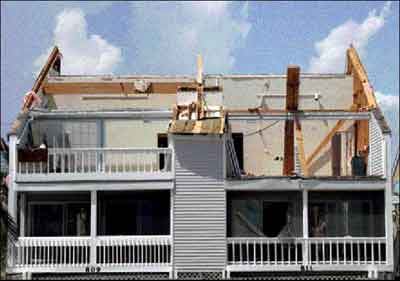
Wind-borne debris carried by hurricane-force winds can crash through window openings — the most vulnerable areas of a building envelope. Air rushing in the openings can then over-pressurize the envelope, just like blowing up a balloon until it bursts — a fate that befell this home on North Carolina’s Outer Banks during Hurricane Isabel in 2003.
As Florida recovers from four devastating hurricanes in one season, a clear lesson is emerging: The new codes worked. Better nailing, sturdier shear walls, more framing hardware, and beefed-up opening protection made a difference. Homes built to stringent new standards fared far better than older houses approved under pre-Hurricane Andrew codes.
Florida’s lesson won’t be lost on builders or code officials in the rest of the Atlantic and Gulf seaboards. But in states where the new International Residential Code (IRC) and International Building Code (IBC) are just coming into force, the beefed-up details these codes require in high-wind zones pose an unfamiliar problem for many contractors and inspectors. Window requirements in the new codes are a particular source of confusion. Here, we take a look at what the codes say about windows near the coast, and at what those requirements mean in practice.
EXPERIENCING TECHNICAL DIFFICULTIES
Before contractors in hurricane-prone areas can even start to tackle the intricacies of actually building the house, they have to come to terms with the new codes and figure out what systems and products their building is required to have.
In states north of Florida, windows need double-pane glass to meet the energy code. That means a fatter sash and frame. Strengthening the glass, sash, and frame to stand up to higher wind pressures or flying objects has meant adding more thickness, which makes the windows too bulky and heavy for existing hardware to support. Working out the resulting technical issues has been a real challenge for window suppliers, raising the cost of code-compliant windows and limiting the range of available products from which coastal contractors can choose.
The good news is that the codes provide a “simplified procedure” that covers most residential work. Builders can usually find answers by working their way through the look-up tables in Chapter 3 of the IRC. The bad news is that using those tables may lock builders into some expensive choices when it’s time to pick windows, as the prescriptive rules can seriously limit product and design options. But leaving the “simplified” path means getting help from an architect, an engineer, or both.
STRUCTURE VS. CLADDING
Andrew DiGiammo is an architect and builder who specializes in custom homes in coastal Massachusetts and Rhode Island. Rhode Island adopted the IRC in 2002, and Massachusetts is set to adopt it soon. So DiGiammo has begun to work the IRC‘s wind-related requirements into his design process, starting with the preliminary site analysis.
There are really two parts to wind design, he explains. The first is what the code calls the Main Wind Force Resisting System, or MWFRS. This includes the structural components like wall framing, floor and roof diaphragms, and shear walls — all the big elements that resist the wind forces acting on the structure of the building, keeping it from tipping over, sliding off the foundation, or just getting blown away.
Second, the wind design must address Components and Cladding, or C&C. That’s the section of the code that applies to elements such as roof sheathing, roof covering, exterior siding, windows, doors, soffits, fascias, and chimneys. This is where a builder will consult design pressure tables and determine the requirements for different building elements, including the windows.
Requirements for the main structure and for the components and cladding are found together in the new codes. In the IRC, they’re located in Chapter 3, “Building Planning,” and in the IBC, they’re in Chapter 16 under “Wind Loads.” Provisions in each code ultimately go back to the ASCE 7 engineering standard, Minimum Design Loads for Buildings and Other Structures, published by the American Society of Civil Engineers. The prescriptive tables in Chapter 3 of the IRC are just ASCE 7’s “simplified method,” applied to a limited set of building sizes and shapes experiencing basic wind speeds lower than 110 mph. If your needs go beyond those tables, the IRC and IBC both refer you back to ASCE 7, or to publications based on it.
When designing to resist high winds, the MWFRS and C&C must each be addressed separately. But DiGiammo doesn’t use the IRC tables in his design process, because that approach limits his options for shear wall layout and window placement. Instead, he does a wind-load analysis for each building that conforms to the more advanced method provided in the ASCE 7 standard.
“You have to start with shear panels, so that you’ll know where you can put holes in your wall to begin with,” DiGiammo points out. “That is all part of the Main Wind Force Resisting System. If you go with the prescriptive code, the sheathing layout for shear panels is going to limit where you can and can’t put windows. But if the MWFRS has all been determined, and the builder just wants to know the design pressure rating required for windows in a given plan, all you really need to know is how to use the IRC.”
Once he has done his MWFRS analysis, says DiGiammo, finding out the required window design pressures “is actually quite simple on my end. I just go to the Andersen Windows website and use the online Design Pressure Estimator. That makes it easy.” Most other window manufacturers offering impact-resistant units can provide some level of design pressure analysis, as well.
Figure 1. WIND PRESSURE ZONES
In a hurricane, the dynamics of swirling air currents around house corners create localized zones of higher positive or negative pressure. In an engineered design, pressures are calculated using formulas. But the “simplified method” used in the IRC just defines pressure zones on a basic house, and provides precalculated values for the expected pressures. The builder can look up these required design pressure ratings for each window in IRC Table R301.2(2). Zone 1: Main roof area (locations at least 4 feet from the eave, ridge, or hip) Zone 2: Roof edge locations within 4 feet of an eave, ridge, or hip, except for corner areas Zone 3: Roof locations within 4 feet of the wall corner or gable-ridge intersection Zone 4: Main wall area (not within 4 feet of a corner) Zone 5: Wall corner area (within 4 feet of the corner)
Understanding how the IRC rules work is crucial, though. The manufacturing and testing issues mean that higher design pressure ratings can’t be achieved in every window type or size; and when compliant windows are available, the cost can be prohibitive. Also, different parts of a house may experience different wind pressures. Changing a window’s size or location can significantly affect how strong it has to be — so a simple thing like moving a window or skylight may no longer be so simple.
“Calculating window design pressures might as well be left to the window company’s engineering staff,” says DiGiammo. For the designer or builder, the thing to do is to get familiar with the figures and tables in Chapter 3 of the IRC — especially the drawings that show the wind pressure zones on a house. That will give you an intuitive grasp of how wind impacts your building and what that means for window characteristics (Figure 1). With that clear, it’s easier to understand the design decisions or product choices.
NAVIGATING THE CODE
The figures and tables in the IRC amount to a road map for determining window requirements. The first step is to figure out your site’s “basic wind speed,” as found in the newly revised wind speed zone map from ASCE 7 (Figure 2). That gives you a starting value for wind pressures on your building. If you’re below the 110-mph threshold, the whole building can be designed with the IRC prescriptive rules. In the 110-mph and higher zones, the designer has to turn to the ASCE 7 standard or to the American Forest & Paper Association (AF&PA) or SBCCI design manuals that apply equivalent methods.
WHERE THE WIND RULES
The basic wind speed map is the starting point for establishing window design pressure ratings. The 120-mph and higher zones and sites within a mile of shore in the 110-mph zone are designated “wind-borne debris regions,” where impact-resistance rules apply. Regions inland of the 110-mph zone may use prescriptive values defined in the code. Structures on the coastal side of this line must be engineered. While the map gives a rough idea of the regions affected by the new rules, check with local jurisdictions. The actual boundaries between wind regions sometimes follow convenient markers, such as county lines or highways. Also, the actual design pressure designated within a specific wind zone will depend on the degree of exposure or shelter at a specific building site, and is higher for buildings that serve critical public functions.
Your building department officials should be able to tell you the site’s wind speed. They’ll also make the determination of a modifying factor called “Exposure Classification.” Exposures range from Exposure A, a location sheltered by tall buildings and rough terrain, up to Exposure D, a windswept location facing a mile of open ocean, mud flats, or ice. Sheltered locations let you reduce the required design pressures, but in exposed locations, you must increase them.
Once the shear-wall and anchoring details are decided, either by the prescriptive code or by engineering methods, the window design pressures can be looked up. These will vary depending on the size of the window, its placement in the wall, the height of the building, and the exposure classification of the site. Smaller windows require higher design pressures, taller buildings have to use higher design pressures, and windows near a corner, eave, hip, or ridge also need higher ratings. All of these factors are reflected in the values in IRC Table R301.2(2). But for buildings taller than 35 feet, and even for shorter buildings in exposure classifications C or D (the relatively exposed sites), the values from Table R301.2(2) have to be increased by 21% to 87%, using an adjustment coefficient from Table R301.2(3).
Once the design pressure ratings have been established, the next piece of the puzzle is to decide exactly how to protect the openings. In 120-mph and higher wind speed zones, or within one mile of the shoreline in the 110-mph zone, the code requires all windows to pass American Society for Testing and Materials (ASTM) testing for impact resistance or to be equipped with approved storm shutters. Otherwise, the builder has to provide plywood or OSB protective panels cut to fit each window opening, along with fasteners for attaching them. The impact glass adds yet more size, weight, and cost to the window — and so do the other beefed-up construction details needed for the window’s frame, as well as its glass, to survive the impact of the test missile (Figure 3).
PASSING THE IMPACT TEST
Impact-resistant window units must pass the rigorous test procedures defined by the American Standards for Testing and Materials in ASTM standard E1886. In the first part of the test (shown above), a “large missile” — a 2×4 — is shot from a compressed-air cannon at a velocity of 50 feet per second (34 mph). Part two uses a “small missile,” or ball bearing, traveling at 80 feet per second (50 mph). These tests require multiple impacts at designated places on the window unit, and after each impact, the product — which is installed on a test wall or roof assembly — must undergo 9,000 pressure cycles to simulate the damaging pressure fluctuations of turbulent winds. These tests work in concert with ASTM standard E1996, which designates the wind zones where test-compliant products are required and establishes pass/fail criteria for the tests. To pass after impact and pressure cycling, there can be no hole in the assembly large enough to fit a 3-inch sphere, or no tear longer than 5 inches. By code, builders working within “wind-borne debris regions” (see “Where the Wind Rules,” above) are required to install storm shutters or laminated-glass windows and reinforced side-hinge doors and garage doors that can pass the missile-impact and pressure-cycle tests.
Architect Bill Chaleff works on the east end of Long Island, N.Y., all of which falls into the 120-mph wind speed zone. The western part of the island, closer to New York City, is in the 110-mph zone, so areas within a mile of the coast also require window opening protection. “Window manufacturers have hustled to provide us with compliant windows,” says Chaleff. “But they’re double the cost. On our projects, we’ve taken the other compliant path — we supply the OSB panels and fasteners for every house.”
THE “PARTIALLY ENCLOSED” LOOPHOLE DEBATE
Chaleff points out that a close reading of the code shows that impact glazing, shutters, or protective panels may not be needed at all. “The provision actually reads, ‘Windows in buildings located in wind-borne debris regions shall have glazed openings protected from wind-borne debris or the building shall be designed as a partially enclosed building in accordance with the International Building Code,’ ” observes Chaleff.
According to New York State building code authorities, that code language lets builders and designers choose between two options: Either protect the windows, or make the building strong enough to hold together even if the windows fail. In short, conclude the state engineers, “the code does not explicitly require glazed openings to be equipped with protective wood structural panels or costly specialized windows. Instead, these options are available if the building is not designed as a partially enclosed structure.”
A letter from the New York Codes Division engineers indicates that a partially enclosed structure could require strengthening of framed exterior walls and additional hardware for roof rafters. On a typical two-story home with a 30-degree roof pitch, the report specifies that connections would be affected, especially tiedowns for roof framing. As an example, if a design would normally require 25-gauge tiedowns with four 8d nails to connect each rafter to wall framing, it would now require 20-gauge tiedowns with six 8d nails. The engineers go on to say that rafter spacing might need to be reduced or sheathing thickness increased in order to prevent sheathing uplift in a “partially enclosed” design: Half-inch plywood on rafters spaced 24 inches on-center should be acceptable. As for the framing members themselves, the engineers say roof framing that can handle required snow loads is already strong enough to handle the allowable uplift loading. Conventional walls composed of 2x4s spaced 16 inches on-center and having a floor-to-ceiling height of 8 feet would be capable of resisting the increased load. Walls composed of 2x6s spaced 24 inches on-center with a floor-to-ceiling height of 10 feet would also be capable of resisting the increased load. Exterior walls surrounding cathedral spaces, however, would require an engineered design.
Designing a building for “partially enclosed” pressures does not protect the more valuable interior finishes, contents, and occupants. |
In short, the construction requirements for a “partially enclosed structure” aren’t any more rigorous than construction standards in most snow-load regions. But there’s another side to the problem. A structure that is still standing after a hurricane blows all its windows out could still be a total, or near-total, loss. Six to ten inches of rain driven by hurricane-force winds is likely to completely ruin the home’s interior finishes, wreck all the furniture and other belongings, and create a major risk to the health and safety of anyone trying to take shelter within the house.
Considering these risks, engineers creating code reference documents clearly prefer the option of tougher windows. Bradford K. Douglas, the Director of Engineering for the AF&PA’s American Wood Council, phrased it this way in a letter to Florida code officials: “The consensus of the ANSI [American National Standards Institute] group overseeing development of our new Wood Frame Construction Manual for One- and Two-Family Dwellings (WFCM) is that designing the structural members of a building for partially enclosed pressures does not provide the same benefit as protecting the building envelope from flying debris. Designing a building for partially enclosed pressures only protects structural members against accidental overloads. It does not protect the more valuable interior finishes, contents, and occupants.”
TOUGH WINDOW CODES TAKE HOLD
New window requirements from the IBC and the IRC are now being enforced along the entire Gulf of Mexico and Atlantic shorelines, either at the state level (dark blue states) or at least by some municipalities (within light blue states). In all states, contractors should always check with local authorities to see if and how the provisions apply in their jurisdiction. Different local jurisdictions commonly interpret or apply building codes in different ways. Early in the planning process in any state, check with local code officials to determine the requirements for each individual project. Keep in mind, too, that even where protective measures such as pressure-rated or impact-rated windows aren’t necessary to meet local requirements, they might still be needed before the building can qualify for homeowner’s insurance coverage.
Based on their losses in past storms, insurance companies have a strong incentive to push tougher windows. Insured damages from Hurricane Andrew included many complete structural failures; but after later and less powerful storms such as Hurricane Floyd, insurers suffered the bulk of their multibillion-dollar losses in payouts for homes that were still intact after the storm passed but sustained so much interior water damage that they were treated as a total loss, and simply torn down and rebuilt from scratch. This summer’s record crop of Florida storms appears to follow a similar pattern, with relatively few structural collapses but billions of dollars worth of damage caused by lost claddings and rain-saturated interiors.
Accordingly, insurance companies are moving to limit coverage for homeowners who elect not to install storm-resistant windows. Vin Andrews of A.W. Hastings & Co. is an architectural rep for Marvin Windows serving coastal areas of several Northeast states. Andrews says that on one recent project, an architect had to go back to the drawing board twice — once to adjust to windows that would meet code-required design pressures, and a second time when the homeowner realized that her insurance company would limit coverage if the windows lacked impact protection. “She wasn’t even in the zone where the code requires impact glazing,” says Andrews. “But when she read her insurance policy carefully, it said storm damage to the home’s interior was excluded unless the house conformed to that section of the code. Shutters didn’t fit the style of the house she wanted, and she didn’t want to mess around with plywood or OSB panels. So it had to be impact-resistant windows.”
THE PRUDENT PATH
Against this background, builders may be best advised to take on the window issue early in their planning. If you let aesthetic or other design factors drive window choices without considering the required pressures or impact protection, you may be forced to revisit earlier choices when unexpected objections are raised by the building department or an insurance company — or both. With hurricane windows, as with hurricanes, it’s best to plan ahead.