
For Americans in the 21st century, it’s hard to imagine life without electric power. We take for granted that our lights, microwaves, air conditioners, and televisions will always work for us at the flick of a switch. But should a hurricane hit the community, we would instantly be plunged back into the 1800s — or some post-apocalyptic future where people have to piece their lives together from the remnants of modern civilization. Tired, hot, and frustrated, citizens would wait in line for hours to buy basic needs such as water, ice, food, and fuel. And the item that stores would likely run out of first in such scenarios would be portable generators.
Avoid Job-Site Generators
The small, gasoline-powered portable generator is the classic ad hoc response to a major power outage. Yet it may be the homeowner’s worst possible choice. Frank Navetta, who runs PowerPro Service Co., Inc., on Long Island (www.powerprogenerators.com), considers portable generators “a self-defeating proposition” even for a household that needs to run only a microwave and the refrigerator, and much more so for the 8,000-square-foot mansion with wine cellar, hot tub, and 25 tons of air conditioning. Able to provide only enough output for a few lights and a refrigerator, gas-powered generators need frequent refueling and make a lot of noise. But the negatives extend far beyond these practical limitations.
After major storms, portable generators often kill a few people, either by carbon monoxide poisoning or by electrocution. Generator-caused gasoline spills occasionally result in structure fires and serious burns. And if the do-it-yourself user decides to get creative and wire the generator directly into a home circuit, a generator set can “back-feed” the utility by energizing the service drop that leads back to the pole on the street. The transformer on the pole, functioning in reverse, then steps the current up to a lethal 600 volts and sends it into the transmission lines, where it could kill a utility worker trying to restore power to the whole neighborhood. Professionally installed backup power systems, in contrast, are coupled to house power by a “double-throw” switch that maintains safe grounding. The switch disconnects all generator-powered circuits from the utility service before it connects those loads to the generator.
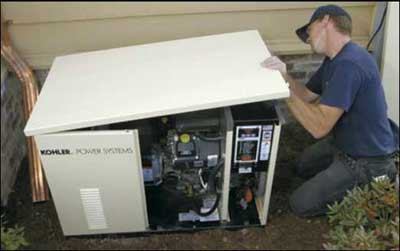
Compared with a portable gasoline-fueled generator, permanently wired and professionally installed generator sets fueled by natural gas, liquid propane (LP), or diesel are a safer, more reliable way to back up utility power.
Selecting a Standby System
Beyond portable generators, backup power systems come in a range of sizes, usually categorized by output capacity:
From 7 kilowatts up to about 15 kW, systems have enough power for a modest-sized home, depending on air conditioning needs. These systems use air-cooled engines like those manufactured for chain saws, lawnmowers, or small lawn tractors. These units can also be converted to run on LP or natural gas.
Air-cooled machines are intended for occasional use. During an extended power outage, someone will have to stop the unit every 8 to 10 hours, at a minimum, to check the oil and air filters.
Above 15 or 16 kW, the generator engines are conversions of standard water-cooled General Motors or Ford auto and truck engine blocks. An 8-liter-displacement V-8 motor can power a 125-kW generator on LP, and up to a 150-kW generator on natural gas fuel. Diesel engines from companies like John Deere are also used to power generator sets in this midsize range.
Electric motors need more power to start up than they use once they’re running. Shown here are estimated operating watts and starting watts for a few common household motors. Standby generators must be sized to supply sufficient startup current for all the connected loads.
Above 150 kW, generators jump to industrial packages, built by companies such as Caterpillar, Cummins, or Waukesha. Top-end unit are typically designed to run on natural gas and LP, though less expensive diesels are usually an option, too.
Diesels have some special maintenance needs, however. Like all generators, they have to be started up and test-run (some models self-test on a weekly or monthly cycle). Diesels, in particular, must be allowed to warm up and run at full load and normal operating temperature for 20 minutes or more, each time they start. Otherwise, unburned fuel will clog valves and the fouled machine may not start or run when it’s needed. In very cold winter conditions, diesels may need a fuel adjustment: a 60/40 mix of diesel fuel and kerosene won’t gel at subzero temperatures the way straight diesel fuel will. (All generators, whatever the fuel, should have engine block heaters that warm the engine oil reservoir when temperatures drop below 40°F. Standby generators don’t idle for 10 minutes at startup as a car might on a cold morning. They are designed to come up to a full 3,600 rpm or 1,800 rpm in about 10 seconds.)
An integrated double-pole, double-throw transfer switch safely disconnects house circuits from the utility before connecting them to the generator, while maintaining a continuous ground for both power sources. The switch may be manual (above) or automatic (right).
Natural gas and LP have their own set of drawbacks, though. In the event of a power outage, natural gas pipeline pressures may drop below the operating requirements of the unit. It’s important to make sure the gas flow through the meter is rated high enough to supply the generator, as well as any other loads in the house for cooking, heating, or clothes drying. Also, pay attention to the length of the supply pipe and the number of bends, warns Jay Blevins, of Kinsley Power Systems in East Granby, Conn. (www.kinsleypower.com). “Just because the unit has a half-inch fitting doesn’t mean that a half-inch pipe will work. If it’s too long or has too many elbows, it may not.”
For extra backup, some backup power specialists can provide dual-fuel generators that can automatically switch to bottled propane if the natural gas supply falters — without dropping the load.
System Sizing
When choosing a generator, the first question must be “How big?” At the low end, the answer depends mostly on whether the homeowner wants to power the entire house or just a few critical circuits. “Typically, the hinge point is air conditioning,” says Frank Navetta. “A 15-kilowatt machine can do heat, refrigeration, a handful of lights. You can do sump pumps. You can even get away with occasionally using a window air conditioner. But if someone has two or three 5-ton air conditioners, the inrush current to start those compressors is so high that you end up needing 30 or 40 kilowatts. And once those air conditioners are started, now you have all this extra current. You might as well use it to run the whole house.”
Builder Paul Buske, of Kitty Hawk, N.C.-based Stormont & Co. (www.stormontandcompany.com), builds primary residences as well as second homes and vacation rental properties on North Carolina’s Outer Banks. Buske reports that his area’s power reliability has improved considerably since the 1980s: “We used to have brief outages all the time, just because of salt corrosion and arcing on transmission-line transformers. But our utility has moved a lot of powerlines underground, and these days we have fewer interruptions.” Backup power nowadays is more about storm readiness than about day-to-day convenience, notes Buske. Rental property investors rarely opt for standby power systems, he adds.
“We have set a lot of year-round houses up with generators, but nobody yet has decided that they want a generator big enough to run the whole house,” explains Buske. “So we go through the house with them, while they pick and choose what they feel they will really need during an outage; and we size the generator to fit that need.”
Most of Stormont & Co.’s year-round houses are laid out with main living space on the first-floor level, and extra bedrooms and baths on upper floors. Each story is served by its own heat pump and air conditioner, which makes it easy to split the power supplies between floors. “Our generator normally runs the air conditioner for the main level, a refrigerator and freezer, the kitchen appliances, and enough light circuits so that the main living level isn’t in the dark,” says Buske. Circuits that will run off the generator are isolated onto a separate subpanel.
Power Issues
Some loads, like ordinary lighting, are easy to estimate. But loads involving motors — well pumps, sump pumps, air conditioner compressors, and so on — are trickier. Compressor, pump, and fan motors — just like power tools — draw more power starting up than they do when running. Generators have to be sized to handle the startup draw of all the equipment they serve, not just the equipment’s operating requirements. Otherwise, big appliances like air conditioners won’t even start.
Smart switches. Temporary power requirements can be accommodated with smart load-management circuitry. Many residential power systems, including models from Briggs & Stratton (www.homegeneratorsystems.com), Generac (www.generac.com), and Kohler (www.kohlerpower.com), include “smart” switches and load-control circuitry that can prioritize between various current draws.
Air conditioning manufacturer Rheem (www.rheemac.com), which markets the Briggs & Stratton standby generators under the Rheem and Ruud brands, offers the smart load-management systems as an option. “All of our transfer switches come with an air conditioner control module,” explains Rheem product manager Art Berg. “If the home is on generator power, and the air conditioning system calls for cooling, the control module looks to see if it has the wattage available to start the air conditioner.” If the power’s not available, the switch waits. “Every 15 seconds it will keep looking for the power,” continues. “As soon as any appliance goes off-line — if you turn off the oven or the clothes dryer stops — it will find the power, start the air conditioner, and go back into operating mode.”
If only selected circuits are to be powered by a generator, a separate subpanel is usually installed for just those circuits behind the transfer switch.
For even finer control, systems may also include a load-control center that has “load-shedding” capability. This feature allows you to select up to six appliances that can go off-line when it’s time to start the air conditioner. So when the thermostat calls for air conditioning, the smart box will first check to see if it has the wattage to start the air conditioner. If it doesn’t, it will start shutting down the selected appliances just long enough to give the air conditioner its starting wattage. When the air conditioner goes into operating mode, the smart box brings the other loads back online again.
Coupled with the smart controls, a standby generator can afford to be as much as 10 kW smaller, according to Berg. “Using the load-control center, a 12-kW unit will replace a 20-kW unit, and a 15 kW will replace a 25 kW, in most cases.” These smaller 12- and 15-kW generator sets are significantly cheaper to buy.
Ordinary household loads like lighting or stoves aren’t fussy about power quality, but modern electronic equipment needs “clean power” with a smooth, regular waveform and without excessive harmonic distortion. Units with electronic governors and digital voltage regulators, such as this one on a Generac unit, can maintain fine control over power quality.
Power quality. Simple “linear loads” like incandescent lighting or electric stove heating elements can tolerate current fluctuations, but new devices, including fluorescent lighting, computers, plasma televisions, and “uninterruptible power system” (UPS) equipment all require “clean power.”
Whether natural gas or liquid propane (LP) is the fuel, gas meters and supply lines must be sized to supply sufficient fuel to operate the generator as well as the home’s other gas appliances (such as heating equipment or cooking stoves). Advanced “dual-fuel” systems can use natural gas as the main fuel source, with an LP backup source available in case natural gas pipeline pressures drop during a power outage.
Clean power means a smooth, 60-Hz (60 cycles per second) sine-wave electrical signal. To produce this, generators have to spin at exactly 3,600 rpm if they have a two-pole alternator, and at exactly 1,800 rpm if they have a four-pole alternator. However, a cheap, underpowered generator tends to run at a little faster under light loads, slow down under heavier loads, and speed up again as a mechanical governor kicks in to compensate. This fluctuation creates harmonic distortion — a deformation of the sine wave dubbed “dirty” power that can damage sophisticated solid-state circuitry. In fact, UPS systems and some solid-state controls on the newest furnaces and air conditioners may refuse to operate at all under fluctuating generator power.
Top-of-the-line units are able to maintain near exact speeds by means of electronically controlled governors and digital voltage regulators that can keep engine rpms and power output within at least 1.5% of the desired 60 Hz.
Hook Up
Once the right-sized generator is chosen, it needs to be wired into the house. If only selected loads are to be generator-powered, those circuits typically get their own subpanel. Upstream of the subpanel (or upstream of the main circuit breaker panel if the generator is intended to serve the whole house) is the key safety device: a “double-pole, double-throw” switch that disconnects the house circuits from the utility grid power feed before connecting them to the generator. “We call it a ‘break-before-make’ switch,” says Jay Blevins. “The switch breaks the connection to the utility before it makes the connection to the generator.”
A professional contractor who specializes in generators must be part motorhead, part sparky, in order to best install and maintain the equipment. Here, contractor Jay Hart of Hart Power Solutions (www.hpsobx.com) in Kill Devil Hills, N.C., performs routine motor maintenance on a generator set at a new home built by Kitty Hawk, N.C. builder Stormont & Co. (www.stormontandcompany.com).
If it’s a manual switch, the homeowner will have to physically throw it during a power failure. If it’s automatic, it will switch over on its own and send a signal to the generator to start. But either way, the important thing is that the house loads never be connected to the generator and the utility at the same time — and that the generator never, ever, be connected to the service drop connecting the house to the pole. Besides the life and safety risk created if the generator is able to back-feed the utility powerlines, there’s a risk of damage to the standby generator if the generator is accidentally hooked into the grid when the utility power is on.
Local codes determine the foundation requirements for a generator set. A gravel pad or concrete slab is typically required (above). In high-wind zones, however, generators may need to be anchored, and in flood zones, they often have to be elevated (right).
Team sport. If a builder is handling the hookup, it will involve multiple trades. Notes Buske: “My electrician has to work hand in hand with my generator guy. My heat and air guy has to be involved. All these people have to be able to work together — cause what I don’t need at the end of this job is one guy pointing his finger at the other saying, ‘You didn’t do your job right.’ “
The builder’s best bet is to go with a specialist, argues Frank Navetta — a full-service generator set supplier with trained maintenance crews, who can professionally install the unit and offer the homeowner a service plan. A builder may save a few hundred dollars by purchasing the generator set himself and paying his electrician to install it, but if it doesn’t work, it becomes the builder’s headache. ~
Grounding Guildelines
At hookup, it’s critical to pay attention to how the unit is electrically grounded.
Typically, a generator set’s ground wire is connected to the home’s main ground wire at the main service panel, which leads to a copper ground stake driven into the earth. That ground is hard-wired, not switch-controlled: the generator, the circuits it powers, and the other home circuits all stay grounded all the time (so throwing the transfer switch transfers the connection for the live wires but not the continuous ground wire). However, a generator set may be provided with a means to ground the generator frame directly to its own copper stake, and some supplier manuals say to make that independent ground when the set is installed. Since double grounding is usually a no-no, the issue can throw electricians off stride.
What’s the answer? Experts say that for residential applications, tying the generator’s ground to the main house ground is the way to go — an additional separate ground at the generator set is unnecessary, and doing so could even cause a hazard in the case of a ground fault. (The separate grounding option on some generator sets is provided in case the application is for what the electrical code terms a “separately derived system” — not usual in a residential setup.) But not all systems are the same, and grounding is an issue for the local inspector to decide. Always have the installation inspected, and let the local inspector make the call.


