by Clayton DeKorne
Soak a chunk of stucco from a demolition project in a bucket of water. You can leave it there for days, and some water may seep through the cold joints between the three layers at the broken edges, but the core will stay dry.
This is the lesson an old-time plasterer taught me about stucco. Done well, stucco is impervious to water. But this is not exactly the emphasis Joe Lstiburek of Building Science Corp. put in his report to the Florida Home Builders Association following the 2004 hurricane season. After examining the extensive water damage to homes from more than 20 inches of rain washing over central Florida when Hurricanes Charlie, Frances, Ivan, and Jeanne swept across the state, Building Science Corporation searched for the leakage pathways by simulating weather conditions with spray racks and pressure washers. The result of this investigation was no real surprise to Lstiburek: “Stucco claddings leak [as do all claddings].” Lstiburek does not dispute that, as a material, stucco without cracks is impervious to water. But cracks are inevitable in real-world buildings, leading to the company’s critical conclusion: “Based on the field observations, it is our belief that it is not possible to construct stucco assemblies without cracks.”
It’s hard to argue with conclusions based on actual site conditions. Facing the certainty of leaks, Lstiburek’s recommendations rightly focus on creating “drainable assemblies,” using flashings and water-resistive barriers, and on details that ensure that when water is forced into a wall, it has someplace safe to drain away and a means by which the wall can dry out. His report (www.buildingscience.com/resources/walls/rainwater_management.pdf) is a must-read for anyone using stucco in any environment but particularly in hurricane-prone coastal regions.
Heartbreaking Reality
At the same time, Lstiburek’s report is disheartening. It underscores the fact that good three-coat stucco seems completely absent on the ground in central Florida, and I doubt Florida is the only state where the practical realities of schedules and budgets push contractors toward alternatives to traditional three-coat systems.
Lstiburek’s report lumps three-coat stucco with “cementitious decorative finishes” — often known as one-coat systems. This was not a lapse on the part of Building Science Corp. but rather a deliberate move to address what’s actually used in the field. In the end, Lstiburek wrote by e-mail, it doesn’t matter if it’s a one-coat or a three-coat system. Both types are subject to cracking; both types fail.
That’s the heartbreaking part, because three-coat stucco, by design, ought to be much more resilient to moisture than a one-coat system. A well-applied three-coat system creates three layers that act independently. This cannot eliminate cracking, but it will largely reduce the chance shrinkage cracks in each of the three layers will communicate the leak all the way through the wall.
“We’ve known for a long time how to keep water out,” says Ron Webber, president of the Plastering Contractors Association of Southern California and a plastering contractor for more than 30 years. Webber underwrote testing in the mid-1990s with Michael Roberts, a stucco expert in Orange, Calif., to address extreme cracking problems with stucco occurring all too frequently on sites. The work set out to evaluate the shortcuts taken by some stucco applicators to make a batch of wet mud easier to spread on a wall. These include the use of clay fines mixed into the sand to make the mud buttery, lime to fluff it up, and soap to smooth it out. All three practices, Webber confirmed, reduce the strength and water resistance of stucco.
Old-School Stucco
Unlike concrete, which is designed to be as strong in compression as possible, stucco is designed to maximize tensile strength, explains Webber. This is no small trick, as stucco’s not a material naturally strong in tension. Key steps include the following:
Solid structure. A wall is only as strong as the foundation below it and the ground beneath that. Begin with well-drained, properly compacted soil that has the capacity to support the structure above it. The wall itself must be rigid; stucco can’t tolerate movement. If well reinforced, and the top floors, roofs, and gable ends framed in wood are well anchored to the basewalls, block construction makes inherent sense in a coastal environment. “It’s unclear if any wood framing system can ever be rigid enough and dimensionally stable enough to keep stucco from cracking in humid, high-wind regions,” says Webber. “Block walls are much more stable and structural cracking much more controllable.”
A wood-framed wall stiff enough for high-wind zones requires tightly nailed APA-rated plywood sheathing. OSB, while structurally equivalent, will take longer to get wet if exposed to water, but it will swell, particularly at the edges, and it stays swollen after the panel has dried. If this happens before the stucco gets applied, it may create irregularities in the surface that the plasterer will feel obliged to flatten out to make his work look good. The result is thin spots in the stucco that are prone to cracking.
Drywall first. In a wood-framed structure, drywall must be hung before the lath and scratch coat are applied. The weight of drywall will stress wood framing, causing early settlement cracks, which can be acute if the drywall is hung before the scratch coat has hardened. Avoiding such problems, however, often comes down to a schedule that is easier to set than it is to stick to.
Lath. Block walls do not typically require lath. The surface should be clean and sufficiently damp and rough to ensure a proper bond. But block surfaces vary widely, and not all block bonds well to stucco. Webber always does a test patch to test bond strength. If he’s not satisfied, he’ll use a bonding agent or apply a Portland cement dash coat of one-and-a-half parts sand to one part Portland cement, then test again. If still not satisfied, he’ll apply metal lath to the block.
Metal mesh must be installed with the right side up, or the stucco will slide off the building. At corners, make sure that the lath is not installed too tightly, or the stucco will pop off. Use corner bead for best results (Figure 1). On wood framing, lath must be installed with the long dimension perpendicular to studs. Best practice calls for securing lath with furring nails, which place the lath in the center of the scratch coat. However, the norm over wood framing has moved toward pneumatic staples, which push the lath hard to the structure, limiting its effectiveness.
FIGURE 1. CORNER BEAD. To prevent stucco from popping off at outside corners, use corner bead. An alternative (not shown) is to round the corner, allowing the lath to pooch out and provide plenty of room for stucco to key to the lath. The end result is a rounded corner that may not be compatible with all architectural styles.
Clean sand is the key to creating a strong coat, with either traditional three-coat or one-coat materials (Figure 2). Webber urges all stucco subs to provide verification to builders that they are using sand that conforms to ASTM 897 for gradation and has a minimum SE (sand equivalent) rating of 70. The SE is a designation of the amount of fines in the sand. “Dirty” sand, or sand intentionally mixed with clay to improve workability, will become porous as the clay dissolves, leaving behind air pockets.
FIGURE 2. CLEAN SANDis as important to stucco as a low water-to-cement ratio and dry cement. “Dirty” sand, or sand intentionally mixed with clay to improve workability, will become porous as the clay dissolves, leaving behind air pockets. In humid climates, watch out for older bags of cement. Humidity can partially react with the cement even if the bags have never been opened.
One-coat mixes are suspect, as well. The code allows “up to 10% other materials,” Webber reports, but because one-coat systems are proprietary, it’s not clear what’s in that added 10%. Webber suggests that additives may include surfactants that not only lower strength but also reduce the surface tension of water, making it slippery enough to slide through the smallest pore in a permeable weather barrier. Surfactant compounds include the soap sometimes added by applicators to improve workability.
Scratch coat. The first coat serves as the foundation for the next two coats. It should be harder than the brown coat and requires a richer mix — one part cement to two to four parts sand. Webber recommends Type II cement without lime or other additives. “It’s got no body and is hard to spread, but when cured, is super strong,” he says (Figure 3).
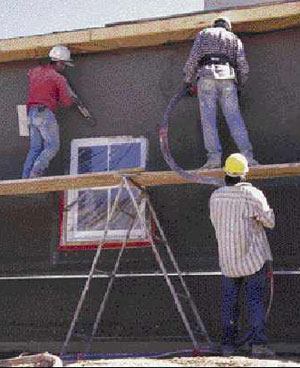
FIGURE 3. SCRATCH COAT.The first coat should be the hardest, using a rich mix. Stucco contractor Ron Webber recommends a Type II “plastic” cement without lime or other additives for the scratch coat. The mix will have no body and is hard to spread, but applying it with a pump makes this practical and results in the strongest possible base coat.
Before applying the brown coat, Webber verifies the hardness of the scratch coat by dragging a nail over the wall. If the nail does not dig in but leaves a white line, the stucco is hard enough for the brown coat.
Brown coat. This is a leveling coat that provides the flat surface for the finished wall. The brown coat also adds strength and thickness, and it is in large part what determines the quality of the finish. It’s a little sandier, at one part cement to three to five parts sand. The increased sand helps reduce the number of shrinkage cracks.
Finish coat. This is what provides the final texture and color (Figure 4). Premixed finish-coat materials usually work fine. Webber recommends steering clear of dark colors, especially reds. Dark colors are prone to spottiness and, if not well blended, will not match the color sample.
FIGURE 4. FINISH COAT. Code requires waiting at least seven days before applying a finish coat. Hairline cracks in this color coat are inevitable, but if the base coats are well cured, these surface cracks will not communicate water through the stucco.
Curing. By code, builders should provide at least 48 hours of curing time after the first coat is applied and wait seven days after the second coat before applying the finish. The critical consideration is that the scratch coat must be hard.
Curing schedules, however, prove to be the Achilles’ heel of modern-day stucco. The first and second coats are often installed in the same day to keep the stucco crew on the job site. Except on a handful of custom jobs, it’s rare for the end of the job to wait seven days in a fast-paced construction climate. Such are the realities that push Lstiburek to his hard-lined conclusions.
Managing Water
Ultimately, leaks do not matter, Lstiburek contends, if the wall functions as a “drained assembly.” Leaks do matter if the wall functions as a “mass assembly,” he continues, but the water getting past the stucco can still be managed to avoid problems.
Drained assembly, in this case, refers specifically to stucco over a water-resistive barrier, such as housewrap, asphalt felt, or Grade-D building paper, applied over wood framing. In the western U.S., building codes have caught on to the fact that stucco needs two layers of paper, not just one, to create an effective drainage space, yet such a rule doesn’t apply in most coastal jurisdictions. Stucco tends to bond to housewrap and building paper. Without a bond breaker — a second layer to separate the stucco from the weather barrier — water will move right through any permeable membrane. Using paper-backed lath over a housewrap or felt saves time over installing three layers — housewrap, bond breaker, and lath — before stucco can be applied.
Mass assembly refers to a wall made of materials that are not affected by water, like a concrete block coated with stucco. This wall has the capacity to store a lot of water, however. Lstiburek contends that whether intended to work this way or not, once you accept that leaks are unavoidable, this is how a block wall functions. Its water-holding capacity is based on a “rate-storage” relationship. When the rate of wetting exceeds the rate of drying, moisture accumulates in a mass wall. As walls become saturated, as many did in the extreme conditions of the 2004 hurricane season, water soaks through to the inside.
To prevent the water absorbed by a mass assembly from damaging interior materials, Lstiburek recommends forming a stepped-down shelf at the slab edge, strapping interior walls over foam to isolate drywall from the wet wall, and installing a weep screed at the bottom edge of the stucco to allow accumulated water to drain, as shown above (Figure 5). Particularly important is proper detailing for a control joint required where wood-framed walls meet masonry basewalls (Figure 6).
FIGURE 5. MASONRY WALL DETAILS. To manage water that builds up in a leaky block wall, form a step in the foundation edge to direct water that reaches the base of the wall outward, rather than allowing it to seep inside, where it can damage flooring. Isolate a potentially wet masonry wall from interior drywall with a continuous layer of semipermeable foam, such as extruded polystyrene (EPS) and strapping. EPS foam, rather than more impermeable XPS or polyisocyanurate, will allow the wall to dry to both the inside and the outside over time.
FIGURE 6. CONTROL JOINT. Where wood-framed upper walls meet masonry basewalls, code allows a metal expansion joint applied on top of the weather barrier — a detail that allows water that gets past stucco to drain into the basewall. To create a true drainable assembly, flash the joint with a peel-and-stick membrane (A), then apply a weep screed (B). Bring the upper-story weather barrier (C) over the top leg of the weep screed, then apply paper-backed lath, (D) which provides both a bond breaker and reinforcement for the scratch coat.
Lstiburek acknowledges in his report that “Workmanship, quality control, and cure impact the number and extent of shrinkage cracking. Soil conditions, the nature of the materials, geometry, and aspect ratio of mass wall assemblies impact the number and extent of settlement cracking.” However, in the end, he urges that despite efforts to control these variables, a builder should expect shrinkage and settlement cracks, and plan to deal with the water in other ways. Regrettably, that’s our practical reality. ~
Clayton DeKorneis editor of Coastal Contractor.
Photos by Ron Webber except where noted.