Since new treated wood formulas entered the market in 2004, contractors have had to adapt to a new ball game, one for which the rules continue to change. Within a few years of the phase-out of CCA (chromated copper arsenate) and the introduction of ACQ (ammonium copper quaternary), newer entries, such as MCQ (micronized copper quaternary) and µCA (dispersed copper azole), have begun to replace ACQ on lumberyard racks. In fact, according to industry expert Mike Freeman, micronized and dispersed formulas now account for as much as 90% of the treated wood on the residential market. The new formulas bring new complications to lumber labeling, and to lumber use and performance. Recently, controversy has bubbled up over whether Osmose’s MCQ lumber, in particular, can perform as well in service as the original ACQ it has replaced. And there’s now a related dispute over whether products like Osmose’s MCQ-treated “NatureWood” should use the name of the American Wood Protection Association (AWPA) in their marketing literature or in labeling their products — even though they have not been through the full process of AWPA standardization. In early March, Osmose, the manufacturers of MCQ, sued Viance, makers of ACQ, in federal court in Georgia over what Osmose calls a “false and malicious” media campaign to discredit MCQ. In a court filing, Osmose said, “It appears Viance is attempting to disrupt and confuse the marketplace in an effort to slow or stop the success of micronized copper wood preservative products until Viance can develop a viable replacement for its older wood preservative system, Alkaline Copper Quaternary (‘ACQ’).” (Download a PDF of Osmose’s complaint.) The complaint stems from an advertising campaign by Viance, based on a claim that Osmose MCQ-treated posts, tested for Viance by an independent testing firm called Timber Products, Inc. (TPI), had rotted in service and created a risk of structural failure. According to the Viance publicity, widespread risk of premature rot in MCQ-treated structural wood is exposing sellers and users of Osmose’s MCQ lumber to legal liability. But according to Osmose, the wood that was tested was being used as signposts, not as structural lumber. And Osmose says some of the wood Viance tested may not have been treated at all, much less with MCQ. In any case, says Osmose, standardized testing as well as field experience bears out the durability of Osmose’s treated lumber. (Osmose claims that more than 10 million MCQ-treated 4×4 posts are currently in service, and that the wood has a good track record.) Soon after the Viance ad campaign began, TPI released its own statement disavowing the use of its test results to disparage Osmose’s treated wood. TPI pointed out that the tested wood was pre-selected by Viance and did not represent a random sample of wood in service. Also, TPI noted that the visual inspection methods it used are subjective. AWPA Standards
One criticism of Viance’s testing of Osmose’s products has been that the methods used have not always conformed with official test protocols of the AWPA. Osmose says that based on accepted AWPA methods, its wood has demonstrated equivalent performance to other types of treated wood. But now, AWPA itself has entered the fray, pointing out that while Osmose may have followed the AWPA test protocols, it did not pursue a full listing of its product in the AWPA standardization process — opting instead to pursue a different pathway to code acceptance — an Evaluation Service Report from the International Code Council Evaluation Service.
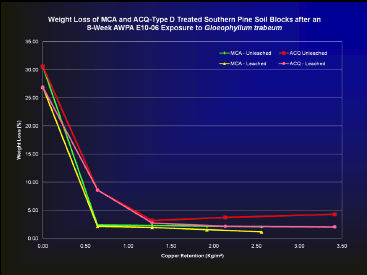
Osmose and Michigan Tech’s “Wood Protection Group” included these graphs in a joint presentation to a 2008 meeting of the International Research Group on Wood Protection (slides published with permission). It’s true that Osmose has publicized test results for its product that are based on AWPA standard testing. For example, these charts (above) are from a presentation by Osmose wood scientists, along with professors from the Michigan Tech’s ” Wood Protection Group,” at a 2008 meeting of the International Research Group on Wood Protection, a global association of more than 300 wood scientists from 51 countries. The upper chart compares the performance of MCQ-treated wood with ACQ wood in AWPA standard “soil block” tests, where small chunks of wood are placed in jars of wet soil inoculated with different fungi. In that example, MCQ performed as well as or better than ACQ. The lower chart compares the performance of MCQ lumber treated to different preservative concentrations, or “retentions.” It’s clear that the higher treatment levels provide the best protection — test stakes treated to the highest levels suffer essentially no decay for 52 months in ground exposures in Hawaii. (Download a PDF of the complete presentation.) Match the Exposure For end users, the most significant issue is not which type of lumber to use — any brand on the market will have passed some form of code-sanctioned testing to demonstrate its durability. More important is that the lumber be rated for the exposure it faces. For posts in the ground, that means either the AWPA “UC 4” (“Use Category 4”) label, or the ICC “Ground Contact” rating. These days, not all wood in the market is treated to those levels, so it’s important to check the labels carefully. Beyond that, however, the word on the street is that for rough exposures, it’s still possible to special-order lumber that is treated with the old, arsenic-based pre-ACQ and pre-MCQ treatment. CCA lumber, which has stood up to decades of outdoor, ground-contact exposure on continuously monitored test plots, is still available through some supply chains. In recent months, I’ve spoken to deck builders in Oregon, Massachusetts, and Oklahoma who all told me that for ground contact exposures, they still use CCA wood when they feel that it’s appropriate.
For marine pilings or foundations, CCA wood is still in widespread use. And some contractors report that they can still get CCA lumber when they need it for any severe ground-contact exposure. (Photo courtesy of Arch Wood Protection) And for marine exposures or for pile foundations, CCA wood is still in the playbook. For extensive detailed information on using treated wood for docks and other marine construction, you can download the manuals, “Treated Wood in Aquatic Environments” and “Aquatic and Wetland Structures” from the website of the Southern Pine Council