The hurricane risk in East Coast beach communities, like the earthquake risk on the West Coast, requires homes to have structural strength far beyond what a house needs simply to stand up under ordinary conditions. In some respects, seismic and wind loading are similar — in both situations, for example, shear walls may be part of the structural solution. But the two kinds of loading are also very different — and methods that aren’t allowed in earthquake country may be just fine for hurricane country. Coastal Connection recently interviewed Dan Dolan, P.E., an engineering professor at Washington State University, about some of the fine points of wind loads and wind-resistant construction. Some of what we learned may surprise you. Dolan is an expert on seismic design, and one of the authors of FEMA’s Homebuilders’ Guide to Earthquake-Resistant Design and Construction. (A PDF of the book can be downloaded from the FEMA site, but the file sizes range from 5MB to 16MB.) He has also been deeply involved in the rewriting of braced-wall rules for the International Residential Code (IRC) — the wall bracing requirements that apply to homes outside of seismic or high-wind areas. In particular, Dolan has focused on the problem of “soft stories” — ground-floor spaces built without sufficient bracing to handle the lateral loads applied by extreme events like earthquakes or windstorms.
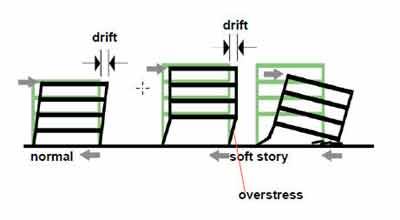
In earthquakes, multi-story buildings with inadequate bracing on the ground floor are especially susceptible to damage and collapse (top). Strong winds can cause the same problems in homes with rigid upper-stories, but large, poorly braced window and door openings on the first floor (above). “It’s everywhere,” says Dolan. “It’s inherent in the way we lay out our buildings from an architectural standpoint. We put all our living quarters on the first floor, and all our sleeping quarters on the second floor. And we like all this open feeling for our living quarters, and so we put all our walls on the second floor and all our windows on the first floor — and then we wonder why all our buildings have a soft story.” When storms or earthquakes happen, the upper stories are relatively inflexible — but the lightly braced lower story walls that pick up the loads may fold over like a house of cards. This occurred widely during the 1994 Northridge, California, earthquake, and has also happened to some buildings in hurricanes. An even more complex concern is the problem of “torsion,” when a particular arrangement of loads and structure may cause a building to twist under load. There are two possible causes, explains Dolan. One would be the shape and massing of the whole building: “In high wind, it comes down to ‘Do you have a symmetrical sail area or not?’ In an extreme example, one side of the building could be three stories and the other side might be one story. Wind on that building would give you some torsion.” The other possibility is that the ground floor of the building could be designed with unbalanced strength. “Suppose you have a big uniform sail area, but all your glass is concentrated on one end of the building,” says Dolan. “Well, glass doesn’t resist anything. So the wind force is trying to be uniform, but the resistance is all on one side.” In that case, says Dolan, the whole building would try to twist around the axis of the well-reinforced half of the building — and the walls on that side would have to manage that additional stress. It’s a rare situation, says Dolan, but one that he has seen during investigations of hurricane damage — “not as the only factor that has caused damage, but as a contributing factor.” When buildings are designed either with asymmetrical sail areas or with asymmetrical wall strengths, Dolan says, designers need to recognize the problem and address that special structural issue. “The walls that are parallel to the wind are probably okay. It’s the walls that are perpendicular to the wind — the front and the back — that have to carry all the torsion load, in addition to resisting the wind in their own lines as well. So you want to strengthen the walls that are perpendicular somehow — go to engineered walls with tie-downs and higher density nails, so you have the strength to prevent that torsion. Anything can be solved, and made to stand up, within reason, if you’re willing to pay the price. But you may have to double the strength of those perpendicular walls — and so they are going to be more expensive.” And then there is the universal problem of wind uplift. This force is strongest at roof and wall edges and intersections, Dolan explains. “So, the more corners and cuts on the roof that you make, the more high-pressure zones that you’re putting onto the buildings. Everywhere that you have a corner of a building, or an edge of a roof, or a ridge, or a dormer, or a re-entrant corner — that’s where the vortices in the wind start to shed off. And that’s where the high pressure is going to occur, because that’s what makes the most turbulence in the wind.” Most houses are designed using the “simplified method” in ASCE-7, the American Society of Civil Engineers Minimum Design Loads for Buildings and Other Structures. That method allows a relatively crude estimate of the wind load based on the projected area of the whole building, rather than requiring an element-by-element analysis. It also includes a higher factor of safety to make up for the simplification. But buildings with multiple cut-up shapes and dormers, with their extra zones of wind turbulence, might experience higher forces. “If you used the analytical method,” says Dolan, “you might back yourself into using a higher nail schedule. Because pretty soon, you have so much area that is in the high pressure zone, where you need extra nails to hold the sheathing on, that you might as well just do the whole roof that way.” When it comes to holding roof sheathing on, however, Dolan offers a simple solution: Glue. Coupled with nails, construction adhesive can dramatically increase the uplift resistance of a sheathing panel. “The simplest thing to do,” says Dolan, “is glue it like you glue your floors, and you solve 99% of your problem.” Depending on the panel thickness and the nailing schedule, Dolan says, the wind uplift load required to blow a roof panel off the building is about 3,000 pounds per full 32-sq.-ft. sheet of plywood. “But it will go up to more than 30,000 pounds, by just putting an elastomeric adhesive, similar to what they put in floor systems to stop the squeaks. That’s a huge change — for the cost of a tube of glue.” Adhesive is so effective, in fact, that it is no longer allowed for shear walls in seismic zones. Dolan’s own Ph.D. research showed that glued and nailed shearwalls were so much stiffer than walls constructed with nails alone, that they transmitted an excessive part of the load to the foundation — overstressing the connection between the house and the foundation. In earthquakes, some deformation of the wall structure is desirable, in order to dissipate the energy of the earthquake. With glue, says Dolan, “You have a stronger system — like three times as strong a system as the most densely nailed wall. So you have to design your anchorage to be able to take those higher loads, so that you don’t fail your foundation, or you don’t fail at inter-element connections….” Rather than force engineers to increase their foundation and connection specs, the code and engineering standards groups elected to prohibit using adhesives in the walls for seismic shear walls. But that does not apply to wind country, where the loads are lower and there is no cyclic factor in the loading. So Dolan says adhesives are perfectly appropriate for a wind-resistant house. There’s a hitch, however — in order to get credit for the adhesive in a shear wall, standards require continuous third-party inspection of the construction process for the assembly. Glue performance depends on installation details, Dolan says: “You can’t put the glue down and then go take a coffee break or lunch break and then put sheathing down. Because the adhesive will skin over, or completely set, before you put your sheathing on, and then it won’t form the bond.” So adhesive is more practical for factory-built houses or walls, where continuous inspection is factored into the budgets. But for a conscientious builder in wind country, says Dolan, adhesive is a perfectly reasonable choice for upgrading your product, whether you get official code credit or not. If a builder in a high wind zone chose to use carefully-applied construction adhesive for all his roof or wall sheathing, in addition to the other code-required structural details, Dolan says, “You would be way, way above code, and you would probably have a very well-performing building.”