“There’s no such thing as a waterproof siding,” insists Robert Criner, owner of Criner Construction of Yorktown, Va. “We assume that every joint in every piece of trim and in every type of siding will leak, no matter where the house is located. But when we build on the coast, we check it three times.”
Coastal climates are more troublesome than most due to prevailing winds and high humidity levels. These conditions demand the utmost rigor, and the demand for this rigor has intensified as storms with straight-line winds have intensified not only along the coast but inland, as well.
It’s not just the driving force on the windward side of a house that pushes water into walls. As wind rises over the top and around the sides of a building, suction pressure can pull water upwards, drawing it underneath lapped siding materials and through even the tightest trim and siding joints.
There are a range of other forces that drive moisture past the siding: In humid climates, condensation (dew) can accumulates on walls. This is most intense in coastal reasons because you not only get high humidity levels but also sea spray — moisture atomized by the crashing surf — accumulates on the exterior, and some of this water wicks to the back of siding and trim through tiny openings by capillary action. When the sun comes out to warm a wet wall, surface water begins to evaporate and vapor pressure forces some of this moisture through porous siding materials where it can condense on the cooler inner-wall surfaces. All of these mechanisms have the power to move water through the exterior cladding and trim. Some materials are less prone to some of these forces, and it’s worth added investment in solid composite materials but that resist wetting via solar drive. But no materials is completely immune to driving rain.
“Certainly wind pressure contributes to problems,” Sylvio Plescia, a building scientist with the Canadian Mortage and Housing Corp. explains, “But the time of wetness — how often a wall gets wet and then has a chance to dry out — determines how quickly problems show up.” According to Plescia, if water gets past the cladding and soaks a wall assembly, and it never has a chance to dry out, problems such as peeling interior paint and mold growth can show up in just a few months, and rot to any wood in the walls, including sheathing and framing, can take hold in only a few years. In areas subject to strong winds and rain but also long dry spells, problems take much longer to manifest. Mold can flourish when water is available but will go dormant when it dries up — only to grow again the next time it gets wet enough. Regions where the relative humidity is high and the drying potential is low are at greatest risk.
The best way to avoid problems is a belt-and-suspenders approach to protecting wall assemblies. Criner, like many builders, relies on a combination of housewrap or integrated air-barrier sheathing and a variety of flashing materials, layering these together to ensure that any water which does leak through has a chance to drain down and out.
WRAPPING THE WALLS
There has been a great deal of debate in the last decade over whether plastic housewraps perform better than black paper. In general, plastic housewrap stays more flexible in cold weather and resists tearing far better than asphalt felt, making it easier to install. Non-perforated polyolefin products, such as Typar and Tyvek, are much more water-resistant than cross-woven polyethylene or needle-punched products. However, all plastic housewraps are susceptible to damage from extractives that can leach out of wood sidings. Builders who regularly use cedar or redwood siding, which are rich in extractives, often gravitate towards black paper to avoid problems. Certainly, all painted wood siding and trim materials should be back-primed with a primer or clear wood sealer. Back-priming not only reduces leaching, but also helps block moisture from moving through the siding and blistering the finish.
No housewrap will work very well if it’s not properly integrated with the flashings around openings. Therefore, builders have developed different procedures for installing housewrap so it is properly lapped. For example, Patty McDaniel, owner of Boardwalk Builders in Rehoboth Beach, Del., prefers black paper as a housewrap. Her crew installs the paper up to the bottom of first-floor windows, and then the flashing. They install the windows before proceeding with the black paper up to the next floor level. However, Tim Cross of Merrick Construction in Monmouth, N.J., prefers to wrap the house as soon as possible. This means his crew must later slit the housewrap when the windows are installed to ensure that the head flashing is overlapped by the housewrap.
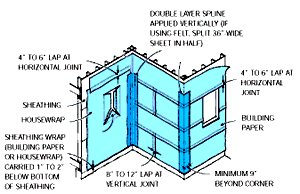
Regardless of the preferred material, most experienced builders now agree on this: It is not a good idea to X-cut the housewrap across rough openings and fold the triangular flaps around the wall framing. Instead, use the modified I-cut shown in Figure 1. The critical detail here is the straight cut across the top of the window. There should not be a flap that gets folded around the window header.
FIGURE 1. WRAPPING IT RIGHT
Any sheathing wrap should be applied from the bottom up. The wide overlaps shown here are recommended for coastal regions where increased wind pressures can pull water uphill, allowing it to leak past a narrow overlap.
FLASHING WINDOW AND DOOR OPENINGS
The advent of peel-and-stick flashing tapes has revolutionized flashing methods. These materials come in widths ranging from 4 to 12 inches (9 inches is typical) and are made from either modified bitumen (similar to eaves flashing membranes) or from butyl rubber. Butyl-based flashing tapes are generally more expensive, but will stay flexible in cold weather and remain much more stable at high temperatures. Butyl products also bond better to difficult substrates. Perhaps most important of all, they can be peeled off and adjusted during installation. Modified-bituthane products start to lose stickiness below about 50°F and will not bond well below 40°F. Problems may also arise with modified-bithuthane flashings in high temperatures. Under a dark-colored metal flashing in direct sun, for example, a modified-bituthane flashing will soften and may begin to drip or ooze. Modified-bituthane flashings should never come into contact with any caulk or sealant unless the sealant is specifically formulated for that use.
While peel-and-stick flashing has gained in popularity, there is still enormous confusion in the field about the correct procedure for applying these materials. Most builders agree that a head flashing must lap under the housewrap, but beyond this, application practices vary for the other flashings. We recommend the procedure shown in Figure 2, which closely compares to the typical sequence used by builders Criner, McDaniel, and Cross.
FIGURE 2. WINDOW FLASHING SEQUENCE
It’s not enough to caulk window flashings when installing a window. Instead housewrap and flexible flashing tape should be interwoven with the flange, as shown in this installation sequence. (Illustration courtesy APA – The Engineered Wood Association)
Sill pan. The sill flashing may be the most important flashing of all, for it allows water that does seep though to drain to the outside (Figure 3 and Figure 4).
FIGURE 3. WINDOW SILL DETAILS
Water will leak through any window over time, so any sill flashing should allow this water to drain to the exterior. Using flexible flashing, this can be achieved by applying a dam or a piece of bevel siding over the rough sill before the pan flashing is put in place.
FIGURE 4. DOOR THRESHOLD DETAILS
As with windows, every door should include a pan beneath the threshold to prevent wind-blown water from seeping inside.
This piece goes in first, and the bottom flap must lap over the top of the housewrap. A sill flashing can be formed easily in the field from flexible flashing tape. Tyvek FlexWrap (www.construction.tyvek.com), a butyl-based flashing tape, has a wrinkled facing that allows it to be molded to the rough opening without any cutting and folding at the corners. This material is decidedly more expensive than most other flexible flashing materials, but the labor savings generally makes up for the higher material cost.
Side flashing. Side pieces should go in after the window has been installed. Some builders dispute this, arguing that these pieces should wrap the rough opening and protect the framing. Any water that gets past the window flange will presumably drain down to the sill flashing. While this theory sounds about right, intense wind pressure in coastal regions can pull water straight back to the interior drywall, long before it reaches the sill pan. Instead, Criner, McDaniel, and Cross all recommend applying the side pieces after the window is installed, lapping the flashing over the window flange to prevent water from getting into the rough opening in the first place.
When positioning the side flashings, don’t butt the tape hard to the flange. Leave 1/4 to 1/2 inch of the flange exposed, so the flashing tape won’t show after siding or trim is installed. Trim or siding should never be tightly butted to the window, but must have at least 1/4 inch to accommodate the expansion of window and cladding materials.
TO CAULK OR NOT
Most window and door manufacturers, as well as the makers of housewraps, recommend bedding the window flange in caulk. Exterior trim details routinely include exterior caulking, as well. However, a 2002 test conducted by NAHB Research Center demonstrated that caulk never lasts as long as the materials it is sealing. The report concluded, “Over time, all exterior wall sealant systems, including caulk, will leak. Caulks work from a few days to a few years, which makes it impossible to predict when and where maintenance will be required.” In short, caulking is largely a waste of time. Instead, the NAHB Research Center advocates caulkless siding systems, which rely on a well-detailed weather barrier and flashing system, similar to those described in this article.
Some builders have argued that caulk helps to seal the window against air leaks. However, air sealing is probably best done from the inside using a spray foam such as Dow’s Great Stuff (www.dow.com/greatstuff). This type of foam remains flexible and won’t cause a window to jam as wall materials expand with climate changes. If air sealing is attempted on the outside, it would necessarily be incomplete because the bottom window flange should never be caulked. Windows will inevitably leak over time, and any water that leaks through the sill must be allowed to drain back out. In general, any horizontal caulking bead will create a dam that holds water, and this dam may prevent water from draining outside as it follows properly lapped membranes (Figure 5).
FIGURE 5. LEDGER FLASHING
Any horizontal element will create a dam, which blocks water that penetrates the siding from draining down and out. To avoid problems, housewrap must overlap the flashing in order to direct water to the exterior.
RAIN-SCREEN RESERVATIONS
Many researchers (but only a handful of builders) push the drainage concept to the extreme, advocating a “rain screen” method of siding. This typically involves installing siding over vertical strapping, or otherwise creating an air space behind siding to allow the siding assembly to dry. Benjamin Obdyke’s HomeSlicker (www.benjaminobdyke.com), for example, provides a dense synthetic mat that presumably provides this air space, while adding only about 3/8 inch to the thickness of the wall, thereby eliminating the need to pack out windows and doors. Most EIFS products also have gone to a rain-screen-type system to avoid moisture problems.
While the theory of a rain screen is sound, strapping is rarely used under wood, vinyl, or fiber-cement siding in practice — primarily because it is difficult to fur out windows and doors. And while more and more builders are beginning to experiment with HomeSlicker, especially now that it is available pre-attached to Typar for a one-step weather-barrier installation, the jury is still out on whether this dense material allows moisture to drain or creates enough air flow to actually allow the siding assembly to dry. A CMHC study to measure the drying potential of various wall systems, including a wall using HomeSlicker, is now underway, and results are expected in 2005. In the meantime, successful coastal contractors are putting their efforts into carefully lapping housewrap and flexible flashings, and allowing clear pathways beneath windows, doors, and other horizontal building elements to allow water to drain to the outside.
Clayton DeKorne is editor of Coastal Contractor.